No federal database tracks dog bites by breed. Small breeds outscore Pitbulls in aggression studies. BSL fails consistently. Here's what the research actually shows.
You probably don't spend much time worrying about crocodiles. You've barely encountered one. There's no reason to.
Dogs are different. You see them every day. Walking past you on the sidewalk. Sleeping in your neighbor's yard. And at least once a week, you read a headline or catch a clip on TV that makes your stomach drop. Another attack. Another snarling face. Another "dangerous breed" doing what dangerous breeds apparently do.
Here's the question nobody asks before sharing that headline: how was the breed actually identified? Where did the number come from? Did anyone check?
Usually, no.
You shared the headline before checking how the breed was identified. You didn't ask where the denominator came from. You didn't ask if the number meant anything.
You were not informed. You were useful.
The United States has no federal database that ranks bite risk by breed. None. Zero. Zilch. The famous CDC-era fatality numbers covered 1979 to 1998. The authors warned about that data themselves. Breed identification was flawed. Reporting was incomplete. Simple danger rankings were NEVER RELIABLE — the researchers said so in their own paper.
Breed identification in bite reports was done by whoever happened to be standing there. A startled neighbor. A police officer who thinks a Boxer is a Pitbull. A journalist on deadline with little patience for nuance. Even experienced shelter professionals disagree on which dogs qualify as "pitbulls." Visual labels regularly conflict with DNA results.
So the next time a headline claims "Pitbulls cause 66% of fatal attacks" — ask: identified by whom? Peer-reviewed where? Published how?
Usually nobody, by eyeball, nowhere. VIBES DRESSED UP AS STATISTICS. That is the entire scientific case behind most of what circulates online.
Pitbulls were bred for dog fighting. Not for attacking humans. That distinction matters more than most people realize.
Dog fighting selected for aggression toward other dogs. Not toward people. Handlers had to restrain these animals. Separate them. Wash them. Transport them between bouts. Human-directed aggression was a liability, not an asset, in that history. That history does not make every Pitbull harmless. It does dismantle the lazy assumption that dog aggression and human aggression are the same thing.
IT'S AN INCONVENIENT FACT, SO IT RARELY MAKES THE NEWS. It's documented. It's history. It just doesn't fit on a BREAKING NEWS banner.
Children are often bitten not by a monster charging from an alley. They're bitten by a familiar dog in an ordinary home. Breed stereotypes teach families to fear the wrong things. They ignore the real ones: supervision, stress, pain, guarding behavior, handling, warning signals.
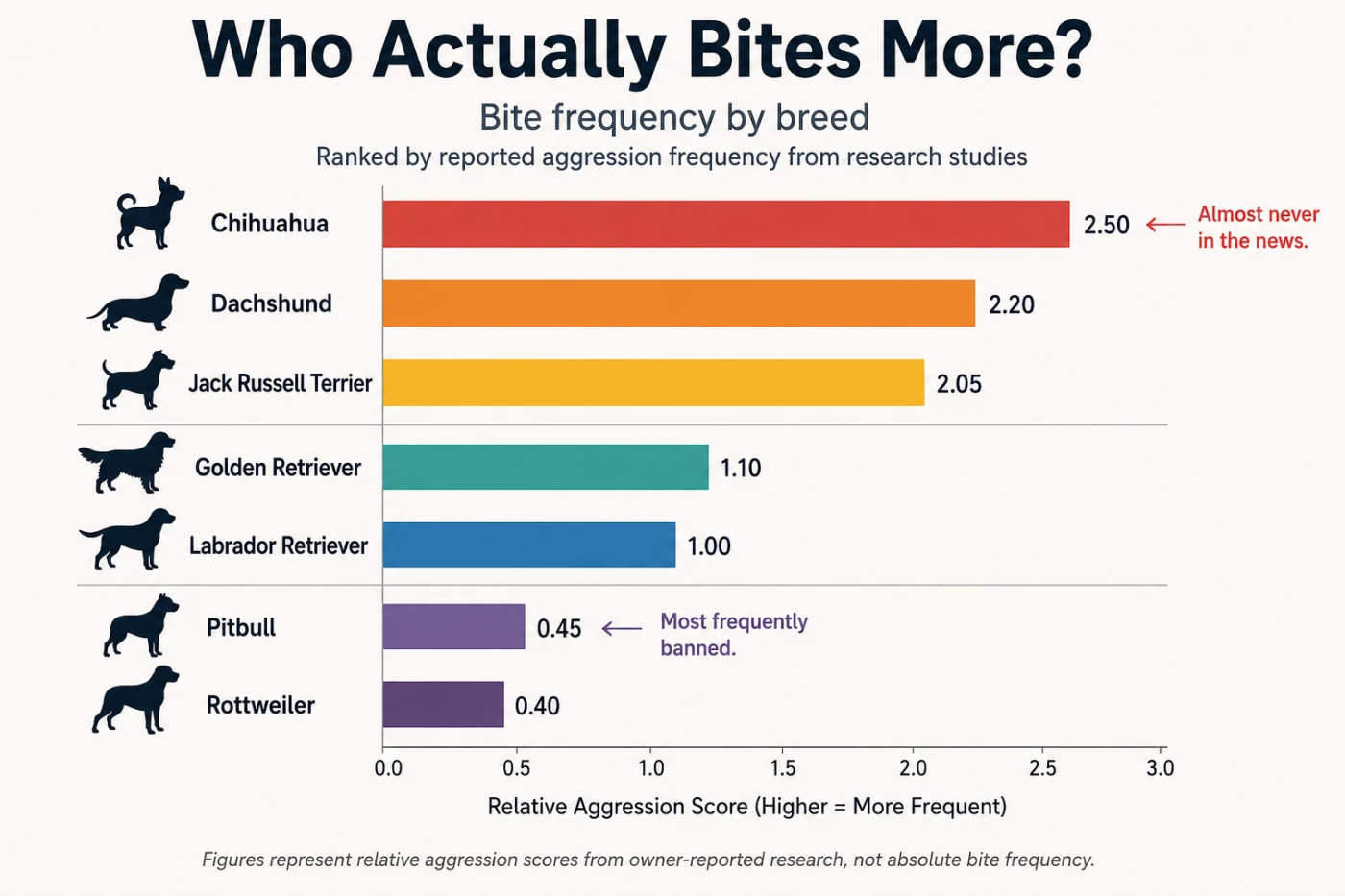
The beloved Golden Retriever. The gentle Labrador. The majestic Husky. The loyal German Shepherd. Every one of them appears in bite statistics year after year. A major University of Pennsylvania study looked at this directly. Dachshunds, Chihuahuas and Jack Russell Terriers ranked among the highest for human-directed aggression — including the small dog in grandma's handbag. DOCUMENTED. REPEATED. RARELY REPORTED.
No headlines. No emergency legislation. No breathless segment on the evening news. The Dachshund simply doesn't have the right face for prime time.
Owner-reported research backs this up. Chihuahuas, Dachshunds and Jack Russell Terriers rank among the breeds most likely to show serious aggression toward people. They rarely make national news. The reason is straightforward: six pounds of fury usually produces a bandage, not an airlift.
The trembling six-pound Chihuahua scores high on aggression in peer-reviewed research. So does the high-strung Jack Russell. So does the sensitive Dachshund. The media tends to ignore this entirely, treats the omission as routine, and moves on.
THE PATTERN RUNS ON PHOTOGENIC INJURIES — not on accuracy.
A 70-pound dog can hospitalize someone. A 6-pound dog mostly can't. That's a difference in consequence, not character. Confusing the two has shaped public perception for decades.
Pitbulls are targeted in the overwhelming majority of BSL ordinances nationwide. And what do these laws actually deliver? Repeated studies have looked at this. Some were commissioned by the very cities that passed the laws. They found NO CONSISTENT DROP IN BITE INCIDENTS after breed bans went into effect.
The people who keep dogs for fighting and intimidation rarely consult municipal ordinances. They don't register anything. They don't follow bylaws. BSL doesn't touch them. It touches the ordinary family whose well-socialized rescue happens to have a wide skull and short coat. That family loses the dog. The actual problem moves on, unaffected.
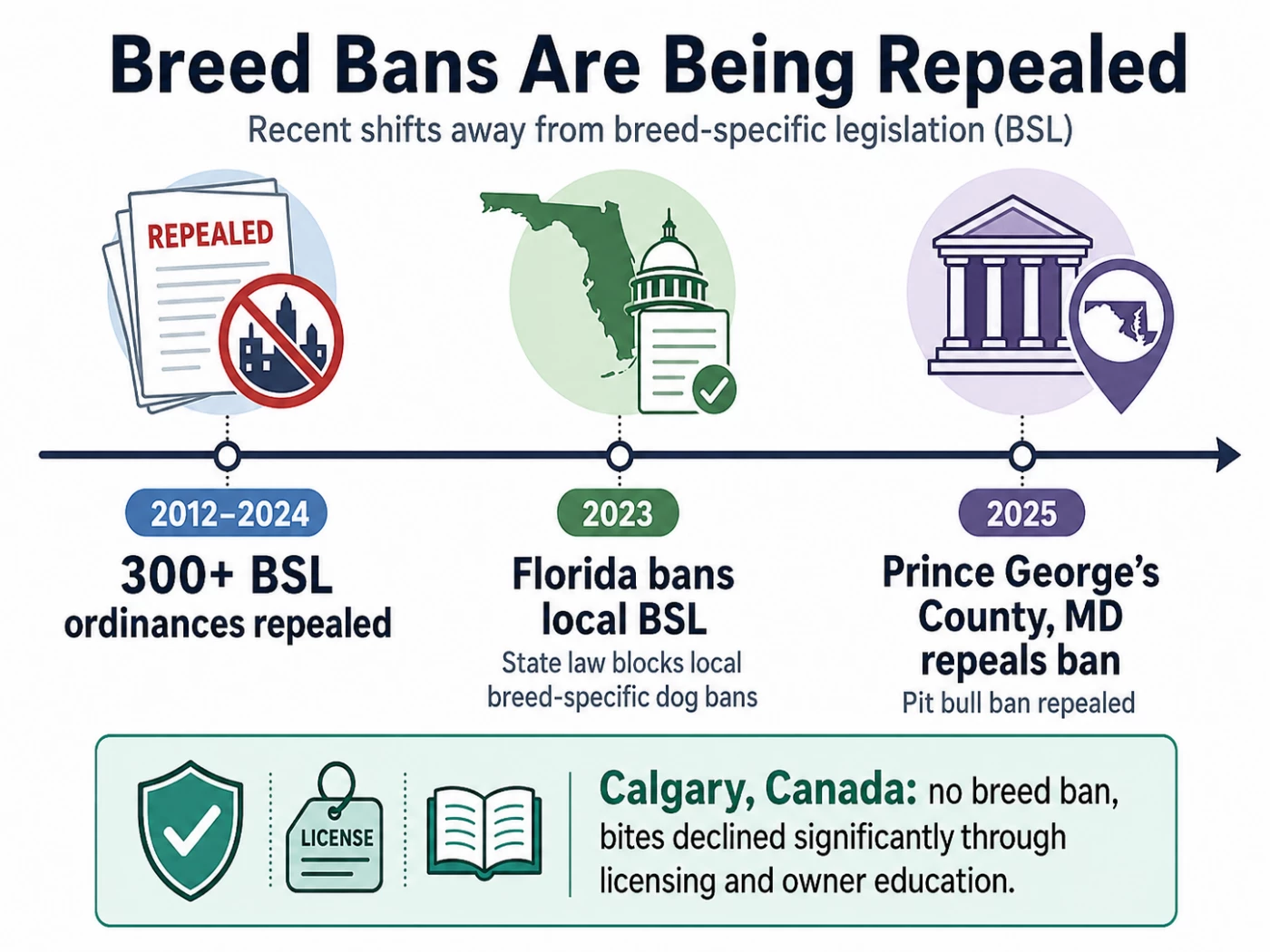
Calgary, Canada took a different approach. It built policy around licensing, enforcement, education and owner responsibility instead of breed bans. Researchers studied the city's data. Severe bite incidents declined significantly over the period studied. THAT IS WHAT EFFECTIVE POLICY LOOKS LIKE — measuring behavior, not legislating skull shape.
More than 300 BSL ordinances were repealed between 2012 and 2024. Florida closed its remaining local BSL loopholes effective October 1, 2023. Prince George's County, Maryland went further in November 2025, voting to dismantle one of the nation's most notorious remaining Pitbull bans. The replacement rules shifted enforcement toward conduct, leashing, permits and owner accountability, taking effect February 2026.
The lawmakers who championed these bans for decades are now quietly walking them back.
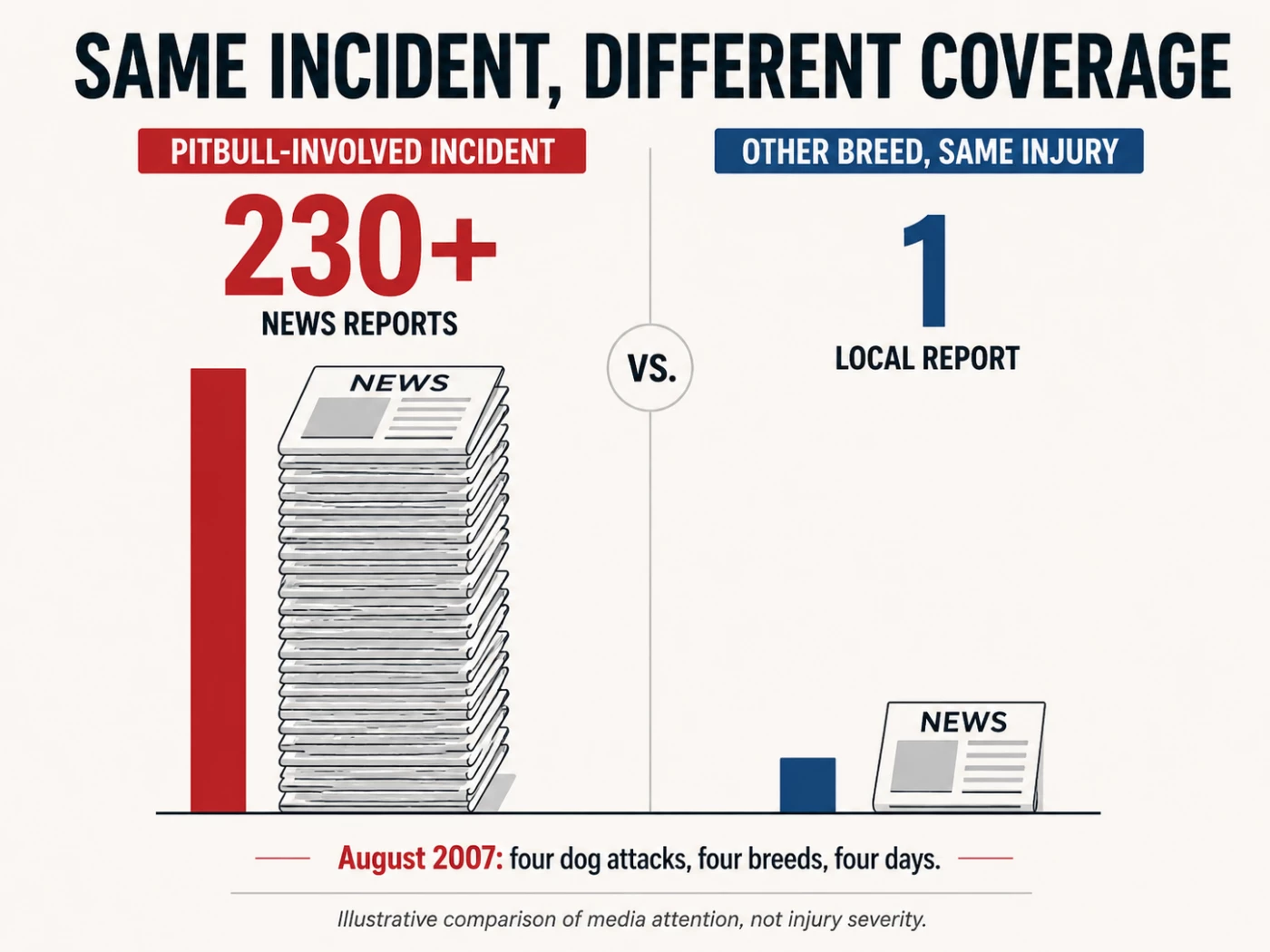
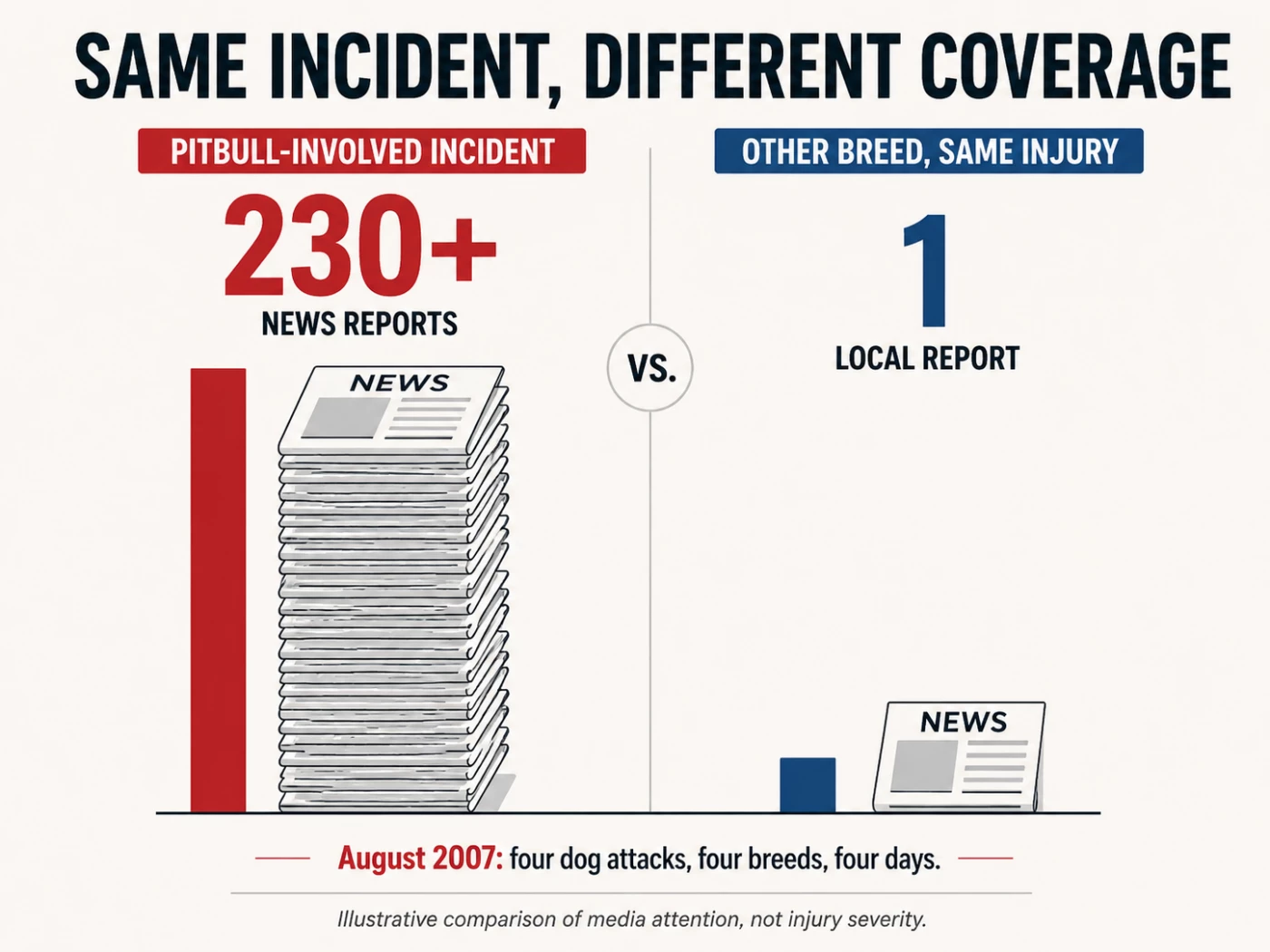
Four serious dog attacks occurred across four days in August 2007. Different victims. Different injuries. Different breeds. Media tracking later cited by animal-law sources found something striking: the Pitbull case generated more than 230 reports across national and international outlets. The other three barely escaped the local page.
Not identical cases. IDENTICAL EDITORIAL INSTINCT: put "Pitbull" in the headline and watch the story travel.
A snarling photo performs. A calm one doesn't. That's not a conspiracy — it's a business model built on clicks, and it rewards fear over accuracy every time.
The editor who chooses that photo isn't necessarily wrong about the facts. They're responding to what gets read. Every share, every comment, every forwarded story feeds the same incentive — while the dog at the center of the story is often the one who pays for it.
Understanding BSL means looking at who these laws actually affect.
Pitbull panic didn't develop in a vacuum. It grew alongside media narratives linking these dogs to poor neighborhoods, poverty, and urban crime. Breed restrictions then spread into housing rules, insurance exclusions and municipal enforcement — areas where banning a dog reads as simpler than addressing the underlying social conditions.
THE DOG BECOMES THE VISIBLE TARGET. The policy becomes the easy win. The actual issue stays untouched.
Serious attacks rarely come from one single variable. They emerge from clusters: negligent containment, isolation, abuse, unmanaged previous aggression, vulnerable victims, absent supervision, and owners who ignored every warning sign until the warning became an emergency.
The owner is the variable politicians rarely address — because it means holding a person accountable rather than a breed. Banning a dog is simpler. More visible. Easier to legislate. A serious trainer or behaviorist will identify the real risk factors in minutes. FEW LAWS ARE BUILT AROUND THAT EXPERTISE.
A dog on a chain is a different animal from a dog asleep on the couch. A dog in chronic pain behaves differently than a dog that's never known pain. A dog protecting newborn puppies is not the same animal in a different context. Treating them as identical, after decades of available research, isn't an oversight anymore. It's a choice.
Fighting breeds aren't for everyone. They're powerful, physical, high-energy, and require experience and commitment. That's simply true.
But "unpredictable monster that will snap without warning" is not a description of an animal. IT'S A NARRATIVE — repeated for thirty years across television, social media, and local news, regardless of what the data actually shows. It generates clicks, campaign talking points, and insurance premiums. It rarely generates accuracy.
The public has absorbed this story for decades. THE DOGS ARE THE ONES WHO'VE PAID FOR IT.
Do pitbulls bite more than other dog breeds?
There is no reliable federal data confirming this. Breed identification in bite reports is frequently inaccurate, and peer-reviewed behavioral research has found small breeds — including Chihuahuas, Dachshunds, and Jack Russell Terriers — rank among the highest for human-directed aggression.
Does breed-specific legislation (BSL) reduce dog bites?
Multiple studies, including ones commissioned by the cities that enacted these laws, found no consistent reduction in bite incidents after BSL was introduced. Calgary, Canada saw a significant decline in severe bites using licensing and owner-accountability policy instead.
Why do pitbulls get more media coverage than other breeds after an attack?
Studies of media coverage patterns show pitbull-involved incidents receive dramatically more national coverage than equivalent incidents involving other breeds, a pattern researchers attribute to higher engagement on breed-specific imagery.
What actually predicts whether a dog will bite?
Research points to a cluster of factors rather than breed alone: lack of socialization, abuse history, inadequate supervision, pain, and prior unaddressed aggression. Owner behavior is consistently a stronger predictor than breed.
Are pitbulls dangerous around children?
Most dog bites involving children come from a familiar dog in the home, regardless of breed. Supervision, training, and the dog's individual history are more reliable predictors of risk than breed alone.
Sources