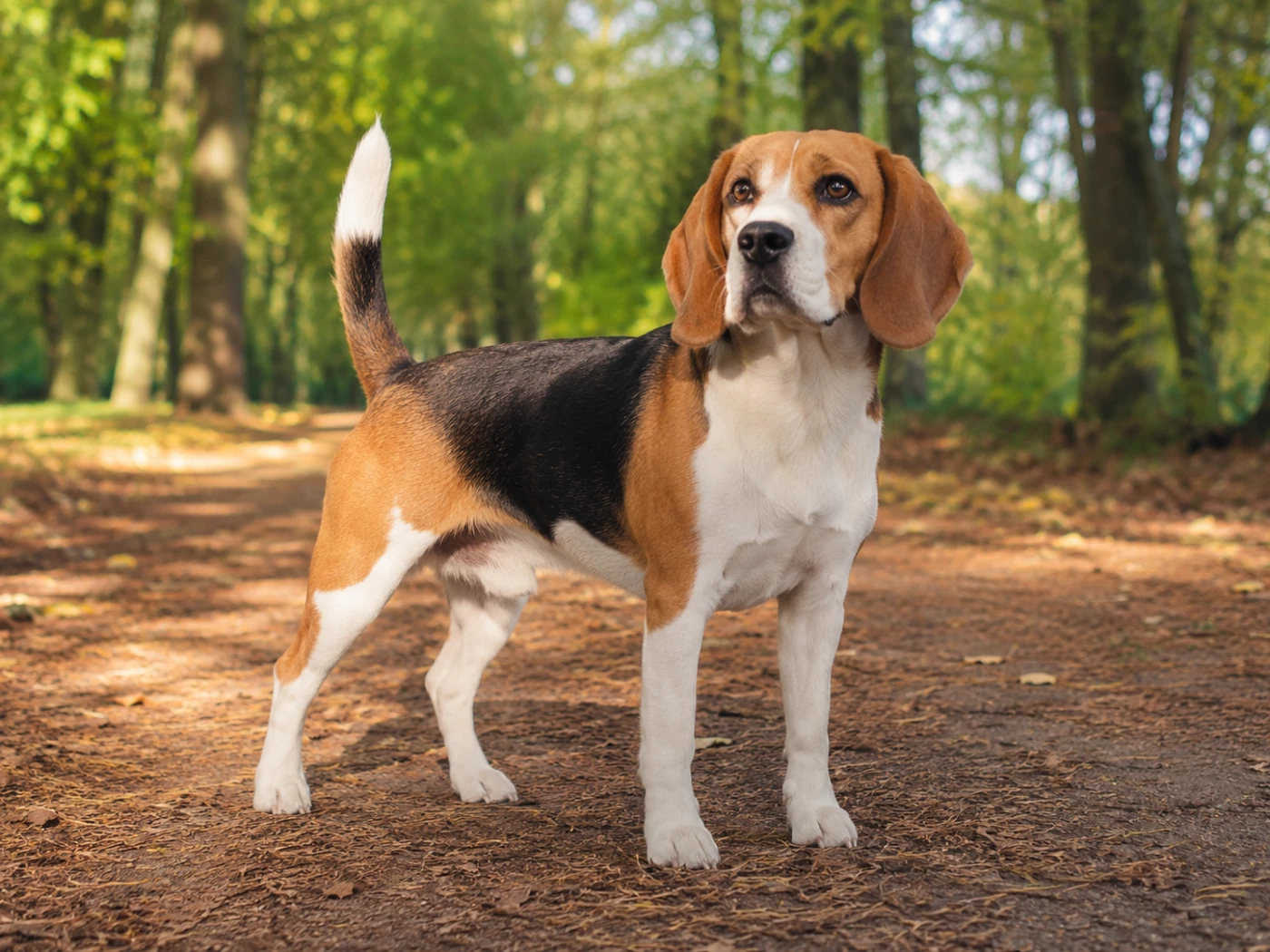
Beagles are easy to fall for. They have expressive faces, a manageable size, and a cheerful way of joining whatever the family is doing. A Beagle can spend Saturday morning exploring a trail, race around the yard with the kids, and still want a place beside you on the couch that evening.
That picture is real, but it is not the whole story.
A Beagle is a scent hound with an independent mind, a powerful nose, and a voice designed to carry. The dog that follows you from room to room at home may seem to forget you exist when an interesting scent crosses the sidewalk. The compact body can also hide a surprising amount of energy, persistence, and appetite.
For the right household, that mix of affection, humor, curiosity, and independence is part of the appeal. For someone expecting effortless recall, quiet apartment living, or a dog that can stay alone all day without a plan, it may become frustrating.
This guide explains how a Beagle behaves, trains, exercises, and fits into family life.
Written by the AllinPets Editorial Team
Published June 2026
| Trait | Beagle details |
|---|---|
| AKC group | Hound Group |
| Breed type | Scent hound |
| Height | Up to 13 inches, or over 13 but no more than 15 inches |
| Typical weight | Smaller variety: usually up to about 20 pounds; larger variety: about 20–30 pounds |
| Life expectancy | Approximately 10–15 years |
| Coat | Short, close, and weather-resistant |
| Shedding | Moderate throughout the year |
| Grooming | Weekly brushing and regular ear inspection |
| Exercise | Around one hour or more daily for many healthy adults |
| Vocalization | High; may bark, howl, and bay |
| Trainability | Intelligent and food-motivated, but easily distracted by scents |
| Apartment suitability | Possible, but noise and exercise needs require planning |
The Beagle was developed in Britain to track rabbits and hares. These dogs worked in packs while hunters followed on foot. The job required stamina, confidence, cooperation with other dogs, and enough independence to keep following a trail without constant direction.
Those old working traits still shape the modern family Beagle. The breed often enjoys company because pack work rewarded social behavior. At the same time, it can make its own decisions outdoors because following scent once mattered more than watching a handler’s face.
The American Kennel Club recognizes two size varieties. One does not exceed 13 inches at the shoulder. The other stands over 13 inches but no more than 15 inches. Both are the same breed and share the same basic working instincts.
Most Beagles now live as companions, but they still approach the world like scent hounds. Their history helps explain why they sniff so much, why recall can be difficult, why many enjoy other dogs, and why their voices can sound much bigger than their bodies.
Beagles are often described as merry, curious, and friendly. Many enjoy being around people and prefer to take part in family life instead of watching from another room. They may follow family members through the house, investigate every delivery box, and look for a chance to join any activity.
This social style suits many active couples and families. Beagles often enjoy walks, backyard play, weekend outings, and time with respectful children.
Beagles are not usually natural guard dogs. They may alert you to a visitor, then become more interested in greeting that person than driving anyone away.
Affection does not always produce obedience. A Beagle may love the family and still ignore recall when a fresh scent appears.
At breakfast, the dog may rest against your leg. On the next walk, it may pull toward a hedge and tune everything else out.
This does not mean the dog cares less. A scent hound was bred to stay focused on a trail, even without close direction.
Many Beagles enjoy regular human or canine company. Some adapt well to normal periods alone when that skill is taught gradually. Others become restless, vocal, or destructive when left for long stretches without exercise, enrichment, or preparation.
A full-time schedule can work, but it needs a plan for exercise, bathroom breaks, and enrichment.
Individual temperament still varies.
Reality Check: Many people choose a Beagle because of its friendly expression and manageable size. The surprises usually come later. Long-term challenges are more often related to scent drive, food obsession, vocalization, and recall than aggression or guarding behavior.
A Beagle experiences the outside world through its nose. During a walk, the dog may notice information you cannot see or hear: where another dog passed, whether wildlife crossed the yard, or where food was dropped hours earlier.
This instinct also explains several common owner questions: Why won’t my Beagle come when called? Can a Beagle be trusted off leash? Do Beagles run away? In many cases, the answer involves scent drive rather than stubbornness alone.
When a Beagle finds a compelling scent, its attention can shift almost completely toward following the trail. The dog may slow down, pull, change direction, or stop responding to familiar cues. What looks like stubbornness is often competition for attention. Your voice is competing with the strongest natural motivation the breed has.
Training can improve attention and recall, but it should work with physical management. Even a well-trained Beagle can make a poor decision near traffic, an open gate, or moving wildlife.
A Beagle should have safe ways to explore without being placed in situations where one exciting scent can lead to danger. Useful habits include using a leash or long line outside enclosed spaces, checking gates and fences, practicing recall in quiet places, and rewarding the dog for checking in voluntarily.
A long line gives the dog room to investigate while keeping a physical connection to the handler. Off-leash time is safest inside a securely fenced area. An electronic boundary should not be the only form of containment.
Check fence bottoms and gates regularly; some Beagles dig or squeeze through gaps.
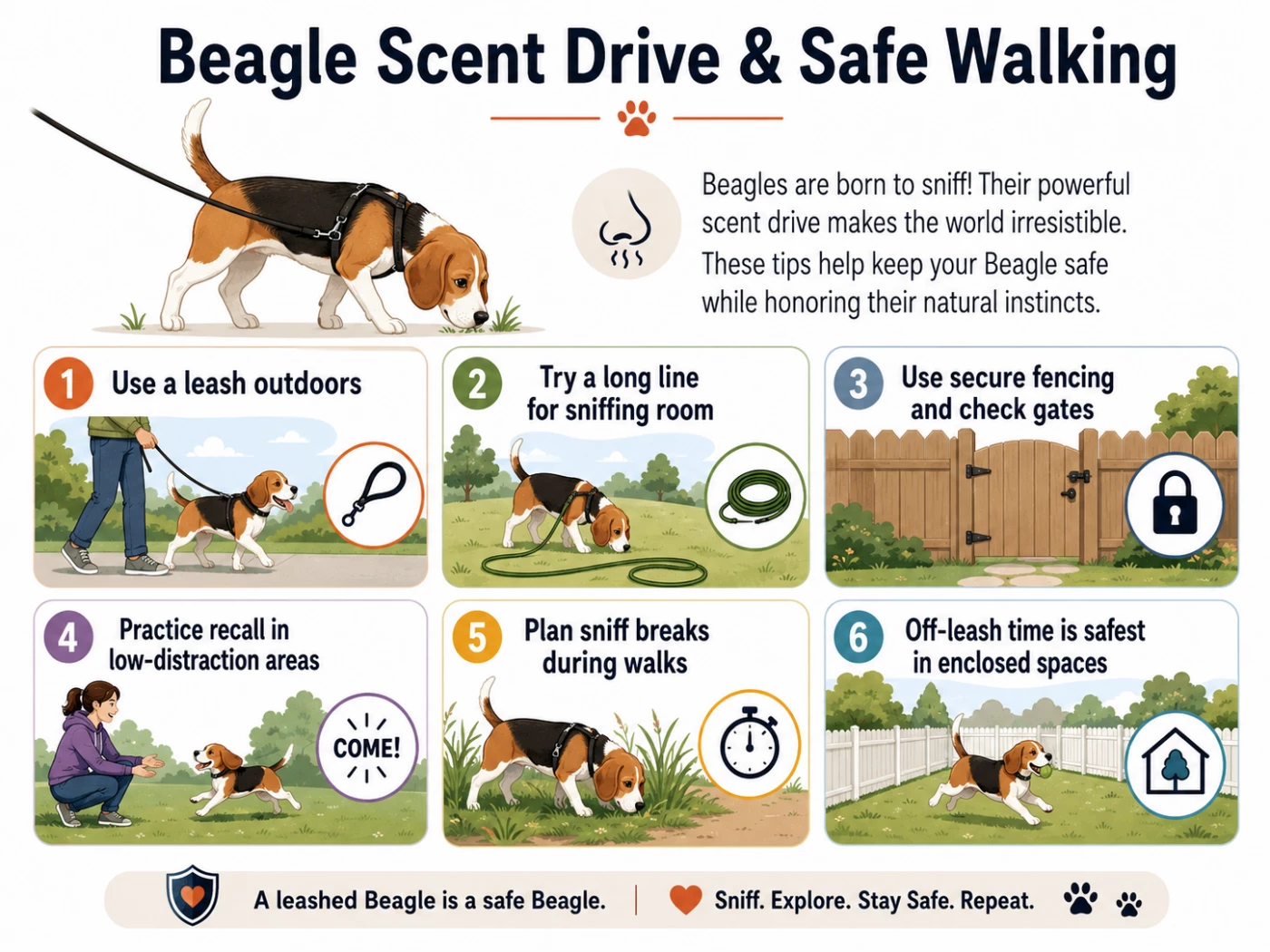
Owners sometimes judge a walk only by distance. For a Beagle, time spent investigating scents can be valuable mental work. A slow sniff walk may cover less ground than a brisk neighborhood loop, yet leave the dog more satisfied.
A practical walk can combine structured movement with planned sniff breaks.
Beagles do not leave their scent skills outside. Many quickly learn where food, trash, treats, and shopping bags are stored. A sandwich near the counter edge or a backpack on the floor can become an immediate project.
Management is usually easier than repeated correction. Use a secure trash container, close pantry doors, keep food away from edges, and ask family members not to feed from the table. Every successful food raid teaches the dog to try again.
Beagles are vocal dogs. Their traditional work required them to communicate with pack members and hunters over distance. That history helps explain why a relatively small dog can produce such a carrying sound.
Beagles may use three recognizable forms of vocalization. Barking often happens during play, excitement, or alerting. Baying is a deep, drawn-out sound linked to following or locating a trail. Howling is a longer vocalization that may be triggered by sounds, excitement, isolation, or distress.
Some Beagles are louder than others. Age, training, exercise, environment, and individual temperament all shape how much noise a dog makes.
A Beagle may vocalize because it sees wildlife, hears another dog, wants attention, or has not had enough activity. Noise during alone time does not automatically mean clinical separation anxiety.
Persistent howling paired with panic, heavy drooling, destructive attempts to reach an exit, loss of bladder control, or an inability to settle may point to a separation-related problem. A veterinarian or qualified behavior professional should assess that pattern.
You can often reduce unnecessary noise, but you cannot remove the breed’s natural voice. Daily exercise, scent games, food puzzles, calm behavior rewards, and a well-taught “quiet” cue can help. Limiting the dog’s view of common outdoor triggers may also reduce repeated alerting.
Yelling is rarely useful. The dog may think you are joining in, while harsh corrections can increase stress. Teaching an alternative behavior, such as going to a mat or looking at the handler, gives the dog something clearer to do.
Homeowners may have more control over noise than renters, but neighbors still matter. A Beagle that bays in the yard early each morning can create conflict even without a shared wall.
Many healthy adult Beagles benefit from around one hour or more of daily activity, divided across the day. The right amount depends on age, health, body condition, weather, and exercise intensity.
A young adult may need more than a senior. Puppies should not be pushed through long, repetitive, high-impact exercise while their bodies are developing. Dogs with heart, joint, or spinal conditions may need a veterinarian-approved plan.
A brisk walk supports physical fitness, but Beagles also need chances to use their noses and solve simple problems. Relaxed sniff walks, food-search games, puzzle feeders, tracking exercises, scent-work classes, and hide-and-seek with toys can all help.
A slow 20-minute sniff walk may be mentally tiring even when the dog covers little distance. For many Beagles, the best routine combines movement, investigation, short training sessions, and rest.
A workable weekday can include a morning walk, a food puzzle, brief training, and an evening sniff walk.
A secure yard is useful for bathroom breaks, play, and supervised exploration. It does not automatically meet the dog’s needs. Many Beagles will follow the same paths, search for food, or wait at the door unless someone creates a reason to engage.
Use the yard as one part of the routine. Toss treats into grass for a search game, practice recall between family members, or set up a simple scent trail. Shared activity is usually more valuable than simply opening the door.
Beagles are intelligent and often highly motivated by food. They can learn household rules, tricks, scent tasks, and obedience cues. The challenge is not whether they can learn. It is whether the lesson remains more rewarding than the environment.
A Beagle may perform perfectly in the kitchen and struggle with the same cue outside. The dog has not forgotten. The level of distraction has changed.
Long, repetitive sessions often lead to wandering attention. Practice for a few minutes, reward success, and stop while the dog is still interested.
Begin new behaviors in a quiet place. Use rewards the dog truly values. Reinforce voluntary attention, raise difficulty slowly, and include sniffing as a reward when appropriate.
Avoid repeating a cue five times while the dog is focused elsewhere. Repetition teaches the dog that the first cue does not matter. Instead, reduce the distraction, move closer, or choose an easier step.
Recall is an important safety skill, but it should not replace a leash or secure fence. Begin indoors or in an enclosed yard. Reward the dog generously for returning, then practice with a long line in places with mild distractions.
Do not call only when fun is about to end. Sometimes call the dog, reward it, and release it to continue exploring. This prevents recall from always predicting the loss of freedom.
Choose one clear recall word and protect it. If you know the dog is unlikely to respond, use the long line rather than testing the cue. Even with strong training, active scent trails may make recall less dependable than in a more handler-focused breed.
Beagles may stop suddenly, zigzag, or pull toward something interesting. A useful walk includes both structure and freedom.
Reward loose-leash walking and use a separate cue that tells the dog when sniffing is allowed. This creates a clearer routine than expecting the dog to ignore every scent from the driveway to the front door.
Use secure, comfortable equipment, but remember that equipment does not replace training.
Most Beagles can be housetrained with a predictable routine. Take a puppy outside after waking, eating, active play, and before bedtime. Young puppies also need regular trips during the day.
Reward immediately after the puppy eliminates outdoors. Waiting until you return inside makes the connection less clear. Supervise closely, limit access to unsupervised rooms, and clean accidents with an enzyme-based product.
A puppy that becomes distracted by smells may forget why it went outside. Using the same toilet area and saving longer exploration for afterward can help.
The Beagle’s short coat is fairly easy to maintain. Weekly brushing helps remove loose hair and keeps the coat in good condition. Shedding continues throughout the year and may become heavier during seasonal changes.
The coat does not usually require professional trimming. Bathing is needed when the dog is dirty or develops an odor, not on a fixed weekly schedule.
The breed’s long drop ears reduce airflow around the ear canal. Check them regularly for redness, odor, discharge, or discomfort.
Clean the ears only when needed or as directed by a veterinarian. Over-cleaning can irritate the canal. Repeated scratching, head shaking, pain, strong odor, or discharge deserves veterinary attention.
Trim nails often enough that they do not affect normal movement. Dental care should include regular brushing with dog-safe toothpaste or another veterinarian-approved routine.
Weight deserves special attention. Many Beagles are enthusiastic eaters and skilled food seekers. Measured meals are usually more useful than leaving food available all day.
Treats used during training count toward daily calories. A healthy Beagle should have a visible waist when viewed from above, and the ribs should be easy to feel under a light covering of tissue.
Excess weight adds strain to joints and the spine and can make existing mobility problems harder to manage. Unexpected weight gain, low energy, or coat changes should be discussed with a veterinarian because an underactive thyroid may contribute.
The National Beagle Club identifies epilepsy, allergies, hypothyroidism, hip dysplasia, and back problems among important breed concerns.
Hypothyroidism means the thyroid gland does not produce enough hormone. It may contribute to weight gain, low energy, and coat or skin changes. Musladin-Lueke Syndrome, usually shortened to MLS, is an inherited condition affecting the skin, joints, and connective tissues.
The current Beagle CHIC requirements include hip evaluation through OFA or PennHIP, an eye examination, MLS DNA testing, a cardiac evaluation, and an autoimmune thyroiditis evaluation. Autoimmune thyroiditis is an immune-related thyroid disorder.
A CHIC number means the required tests were completed and the results were made public. It does not mean every result was normal. Anyone considering a puppy should review each parent’s individual results.

Idiopathic epilepsy means recurring seizures without an identified structural or metabolic cause. It commonly begins between about six months and six years of age.
A first seizure should be reported to a veterinarian. A seizure lasting more than five minutes or multiple seizures within 24 hours is a medical emergency. The dog should be taken to an emergency veterinary facility immediately.
A Beagle may be a strong match if you want a social, active dog that joins family life with enthusiasm. The breed fits best with people who can provide exercise, training, company, and secure outdoor management.
Not every Beagle follows the same schedule, but most thrive when physical activity, mental stimulation, and family interaction are part of everyday life. A routine also makes it easier to notice changes in appetite, energy, bathroom habits, or behavior.
| A Beagle may suit you if… | Think carefully if… |
|---|---|
| You enjoy daily walks and outdoor activities | You want reliable off-leash freedom in open areas |
| You want a playful, affectionate companion | You need a naturally quiet dog |
| You have secure outdoor space or use a long line | The dog would often be alone all day |
| You enjoy training with food and games | You expect instant obedience around distractions |
| You can manage access to food and trash | You prefer a dog with minimal daily interaction |
| You accept moderate shedding | You do not want regular exercise or enrichment duties |
Many Beagles are playful and affectionate with children. Their sturdy size can work well in an active household, but young children and dogs should always be supervised.
Teach children not to pull the dog’s ears, disturb it while eating, climb on it, or follow it into a resting space. The dog should have a quiet area where it can sleep without interruption.
Many Beagles enjoy canine company because of their pack-hound history. A compatible second dog can provide play and companionship, but it does not replace training or human attention.
Introductions should be gradual, especially when one dog is older, nervous, or protective of food and toys. Feeding separately can prevent avoidable conflict.
Some Beagles live peacefully with cats, especially when raised with them or introduced carefully. Others may chase fast-moving animals.
Individual prey drive varies, so early supervision is essential. Rabbits, rodents, and birds should be kept safely separated because the breed was developed to pursue small game.
A Beagle can live in an apartment, but the decision should not be based on size alone. The dog still needs exercise, sniffing opportunities, and gradual alone-time training.
Vocalization is often the biggest challenge. A baying Beagle can be heard well beyond the front door. Consider wall thickness, building rules, your work schedule, and access to safe walking areas.
A Beagle can be a rewarding first dog for someone willing to learn how scent hounds think. First-time owners should be ready to use a leash or long line outdoors, train consistently, secure food and trash, provide daily activity, and accept that recall may never be perfect around strong scents.
The breed may not be the easiest first choice, but it can be a deeply rewarding one for people who enjoy an active, social dog with a strong personality.
Many Beagles make affectionate and playful family companions. They often enjoy children and other dogs, but they need exercise, patient training, company, and secure outdoor management. Individual temperament and early socialization still matter.
Yes, if the owner understands the breed’s scent drive, vocal nature, appetite, and need for consistent training. First-time owners should be ready to use a leash or long line and provide daily mental stimulation.
Beagles are intelligent and food-motivated, but scents compete strongly for their attention. Short sessions, valuable rewards, and gradual increases in distraction usually work better than repetition or harsh corrections.
Beagles are vocal and may bark, howl, or bay. Exercise, enrichment, training, and gradual alone-time practice can reduce unnecessary noise, but the breed is not naturally quiet.
Many Beagles are not truly stubborn. They were developed to follow scent trails independently, which means environmental distractions often compete strongly with owner cues. Training usually improves when the reward is valuable and the difficulty rises gradually.
Most Beagles should not rely solely on recall in unfenced areas. Even well-trained individuals may follow a strong scent trail and ignore commands. A leash, long line, or securely fenced space provides a safer backup.
Healthy Beagles usually have only a mild dog odor. Wet coats, ear infections, skin problems, dental disease, or poor grooming can make odor stronger. A persistent or sudden change in smell deserves attention.
Many healthy adults benefit from around an hour or more of daily activity. The best routine combines walking or play with sniffing, search games, and other scent-based mental work.
Yes, but vocalization may be a larger concern than floor space. Apartment Beagles still need daily exercise, enrichment, training, and a realistic plan for time spent alone.
Some can, especially when raised with cats or introduced carefully. Individual prey drive varies, so supervision is important. Small pets such as rabbits, rodents, and birds should remain safely separated.
Yes. Beagles shed moderately throughout the year and may shed more heavily during seasonal coat changes. Weekly brushing usually keeps the short coat manageable, although owners should expect some hair in the home.
Beagles commonly live about 10–15 years. Genetics, body weight, dental care, exercise, preventive veterinary care, and early treatment of health problems all influence lifespan and quality of life.
Some adult Beagles can handle a normal workday after gradual training, but many benefit from a midday break, dog walker, or other support. Puppies need more frequent bathroom trips and supervision.
A Beagle can be an outstanding companion for people who enjoy an active, social dog and understand the realities of living with a scent hound. The breed rewards patience, consistency, secure outdoor management, and daily involvement.
If a Beagle sounds like the right fit for your household, compare available dogs, seller information, locations, and asking prices before making a decision.
AllinPets.com lists Beagle breeders across all 50 states for free — browse active listings, compare breeders, and reach out directly with no fees or middlemen.
Explore more AllinPets dog breed guides.
This guide was developed using the following primary breed and veterinary sources:
The article is educational and does not replace advice from a licensed veterinarian.