 Cavalier King Charles Spaniel Dog Breed Guide: Temperament, Health & Cost
The Cavalier King Charles Spaniel combines the closeness of a companion dog with the curiosity and movement of a small spaniel. Most Cavaliers want to follow their people, sit beside them, greet visitors, and join whatever the household is doing. Owners often call them “velcro dogs” for good reason.
That affectionate nature explains much of the breed’s appeal. It can also become a problem in homes where the dog must stay alone for long periods. More importantly, Cavaliers face serious inherited health risks. One heart condition affects nearly all Cavaliers that live long enough, and a neurological condition is common in the breed. A buyer should weigh health testing as carefully as temperament, looks, and price.
This guide covers the breed’s daily needs, adult size, health concerns, puppy cost, and suitability for different homes. It spends the most time on health, because for this breed that is where the real money and heartbreak live. You can also explore other dog breed guides or view current Cavalier listings on AllinPets.
Cavalier origin and purpose
Temperament and behavior
The companion instinct
Children, dogs, and cats
Adult size and appearance
Exercise, training, and daily management
Coat care and shedding
Health problems
Mitral valve disease
Chiari-like malformation and syringomyelia
Other health concerns
Health tests buyers should request
Puppy price
How to evaluate a breeder or seller
Is a Cavalier right for you?
Small companion spaniels appear in British paintings going back centuries, often beside aristocratic families. The dogs linked to King Charles II had longer muzzles than the shorter-faced toy spaniels that later became fashionable.
In the 1920s, American Roswell Eldridge offered prize money at the Crufts dog show for breeders who could bring back the older-looking type. That effort helped establish the modern Cavalier King Charles Spaniel as a separate breed from the English Toy Spaniel, known in Britain as the King Charles Spaniel.
The Fédération Cynologique Internationale names Great Britain as the breed’s country of origin and classifies it as a companion and toy dog. The American Kennel Club places the Cavalier in its Toy Group.
This history matters because the Cavalier is not simply a decorative lapdog. Its spaniel background still shows in its interest in movement, birds, scents, outdoor exploration, and chasing small animals.
The typical Cavalier is affectionate, friendly, gentle, and tuned in to people. The official standards describe a sporting but non-aggressive companion with no tendency toward nervousness. Individual temperament still depends on genetics, early development, socialization, health, training, and daily management.
Many Cavaliers are open with strangers and less suspicious than guarding breeds. That makes them pleasant around visitors and good therapy-dog candidates. It also means anyone wanting a serious watchdog will be disappointed.
They usually learn household routines fast. Food motivation and a craving for interaction make basic training straightforward. Harsh corrections are unnecessary and can make a sensitive dog withdraw. Short, reward-based sessions work better.
One caution worth knowing: pain from a condition like syringomyelia can drive sudden changes in behavior. A clear shift in a Cavalier’s temperament is a reason for a vet visit, not just more training.
A Cavalier may be small, but it should not be treated as a stuffed toy. Puppies need controlled exposure to surfaces, sounds, handling, friendly people, stable dogs, grooming, brief separations, and ordinary household activity.
A common surprise for new owners is how closely a Cavalier follows people from room to room. Owners often describe the breed as a “shadow” that wants contact or a clear view of its person.
That can be lovely in a home where someone is usually present. It gets harder when the dog must suddenly handle a full workday alone. Some Cavaliers cope well after gradual training; others whine, bark, pace, have toileting accidents, or become destructive.
Closeness does not automatically mean clinical separation anxiety. But buyers should not assume an affectionate puppy will simply grow independent on its own.
Start brief, calm separation practice early. Teach the puppy to rest behind a gate, settle in another room, and stay relaxed while people move around the home. Build up alone time gradually rather than leaving the dog for hours with no preparation. A second pet may offer company, but it does not guarantee that anxiety about a particular person disappears.
Well-socialized Cavaliers usually get along with considerate children, friendly dogs, and dog-aware cats. Their small size makes supervision important. A child can hurt a puppy by dropping it, stepping on it, or handling it roughly.
Some Cavaliers keep enough spaniel prey interest to chase birds, squirrels, or unfamiliar cats outdoors. A friendly household temperament does not make off-leash freedom safe by default. Use a leash or a secure fenced area until recall has been trained and tested under distraction.
Keep introductions to resident animals controlled. Feed pets separately when needed, protect resting areas, and never force interaction.
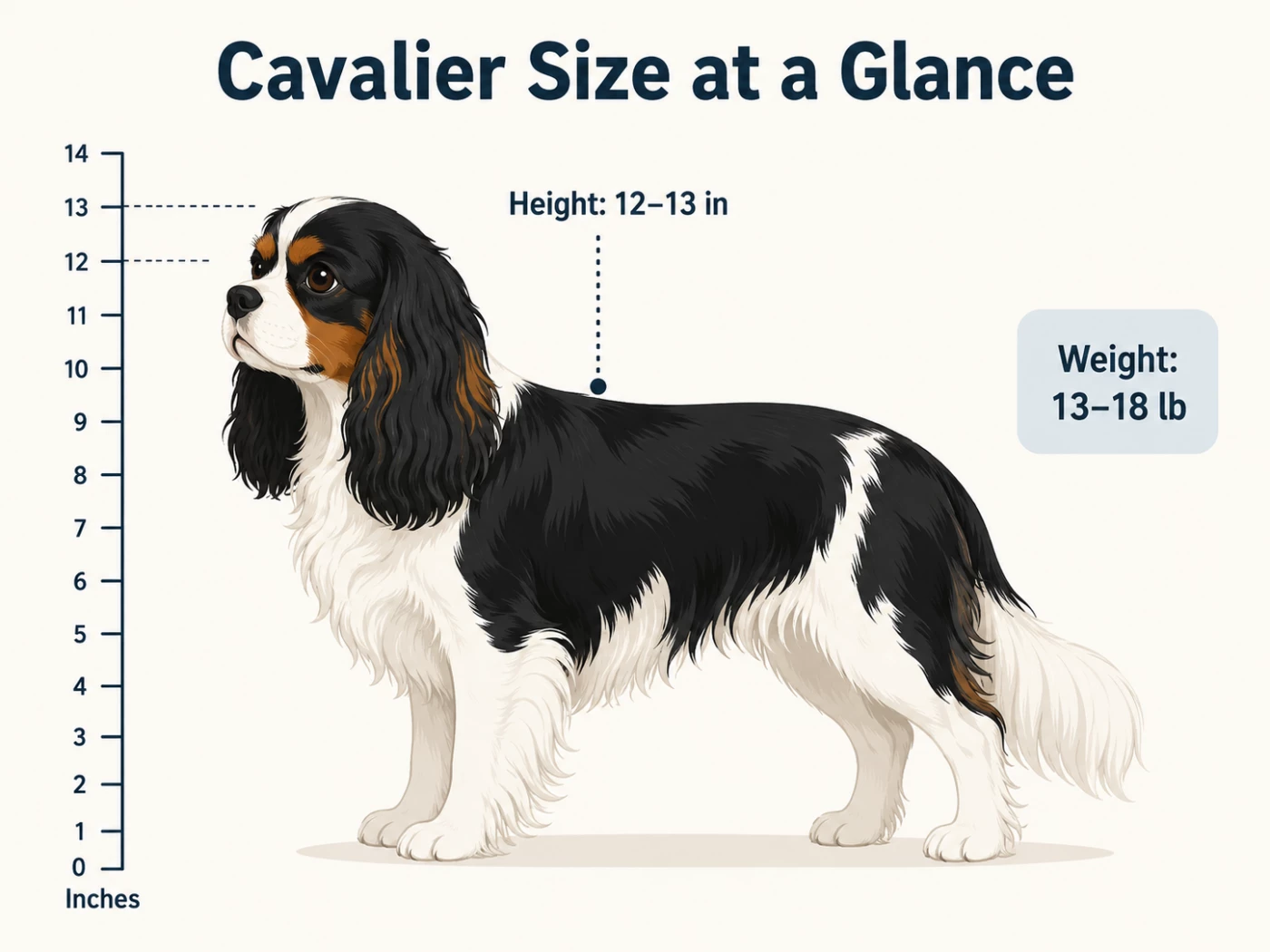
The American Kennel Club standard gives an ideal adult height of 12–13 inches at the withers and a weight of 13–18 pounds. Slight variation is allowed. The FCI standard gives a weight range of 12–18 pounds.
Some adult Cavaliers, especially males, top 18 pounds without being unusually tall. There is only one recognized size. A seller advertising “teacup,” “micro,” or deliberately miniaturized Cavaliers is not describing an official variety, and dogs bred for size alone often carry extra health risk.
| Characteristic | Typical breed-standard description |
|---|---|
| Adult height | 12–13 inches |
| Adult weight | 13–18 pounds |
| Median lifespan (2024 UK study) | 11.8 years |
| Build | Small, balanced, slightly longer than tall |
| Coat | Long, silky, with feathering |
| Official colors | Blenheim, tricolor, ruby, black and tan |
| AKC group | Toy Group |
| Original role | Companion and toy spaniel |
The four recognized colors are:
The breed standard calls for a natural coat with no sculpting or artificial alteration. Pet owners may still pick a shorter practical trim, but shaving does not remove the need for skin, ear, nail, and coat care.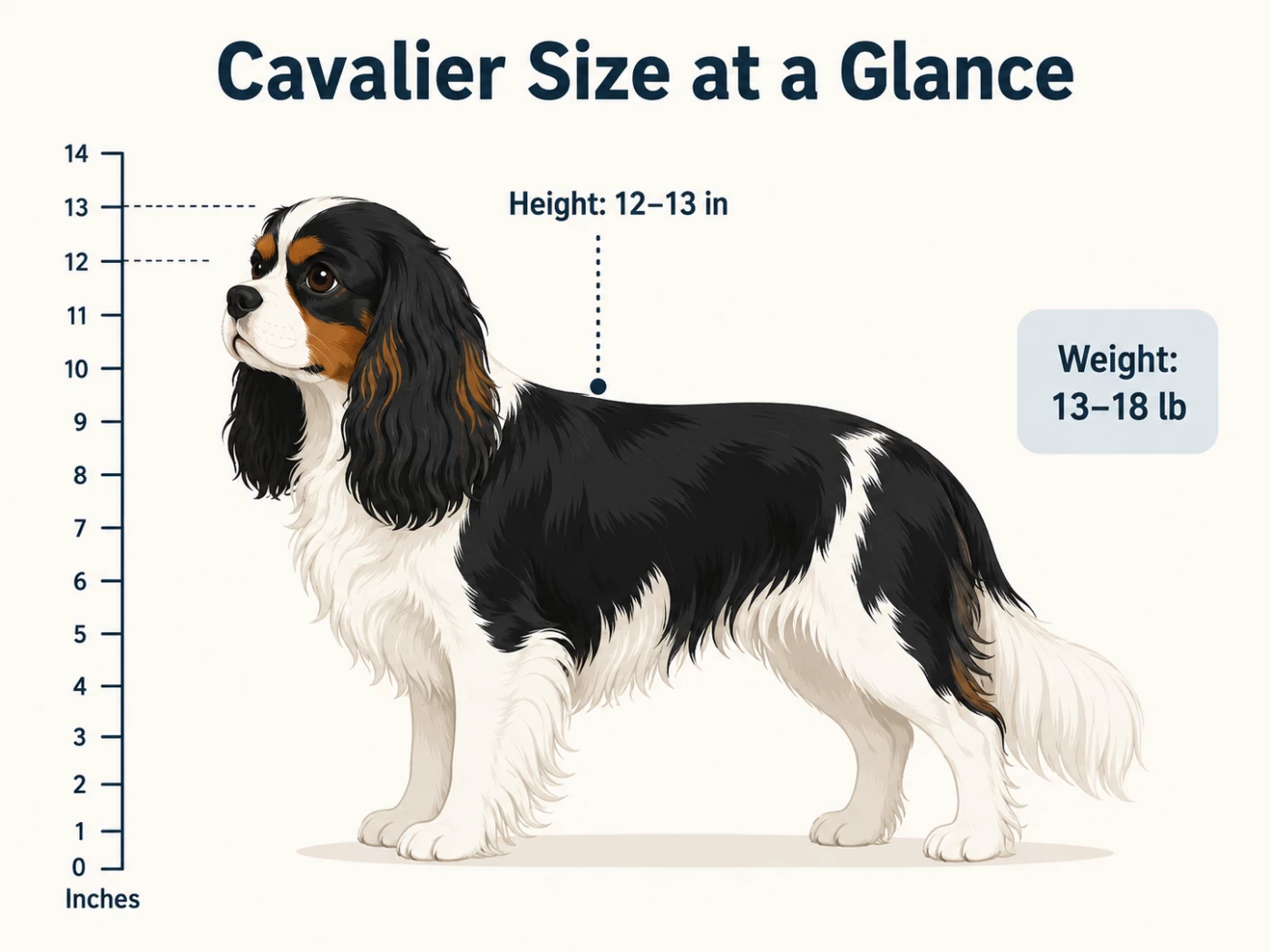
Most healthy adult Cavaliers need moderate daily activity, not endurance work. A practical routine is two daily walks of about 20 to 30 minutes, plus indoor play, sniffing time, and a few short training sessions. Once their needs are met, they are happy to rest near you.
Young puppies need shorter, age-appropriate activity. Limit repetitive jumping, forced running, and long stair sessions while the body is still developing. Dogs with heart, orthopedic, or neurological disease may need an exercise plan from a veterinarian.
Cavaliers often enjoy:
The breed’s size makes apartment living workable, but that depends on training and companionship more than square footage. A Cavalier that barks or panics when alone can be harder to manage in shared housing than a larger but more independent dog.
House-training takes patience. Small puppies have limited bladder capacity, and some owners report setbacks in rain or cold. A predictable schedule, frequent outdoor trips, supervision, and immediate rewards beat punishment every time.
Because many Cavaliers are highly food-motivated, weight can creep up quietly, especially after age two when they get calmer. Measure meals, count training treats, and judge body condition by feel rather than the number on the scale. Keeping the dog lean is one of the simplest things you can do for its joints and heart.
Cavaliers shed and are not a hypoallergenic breed.
Their silky coat does not need the heavy sculpting some long-coated breeds require, but feathering can mat behind the ears, under the legs, around the chest, and near the tail. Most owners find that frequent short brushing sessions are easier than untangling mats later.
A practical care routine:
Some owners keep the natural coat with brief home brushing; others use professional grooming and a shorter pet trim. Coat density varies, so one Cavalier may need much more upkeep than another. Because the ears are long and low-set, weekly ear checks help head off infections.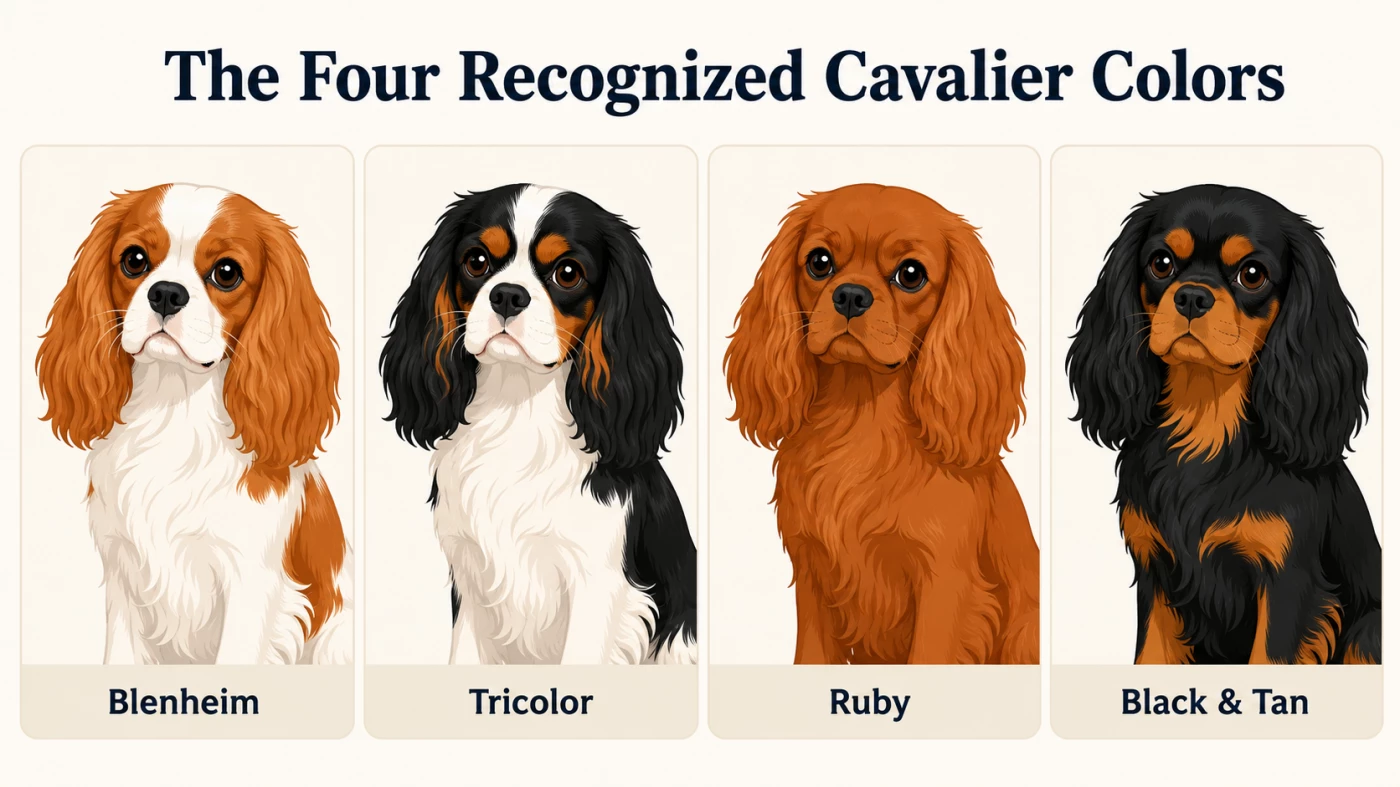
Read this section carefully before you fall in love with a puppy photo. Health is the breed’s most serious disadvantage. Cavaliers carry meaningful inherited risks in the heart, brain and spinal cord, eyes, kneecaps, hips, and other systems.
No health test guarantees a disease-free puppy. Testing does show that a breeder is identifying affected dogs and making more informed breeding decisions.
Myxomatous mitral valve disease (MMVD, often just called MVD) is a progressive degeneration of the heart’s mitral valve. The damaged valve lets blood leak backward, producing a murmur and, in some dogs, eventual congestive heart failure.
Cavaliers are strongly predisposed. North Carolina State University reports that mitral valve disease is roughly 20 times more prevalent in Cavaliers than in the general dog population and is a leading cause of death in the breed. A US study found murmurs in 56% of Cavaliers aged four or older and in 100% of those aged ten or older. The disease also tends to start younger in Cavaliers than in most breeds, which makes cardiac screening and family heart history especially important when choosing a puppy.
A murmur alone does not show the full severity of disease. A vet may use auscultation, imaging, blood pressure measurement, radiographs, and other tests depending on the dog.
Possible warning signs include coughing, reduced stamina, rapid or labored breathing, weakness, collapse, and abdominal swelling. Labored breathing, collapse, or blue or gray gums require urgent veterinary attention.
Breeding dogs should have a current cardiac exam by a board-certified veterinary cardiologist. Ask for the actual report rather than accepting “vet checked” as proof of specialist cardiac clearance.
Chiari-like malformation describes a mismatch between the skull and brain near the opening at the back of the skull, where the skull is too small for the brain. Syringomyelia happens when fluid-filled cavities form within the spinal cord. The condition can cause pain and unusual neurological behavior.
Possible signs include:
Scratching alone does not prove syringomyelia. Ear disease, allergies, skin irritation, and orthopedic pain can look similar. Signs usually appear between six months and three years. Chiari-like malformation is extremely common in the breed; syringomyelia affects a significant, age-dependent share of dogs and tends to increase with age. Diagnosis requires neurological evaluation and an MRI scan.
MRI screening is not one of the four core tests in the current US breed-club health-testing guidelines. The club does advise buyers to discuss syringomyelia and ask whether the parents or other breeding dogs have been MRI screened.
Other conditions relevant to the breed include patellar luxation, hip dysplasia, inherited eye disease, episodic falling syndrome, and dry eye and curly coat syndrome.
Patellar luxation is when the kneecap slips out of position. Signs include intermittent skipping, briefly carrying a rear leg, pain, or lasting lameness.
Episodic falling syndrome is an inherited disorder involving abnormal muscle tone. Affected dogs may have exercise- or excitement-triggered episodes while staying conscious. A DNA test is available.
Dry eye and curly coat syndrome is another inherited condition with a DNA test. It affects tear production and can involve an abnormal coat, skin, nails, and feet.
These DNA tests answer specific genetic questions. They do not replace cardiac, eye, patella, or hip exams.
For a Cavalier, health testing is the single biggest thing separating a responsible breeder from a risky one. To qualify for CHIC, the joint database run by the AKC Canine Health Foundation and the Orthopedic Foundation for Animals, Cavaliers must be screened for hips, cardiac, eyes, and patellas. The Cavalier King Charles Spaniel Club, USA recommends these four evaluations before breeding:
| Test | Recommended examiner or method |
|---|---|
| Heart | Board-certified veterinary cardiologist |
| Eyes | Board-certified veterinary ophthalmologist |
| Patellas | Licensed veterinarian |
| Hips | Hip radiographs submitted to OFA |
The club recommends a minimum cardiac clearance at 2.5 years of age by a board-certified cardiologist, plus periodic repeat exams for the heart, eyes, and patellas. Note that final OFA hip certification generally requires the dog to be at least two years old, while PennHIP can be done earlier.
Ask for current results on both parents. Verify records through the OFA database where available. A CHIC number means the required test results were submitted and made public; it does not mean every result was normal.
Other questions worth asking:
The serious watch-out is simple: registration papers, a polished website, and a routine puppy exam are not substitutes for breed-specific testing. Be wary of any breeder who says testing is unnecessary “because there’s no disease in my lines.”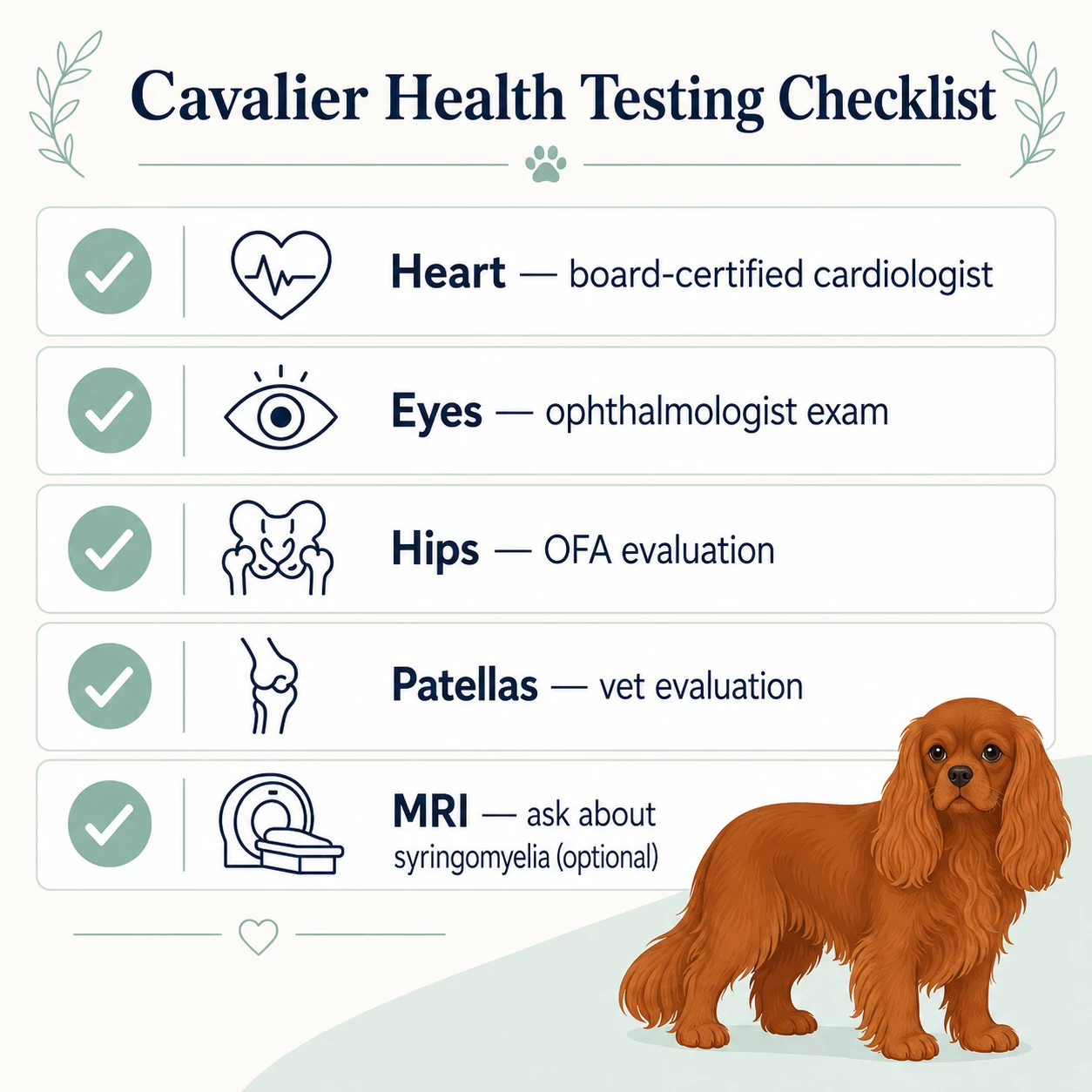
Cavaliers are not a budget breed, and the gap between a tested and untested puppy is the most important point here.
Current guidance from the Cavalier King Charles Spaniel Club, USA puts the general price of a Cavalier puppy at roughly $3,500–$6,000. Regional living costs, conformity to the breed standard, pedigree, health screening, and the individual breeding program all move the final number. Show prospects, puppies from particular bloodlines, or puppies needing transport may cost more, and transportation is often billed separately.
Prices as of June 2026 — check current listings on AllinPets.
A higher price does not prove responsible breeding, and a lower price does not automatically mean an unhealthy puppy. But a price well below the established-breeder range should prompt a careful look at health testing, documentation, and breeding practices. The cheap puppy is rarely a bargain: untested breeding raises the odds of early MVD and severe syringomyelia, and the vet bills that follow can dwarf the upfront savings.
Compare:
Medical costs can be steep if a Cavalier develops heart, neurological, eye, or orthopedic disease. Consider emergency savings or pet insurance from puppyhood, before symptoms create coverage exclusions. For this breed, that matters more than for most.
Start with documents, not promises. Ask for the registered names of both parents, specialist reports, OFA records, DNA results, and a written contract.
A responsible breeder should be able to explain why the parents were paired and discuss weaknesses as well as strengths. “Our dogs have never had problems” means little without test records and family history.
Use these checks:
A responsible breeder usually asks about your schedule, housing, finances, pets, children, and plans for the dog. Buyer screening is a good sign when it is relevant and respectful. The parent club prohibits placing puppies before eight weeks and recommends ten to twelve weeks.
Listings and directories are starting points, not guarantees, so evaluate each seller independently. You can also compare all dog listings on AllinPets while researching availability and asking prices. AllinPets.com lists Cavalier King Charles Spaniel breeders nationwide for free.
A Cavalier may suit someone who wants an affectionate, portable dog that enjoys both lap time and moderate outdoor activity. The breed often fits families, couples, retirees, first-time owners, and multi-pet homes when companionship and health care are planned realistically.
It may be a poor match for someone who:
| Likely advantage | Possible drawback |
|---|---|
| Affectionate and people-focused | May struggle with long isolation |
| Usually sociable | Limited watchdog value |
| Moderate exercise needs | Can chase wildlife |
| Small and portable | Physically vulnerable to rough handling |
| Often responsive to training | Food motivation can lead to weight gain |
| Adaptable to many homes | Serious inherited health risks |
| Attractive natural coat | Sheds and develops mats |
The clearest reason not to choose this breed: if you cannot commit to a health-tested line and a realistic medical budget, the Cavalier’s inherited conditions can turn a loving companion into a heavy emotional and financial strain. The best Cavalier home is not the largest or most active one. It is the one that offers companionship, gradual independence training, routine coat care, safe exercise, weight control, and access to good veterinary care.
AllinPets.com lists Cavalier King Charles Spaniel breeders across all 50 states for free — browse active listings, compare breeders, and reach out directly with no fees or middlemen.
Written by the AllinPets Editorial Team
Yes, for many families. Cavaliers are gentle, affectionate companions that enjoy adults and considerate children. Because they are small, supervise young children to prevent rough handling, falls, and injury. The main cautions are their need for company and their inherited health risks.
The AKC standard gives an ideal adult height of 12–13 inches and a weight of 13–18 pounds. Some healthy adults fall outside that range. There is only one recognized size; “teacup” Cavaliers are not an official variety.
Current US breed-club guidance puts the general price at roughly $3,500–$6,000. Region, pedigree, health screening, transportation, and the individual breeding program affect the final amount. A price well below that range is a reason to scrutinize health testing.
A large 2024 UK study reported a median lifespan of 11.8 years. Other veterinary datasets are somewhat lower, so individual lifespan varies with genetics, disease, weight, preventive care, and treatment. Mitral valve disease is the main factor limiting lifespan.
Yes. Cavaliers shed and are not hypoallergenic. Brushing several times a week removes loose hair and prevents mats, especially behind the ears and around feathered areas. Regular ear checks help prevent infections.
Often not well. Many are highly people-focused and prone to separation-related distress. Some adults manage reasonable periods after gradual training, but a home where the dog is routinely isolated for a full workday is a poor fit without breaks or reliable care.
Request cardiac clearance by a board-certified veterinary cardiologist, an ophthalmologist’s eye exam, a patella evaluation, and an OFA hip evaluation for both parents. MRI history for syringomyelia and relevant DNA testing should also be discussed.
Many respond well to food, play, and social rewards, and short, consistent sessions work well. Recall and calm separation deserve extra attention, since spaniel chasing instincts and strong attachment can create real-world problems.
This article is for informational purposes only. Always consult a licensed veterinarian.