
Long Read · 11 min
In this guide:
What Flea Allergy Dermatitis Actually Is
Where It Shows Up on the Body
But I Never See Any Fleas
Why the House Is the Real Infestation
How It Gets Diagnosed, and What Is No Longer Recommended
What Treatment Actually Looks Like
Every Pet in the Home, Not Just the Itchy One
What Else Fleas Carry
Five Mistakes That Keep the Itch Going
Frequently Asked Questions
Flea allergy dermatitis is an allergic reaction to proteins in flea saliva, not a reaction to the number of fleas on the dog. In a sensitized dog, a single bite can trigger days of intense itching, which is why an owner can find no fleas at all and still be looking at a flea problem. The Merck Veterinary Manual describes it as a hypersensitivity disorder caused by antigens injected from the salivary glands of fleas as they feed, and states that controlling it requires treating the affected pet, every other pet in the household, and the environment.
That last sentence is the whole article, and it is the part owners skip. Treating the itchy dog alone almost never ends the itch.
When a flea feeds, it injects saliva. That saliva contains histamine-like compounds, enzymes, and antigenic proteins. In most dogs this causes ordinary irritation. In a dog whose immune system has become sensitized to those proteins, it causes a disproportionate allergic response, and flea bite hypersensitivity is the most common skin allergy seen in small animal veterinary practice.
The consequence is that the usual mental model fails. Owners assume the amount of itching should match the number of fleas. In flea allergy dermatitis, it does not. The Merck Veterinary Manual notes that severely allergic animals can react to very few bites. A dog with a heavy flea burden may scratch mildly. A dog with almost no fleas at all may tear its own skin open.
The condition is often seasonal in temperate parts of the country, worst in warm months and frequently at its peak in the fall, and effectively year-round in the subtropical South.
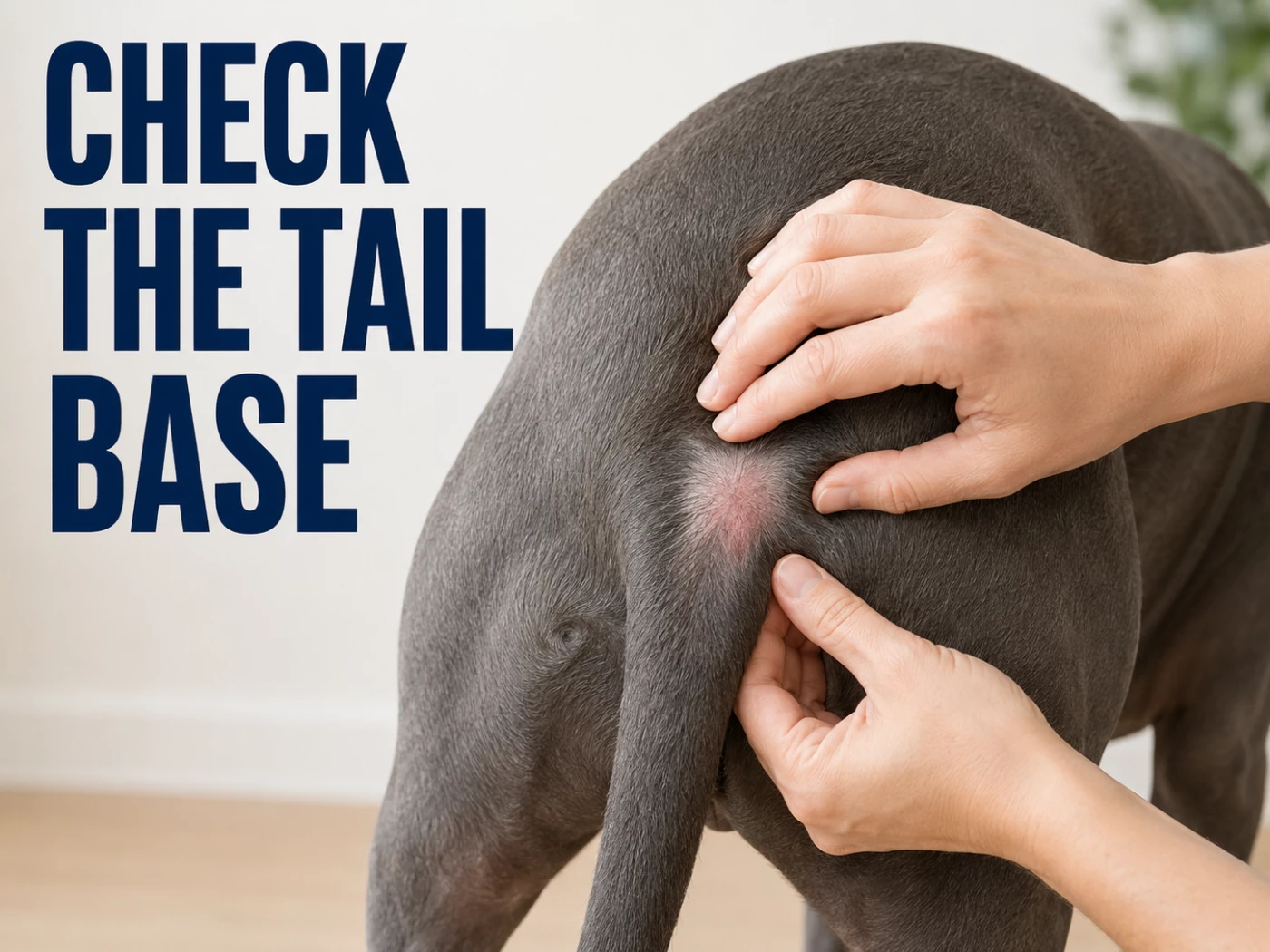
The location of the damage is the strongest clue, and it is remarkably consistent.
| Species | Typical distribution | What it looks like |
| Dogs | Lower back, base of the tail, back of the thighs, inner thighs, belly | Intense itching with small bumps and crusts, hair loss, scabbing, raw patches from chewing and scratching |
| Cats | Head, neck, and back, plus the groin area | Itching, small crusted bumps, and bald patches created by overgrooming rather than by scratching |
A dog that chews at the base of its tail and along its rump is showing a distribution strongly compatible with flea allergy dermatitis. But it is not diagnostic, and it does not exclude a concurrent environmental or food-triggered allergy. Chronic or severe cases can involve the face and ears too, and a dog can have flea allergy and atopic dermatitis at the same time.
Left alone, the picture changes. The Merck Veterinary Manual describes chronic cases progressing to hair loss, thickened skin, and darkened skin color, with secondary infections along the way. In heavy infestations, and particularly in young puppies, blood loss from fleas can cause anemia. A puppy with pale gums, weakness, or lethargy alongside a visible flea burden needs veterinary attention promptly, not next week.
This is the most common objection, and it is also the most misleading. There are three separate reasons a genuinely flea-allergic pet can look flea-free.
First, sensitivity. A very small number of bites is enough. There may be nothing to find because there was never much there.
Second, grooming. Dogs and especially cats chew and groom fleas off themselves, and cats are extremely good at it. A cat can carry a flea population, remove most of the evidence, and still seed the house with eggs.
Third, and least appreciated: many systemic flea products kill fleas after they begin feeding, so an allergic pet may still be exposed to saliva before the flea dies. The Companion Animal Parasite Council makes the point directly, noting that by the time a pet owner notices fleas, those fleas have already injected salivary proteins and begun laying eggs. A flea that jumps onto a treated dog, bites, and dies is a dead flea. For an allergic dog it is also an allergic reaction. This is why an owner can say, truthfully, "he is on flea prevention and I never see fleas," and still have a dog covered in flea allergy dermatitis.
The practical test is flea dirt, not fleas. Comb the dog over a damp white paper towel, concentrating on the rump and tail base. Flea dirt is digested blood, so specks that smear reddish-brown when wet are the confirmation you are looking for. A groomer will often spot it before you do, which is one reason to mention it at the appointment rather than wait.
The fleas you can see are a rounding error. In published flea research, only about 5 percent of the flea population is made up of adults. The other 95 percent, the eggs, larvae, and pupae, are in the environment: carpet fibers, floor cracks, bedding, upholstery, the yard, the spots where your dog sleeps.
The arithmetic is unforgiving. A female flea lays eggs in the coat at a rate of up to 50 per day, and because the eggs are not sticky, they fall off wherever the animal goes. The Centers for Disease Control and Prevention puts egg hatching at roughly one to ten days depending on temperature and humidity, and the larval and pupal stages then take weeks. Pupae are the stubborn stage: they are resistant, and they can sit and wait for a host far longer than the rest of the cycle suggests.
Two things follow:
The cat flea, Ctenocephalides felis, is the species responsible for the overwhelming majority of flea infestations on both dogs and cats. The name is a historical accident, not a species barrier.

Flea allergy dermatitis is diagnosed clinically. The Merck Veterinary Manual states that diagnosis rests on history and clinical signs, with the distribution of the lesions doing most of the work.
What has changed is the role of allergy testing. Intradermal skin testing and blood tests measuring flea-specific IgE have limited sensitivity and specificity for this condition, and the Merck Veterinary Manual states they are no longer recommended for diagnosing flea allergy dermatitis. If you have read older articles telling you to ask for a flea allergy blood test, that advice has moved on.
What your veterinarian will look for instead:
Treatment runs on two tracks at once, and skipping either one wastes the other.
Track one is flea elimination. Strict, continuous flea control on the affected pet and every other pet in the home, plus the environment. The VCA veterinary hospital network is explicit that even if you do not see fleas on your dog, rigorous flea treatment and environmental control must continue, and that the best treatment is prevention using modern oral or topical products chosen with your veterinarian.
Track two is comfort and infection control. The itch itself, and any secondary skin infection, generally need their own treatment. Your veterinarian can prescribe medication for this. Do not improvise with human medications: dosing, formulation, and safety differ enormously between species, and some over-the-counter human drugs are dangerous for dogs and cats.
One expectation to set honestly: even excellent flea control may not eliminate the itch instantly, because fleas emerging from the environment can keep biting while the reservoir is being cleared. Veterinary treatment of the inflammation can bring relief sooner, but full environmental control is measured in weeks.
And once it is under control, it stays under control only if the prevention continues. Flea allergy dermatitis does not get cured. It gets managed, year-round, for the life of the pet.
This is where most flea allergy cases actually go wrong. The Merck Veterinary Manual is unambiguous: prevention and treatment require treating the affected pet, the other pets in the household, and the environment. All three.
The untreated cat is the classic hole in the plan. Cats groom fleas off efficiently, look clean, and quietly keep feeding and reseeding the household infestation while the dog gets the treatment and the blame. If you live with both species, our guide on managing a household with both a dog and a cat is worth a read, but for parasites the rule is simple: every animal in the home, year-round, on the schedule specified for its own species-approved product. Some products are monthly, some collars run for months, and the interval belongs to the label, not to your calendar habits. Many of these same products are dual-purpose, so it is worth reading our guide to tick prevention for dogs before you settle on one for the whole household.
One safety warning that matters enormously in mixed households: never use a permethrin-containing dog flea product on a cat, and keep cats away from a dog that has just been treated with one for the period the label specifies. Cats metabolize permethrin poorly and can develop life-threatening poisoning after exposure. Ask your veterinarian for a product plan that covers the whole household safely.
AllinPets.com is a free pet classifieds, breeder directory, and local pet services platform covering dogs, cats, 250-plus breeds, and all 50 US states, with cats and kittens listed near you as well as dogs.
Flea allergy dermatitis is one of the most clinically important consequences of flea exposure, but it is not the only one. The cat flea is the intermediate host of Dipylidium caninum, the common tapeworm of dogs and cats, which is how a dog that swallows a flea while grooming ends up with a tapeworm. Fleas are also competent vectors of pathogens with human relevance, including Bartonella henselae, the agent of cat scratch disease, and Rickettsia felis.
None of this is a reason to panic. It is a reason to treat flea control as veterinary care rather than as a cosmetic issue, and to keep it going in the months when nobody is thinking about fleas, in the same way heartworm prevention has to run year-round rather than only in mosquito season.
It is also worth separating flea allergy from the other skin conditions it gets confused with. Skin fold dermatitis, for instance, is a mechanical and microbial problem in the folds of a flat-faced breed, not an allergy, and it is managed completely differently. Our French Bulldog health guide covers that distinction in a breed where it comes up constantly.
If you are still choosing a dog and weighing what its coat and skin will demand of you, you can browse puppies available from breeders on AllinPets. Whatever you choose, flea control is the one preventive that has to run all year, in every animal in the home, if you want it to work at all.
Yes, and it is common. Flea allergy dermatitis is a reaction to proteins in flea saliva, so a sensitized dog can react severely to a very small number of bites. Dogs and cats also groom fleas off, and many systemic products kill fleas only after they begin feeding. Absence of visible fleas is not evidence against the diagnosis.
The Merck Veterinary Manual describes the typical distribution in dogs as the lower back, base of the tail, and the back and inner surfaces of the thighs, with itching, small crusted bumps, hair loss, and scabbing. In cats, the pattern is different: head, neck, back, and groin, often with bald patches caused by overgrooming.
There are such tests, but the Merck Veterinary Manual states that intradermal skin testing and IgE blood testing for flea-specific antigens have limited sensitivity and specificity and are no longer recommended for diagnosing flea allergy dermatitis. Diagnosis is based on history, clinical signs, lesion distribution, and response to strict flea control.
Improvement time varies. Itch relief may begin sooner with veterinary treatment of the inflammation, while full environmental control can take weeks or longer. Only about 5 percent of a flea population lives on the animal, so new adult fleas continue to emerge from the household environment while the immature stages are being cleared. Secondary skin infections, which are common in flea-allergic pets, also need their own treatment before the itch fully settles.
Yes. The Merck Veterinary Manual specifies treating the affected pet, all other pets in the household, and the environment. The same species of flea lives on both dogs and cats, and an untreated cat will keep replenishing the eggs in the home even when it looks perfectly clean. Use only products labeled for cats, and never a permethrin-containing dog product.
This article is general educational information, not veterinary advice, and it cannot account for your individual animal. Severity, secondary complications, and product suitability vary from pet to pet, and dosing intervals belong to the label of the specific product. Talk to your veterinarian before starting, stopping, or changing any parasite preventive or skin medication, and seek veterinary care if your pet is losing hair, breaking the skin, or showing signs of infection.
Written by the AllinPets Editorial Team