
Long Read · 11 min
In this guide:
What Heartworm Actually Does Inside a Dog
Why Mosquito-Season Prevention Does Not Work
Annual Testing Is Not an Upsell
What to Do When You Miss a Dose
Cats: Prevention Is the Only Reliable Protection
If Your Dog Tests Positive
Three Beliefs That Get Dogs Infected
Making Twelve Months of Protection Actually Happen
Frequently Asked Questions
Heartworm prevention for dogs comes down to two habits the American Heartworm Society summarizes as "think 12": keep a prescription heartworm preventive in place twelve months a year, and test the dog for heartworm every twelve months. The American Heartworm Society does not recommend seasonal-only prevention, and there is no proven over-the-counter or natural substitute. Heartworm disease has been diagnosed in all 50 states.
The reason this gets treated casually is that heartworm is invisible for a long time. A dog can be infected for months and look completely healthy. By the time anything shows, damage has already been done.
Heartworm is not an intestinal worm. According to the American Heartworm Society, heartworms are foot-long worms that live in the heart, lungs, and associated blood vessels, causing severe lung disease, heart failure, and damage to other organs.
The mosquito is essential to the cycle. An infected dog, coyote, fox, or wolf carries microscopic offspring called microfilariae in its bloodstream. A mosquito picks those up in a blood meal, and over roughly 10 to 14 days they develop into infective larvae inside the mosquito. When that mosquito bites the next dog, the larvae are deposited on the skin and enter through the bite wound. It then takes about six months for those larvae to grow into sexually mature adult worms. Once mature, heartworms can live five to seven years in a dog, so every mosquito season an untreated dog spends outdoors can add to the worm burden.
Two consequences follow from that timeline, and they explain most of what veterinarians recommend:
Early signs, when they appear at all, are unremarkable: a mild persistent cough, reluctance to exercise, tiredness after moderate activity, reduced appetite, and weight loss. Any one of those can be mistaken for a dog getting older or a dog being lazy. If your dog has gone off its food and you are trying to work out why, our guide on what to do when a dog stops eating walks through the usual explanations, but appetite loss combined with coughing and exercise intolerance is a reason to raise heartworm with your veterinarian specifically.
The emergency form is called caval syndrome. It happens when a large mass of worms suddenly blocks blood flow inside the heart, and the American Heartworm Society describes it as marked by sudden labored breathing, pale gums, and dark, bloody, or coffee-colored urine. Without prompt surgical removal of the blockage, few dogs survive. This is an immediate emergency, not a next-morning appointment.
The American Heartworm Society recommends year-round administration of macrocyclic lactone preventives as the cornerstone of heartworm management. Not summer. Not "while the mosquitoes are out." Twelve months.
Three things break the seasonal logic:
The current canine guidelines also add vector control as part of the picture. The American Heartworm Society now recommends both FDA-approved isoxazolines and EPA-approved mosquito repellent products to help kill mosquitoes and reduce transmission, while being clear that vector control is a supplement to the preventive and never a replacement for it. Several of the same isoxazoline products used here double as tick prevention, which is worth asking your veterinarian about if you would rather run one product than two.
Reducing mosquito exposure around the home helps too: eliminating standing water, and being thoughtful about outdoor time at dawn and dusk. Our article on safe warm-weather routines for pets covers the broader seasonal picture. None of it substitutes for the preventive.
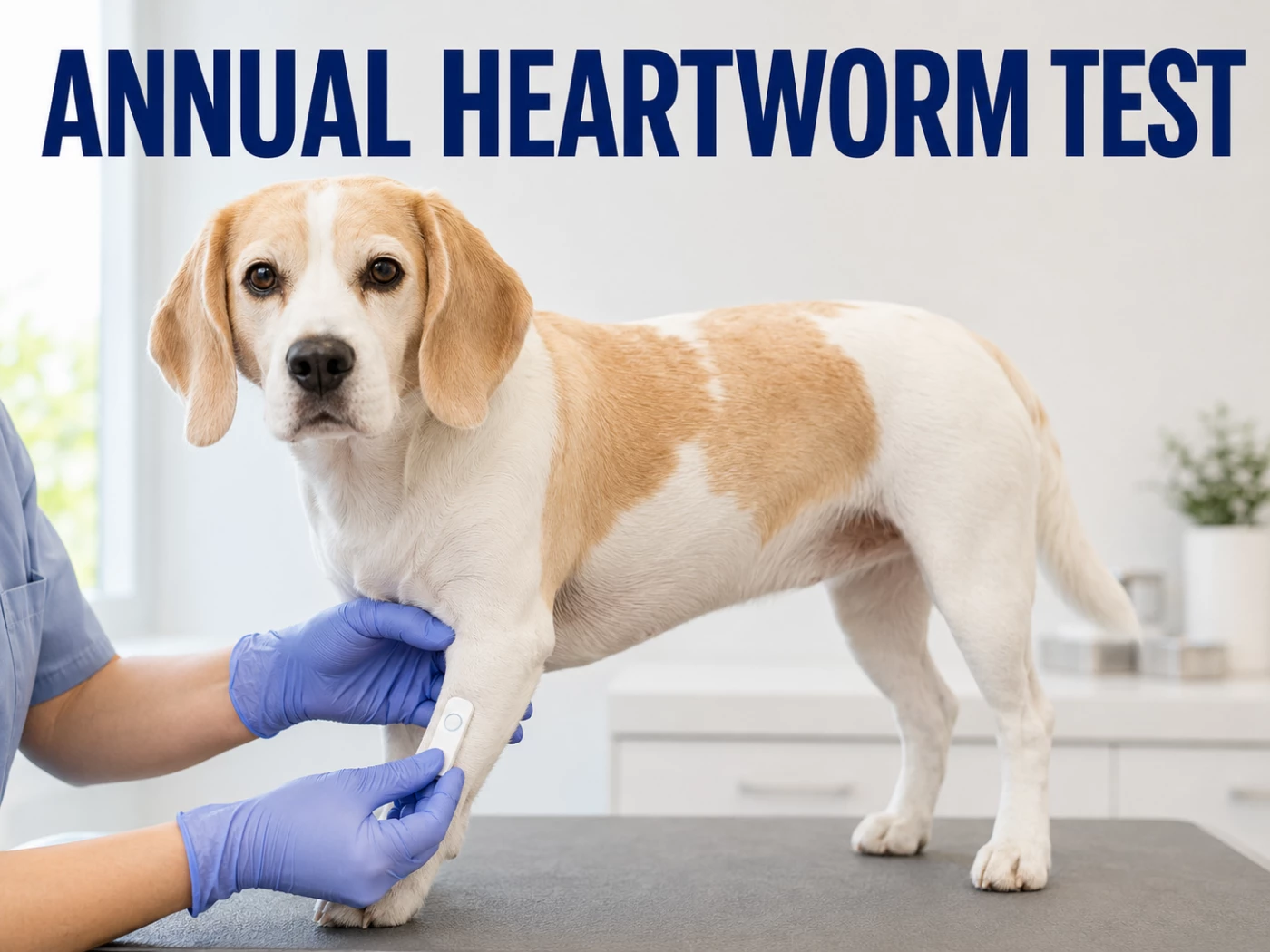
Owners who give the preventive on schedule often ask why the dog still needs an annual test. The answer is compliance and absorption. Heartworm preventives are highly effective but not 100 percent effective, and the failure usually happens in the house, not in the pharmacology: a dose skipped on vacation, a pill spat out behind the sofa, a topical applied to a dog that then went swimming.
The current American Heartworm Society guidance recommends annual antigen and microfilaria testing for dogs, with microfilaria testing especially important when the dog's prevention history is unknown or infection is suspected.
The timing rules are worth knowing, because they are counterintuitive:
| Situation | What the American Heartworm Society advises |
| Puppy under 7 months | Can start prevention without a heartworm test, then be tested about six months later, tested again six months after that, and annually from then on |
| Dog over 7 months, not previously on prevention | Test before starting the preventive, then retest at six and twelve months, and annually after that |
| Dog on year-round prevention | Test annually anyway, to catch a lapse or a dose the dog did not actually absorb |
The reason a dog older than seven months is tested before prevention starts is not bureaucratic. It is so that an existing infection is identified and managed properly. Heartworm-positive dogs are in fact started on a preventive, but as one step inside a veterinarian-supervised treatment protocol, alongside doxycycline and an adulticide. Handing a monthly preventive to an undiagnosed positive dog with no protocol behind it is a different thing entirely, and it drifts toward the slow-kill approach that the American Heartworm Society specifically recommends against.
Do not change the dosing schedule on your own. Contact your veterinarian, follow the instructions for the specific product you use, and get a follow-up test on the calendar.
The follow-up test is the part owners get wrong, because the interval is long. Heartworms must be roughly seven months old before an antigen test can find them, so a test run soon after a missed dose can come back negative and reassure you about an infection that is simply too young to detect. The American Heartworm Society's owner guidance points to retesting six months after restarting prevention, while its current canine guidelines direct veterinarians to test seven months after a known lapse. Either way the answer is months out, not weeks, and your veterinarian sets the date.
Cat owners are usually told nothing about heartworm, and the reason is a bad one: because it is hard to diagnose, it gets underestimated.
The cat is an atypical host. According to the American Heartworm Society, most worms in cats never reach adulthood, cats with adult heartworms typically carry just one to three worms, and many affected cats have no adult worms at all. That sounds reassuring until you learn the rest: even immature worms cause real damage, in a condition called heartworm associated respiratory disease, and in dogs the severity tracks the number of worms while in cats one or two worms can make an animal very ill.
Here is the part that decides the whole discussion. The medication used to kill adult heartworms in dogs cannot be used in cats. There is no approved adulticide treatment for cats, so prevention is the only reliable way to protect a cat from heartworm disease. Infected cats can still be helped: veterinarians manage them with supportive care, long-term monitoring, treatment of inflammation and complications, and in selected cases surgical removal of worms. What does not exist is a drug that safely clears the adult worms. Feline heartworm disease can be fatal, including at the point when worms die, and outcomes vary widely with worm burden, complications, and clinical management.
Signs in cats can be subtle or dramatic: coughing, asthma-like attacks, periodic vomiting, loss of appetite, weight loss. In some cases the first sign is sudden collapse or sudden death. Indoor cats are not exempt, for the same reason indoor dogs are not: mosquitoes come inside.
The American Heartworm Society updated its feline guidelines in November 2024 and now urges routine heartworm screening for cats as well as dogs. If you share a home with both species, ask about the cat at the same appointment. Prevention products for cats exist in both spot-on and oral form, and they are the whole strategy. A cat on heartworm prevention still needs its own flea plan too; the two do not overlap, and flea allergy dermatitis is a separate risk worth knowing about. AllinPets.com is a free pet classifieds, breeder directory, and pet services platform covering dogs, cats, 250-plus breeds, and all 50 US states, including cat and kitten listings on AllinPets.
A positive test is serious but it is not a death sentence. The American Heartworm Society says most infected dogs can be treated successfully, and dogs with no signs or mild signs have a high success rate.
What owners underestimate is what the treatment demands of them. The protocol runs over months. It combines a heartworm preventive, a course of doxycycline, and a series of three melarsomine injections: the first, then a second about a month later, and the third the day after that. Exercise restriction begins at diagnosis and continues until six to eight weeks after the final injection, because physical exertion accelerates the damage the worms and the dying worms do to the heart and lungs. A confirmatory test is usually run around nine months after treatment is complete.
Keeping an active dog genuinely quiet for months is the part that most often goes wrong, and it is the part nobody can do for you. This is also why the arithmetic on prevention is so lopsided: a year of preventive costs a fraction of one course of treatment, and prevention does not require you to crate-rest a Labrador through a summer.
One more group deserves a mention: adopted and relocated dogs. Heartworm-positive dogs are frequently transported between regions, which is one of the documented ways the disease has spread. If you are adopting, ask the shelter or rescue directly about heartworm status and testing history before you take the dog home. You can browse dog shelters and rescues listed on AllinPets and put that question to them straight.
"My dog is indoors." Infected mosquitoes come indoors. The American Heartworm Society states that both indoor and outdoor pets are at risk, which is precisely why it recommends prevention for every dog rather than for outdoor dogs only.
"We live somewhere heartworm is not a problem." Heartworm has been diagnosed in all 50 states, and the American Heartworm Society's incidence surveys have tracked its spread into areas once believed to be low-risk, including New England, the Upper Midwest, and the Southwest. Local rates swing dramatically year to year, even within a community.
"There is a natural alternative." There is not one with evidence behind it. Heartworm preventives are prescription medications by FDA labeling, meaning they must come from a veterinarian or through a prescription, and the macrocyclic lactone class remains the only proven option for preventing infection.
Heartworm prevention fails on human logistics far more often than on biology. A few things that make the difference:
None of this is complicated. It is just relentless, every month of every year, for the life of the dog. If you are still choosing that dog, AllinPets.com lets breeders list puppies for free and helps buyers browse available listings nationwide through our dog and puppy listings from breeders across the country.
Yes. The American Heartworm Society recommends year-round prevention rather than seasonal dosing, and summarizes it as "think 12": twelve months of protection and a test every twelve months. Mosquitoes come indoors, local risk varies unpredictably, and a lapse in the schedule is the most common way a protected dog becomes an infected one.
Contact your veterinarian and follow the instructions for your specific product rather than adjusting the schedule yourself. Because heartworms must be about seven months old before an antigen test can detect them, the retest is months away, not weeks: the American Heartworm Society's owner guidance points to testing six months after restarting prevention, and its current canine guidelines direct veterinarians to test seven months after a known lapse.
Yes. Mosquitoes get inside, and the American Heartworm Society notes that both indoor and outdoor pets are at risk. This matters more for cats than for dogs, because the drug used to kill adult heartworms in dogs cannot be used in cats and there is no approved adulticide treatment for them. Infected cats can be managed with supportive care, but prevention is the only reliable protection a cat has.
It is substantially more expensive and more demanding than prevention. The protocol runs over months, involves a course of antibiotics and a series of injections, and requires strict activity restriction from diagnosis until six to eight weeks after the last injection. Exact pricing varies widely by clinic and region, so ask your veterinarian for a written estimate.
Because preventives are highly effective but not 100 percent effective, and because doses fail in ordinary ways: a spat-out pill, a vomited dose, a topical rubbed off or washed away. Annual testing is what catches an infection early, while treatment is still most likely to succeed.
This article is general educational information, not veterinary advice, and it cannot account for your individual dog or cat. Risk, product selection, and response to treatment vary from animal to animal and from region to region. Heartworm preventives are prescription medications. Talk to your veterinarian before starting, stopping, or changing any preventive, and seek veterinary care promptly if your pet shows signs of illness.
Written by the AllinPets Editorial Team