
Long Read · 11 min
In this guide:
Why Seasonal Tick Control Keeps Failing
How Disease Actually Gets From Tick to Dog
Tick Products: What Each Type Really Does
The Cat Problem in Multi-Pet Homes
The FDA Warning Worth Reading Before You Buy
How to Remove a Tick the Right Way
Your Yard, Your House, and the Tick That Lives Indoors
Testing: The Step Most Owners Skip
Building a Tick Routine That Survives October
Frequently Asked Questions
Effective tick prevention for dogs is two things done together: a year-round tick preventive selected with your veterinarian and used according to its label, and a hands-on tick check after every walk in grass, brush, or woods. The product provides the primary protection, while regular tick checks add another layer and allow prompt removal. The Companion Animal Parasite Council recommends that all pets stay on effective tick products year-round, not just in summer, and that any attached tick be removed promptly rather than left to detach on its own.
Most owners already know they should "do something about ticks." What trips them up is the detail: which product, how often, what to do when they find one, and whether the dog needs testing afterward. This guide covers those decisions in the order you will actually face them.
The single most common mistake is treating tick control as a summer chore. Ticks are not summer insects. Adult deer ticks quest whenever the temperature is above freezing and the ground is not covered in snow, which in much of the United States means late fall and mild winter days are active tick days. Many owners stop treating in September, exactly when adult tick activity picks back up.
The Companion Animal Parasite Council goes further and recommends year-round, broad-spectrum parasite control that covers heartworm, intestinal parasites, fleas, and ticks together, with annual testing for tick-transmitted pathogens in areas where they are endemic or emerging. The reasoning is simple: a gap in coverage is a gap the tick uses.
There is also a tick that ignores the calendar completely. The brown dog tick can complete its entire life cycle indoors. A single dog carrying a few brown dog ticks home from a boarding stay can seed a household infestation that has nothing to do with the season outside.
A tick does not inject disease the moment it lands. It has to attach, insert its mouthparts, and feed. That feeding period is the window you are trying to close.
The often-repeated 24-to-48-hour figure is real but narrow. Veterinary parasitologists describe that window as applying to pathogens such as the Lyme bacterium and Babesia. Other tick-borne organisms can transfer far faster, in a matter of hours. Weekly checks leave too much time for transmission. Check after exposure, and do not use inspection as a substitute for prevention.
The product is there to kill or repel the tick during the hours your eyes cannot. The check is there to catch what the product missed, and to get an attached tick off fast.
The main tick-borne diseases veterinarians look for in American dogs include Lyme disease, ehrlichiosis, anaplasmosis, Rocky Mountain spotted fever, and babesiosis. The Companion Animal Parasite Council notes that many dogs that test positive for exposure never show obvious illness, which is one more reason owners underestimate the risk: an infected dog often looks like a normal dog for a long time.
Tick products are not interchangeable, and the marketing rarely makes the difference clear. The practical distinction is whether a product kills the tick after it bites, or repels and kills it on contact before it feeds.
| Product type | How it works | Practical notes |
| Oral isoxazolines | The tick must bite and take blood before the drug kills it | Convenient, not washed off, unaffected by swimming. Does not stop the bite itself |
| Some topical repellent products | Repel and kill on contact, so many ticks never feed | Not every topical repels. Several that do contain permethrin, which carries strict label precautions around cats. Bathing and swimming can affect them |
| Tick collars | Release active ingredient over months | Long duration. Fit and skin contact matter, and collars can be lost or chewed |
| Long-acting injection | Given by a veterinarian, covers many months | The FDA approved the first long-acting injectable flea and tick treatment for dogs in 2025. The interval depends on which tick species the dog is likely to meet |
There is no single best answer here. A hiking dog in a Lyme-heavy region and an apartment dog that walks on pavement do not need the same plan, and a household with cats narrows the field. This is a conversation to have with your veterinarian, who can also tell you which pathogens are actually circulating in your county.
Never put a dog tick product containing permethrin on a cat. This is an emergency-level mistake. Cats metabolize permethrin poorly and are highly susceptible to poisoning. The American Association of Feline Practitioners states that topical application of permethrin-containing dog flea products to cats accounts for a major portion of the feline toxicities reported to the ASPCA Animal Poison Control Center.
The poisoning does not always require a direct application. A cat that grooms or sleeps against a dog whose spot-on treatment is still wet can absorb enough to become seriously ill. Signs include muscle tremors, twitching, drooling, elevated body temperature, and seizures, and they can appear within an hour or be delayed. A cat showing these signs after any exposure to a dog flea or tick product needs a veterinarian immediately.
What this does not mean is that a cat in the house bans every permethrin product outright. Some permethrin products may still be used in mixed-species homes only if the exact label precautions can be followed, which usually means keeping the cat away from the treated dog for the period the label specifies. Product-specific instructions matter and they are not identical between brands. Read the label, and tell your veterinarian you have a cat before you choose a product rather than after. A cat sharing the house with an itchy dog is worth a second look too, since the itch a flea allergy causes spreads through households the same way ticks do, one untreated animal at a time.
AllinPets.com is a free pet classifieds, breeder directory, and pet services platform covering dogs, cats, 250-plus breeds, and all 50 US states, which is a long way of saying that the cat in the room is a pet with its own parasite plan, not an afterthought. If you are still adding to the household, the cat and kitten classifieds are worth reading with that in mind.
The isoxazoline class, which includes several of the most widely used oral flea and tick products, carries an FDA advisory. The FDA has alerted pet owners and veterinarians to the potential for neurologic adverse events in dogs and cats treated with isoxazoline products, including muscle tremors, ataxia, and seizures. The agency also states that these products are safe and effective for the majority of dogs and cats, and that seizures may occur in animals with no prior seizure history.
The practical takeaway is not to avoid the entire class. It is to mention any history of seizures or neurologic disease when your veterinarian is choosing the product, and to report anything unusual after a dose rather than assuming it is unrelated. Severity varies from dog to dog, and most dogs tolerate these products without incident.
Speed matters more than technique, but technique still matters. The Centers for Disease Control and Prevention gives a method that works on dogs as well as people.
The CDC is direct about what not to do: do not use petroleum jelly, nail polish, heat, or a lit match to make the tick let go. The goal is to remove the tick as fast as possible, not to wait for it to detach. Those folk methods keep the tick attached longer, which is the opposite of what you want.
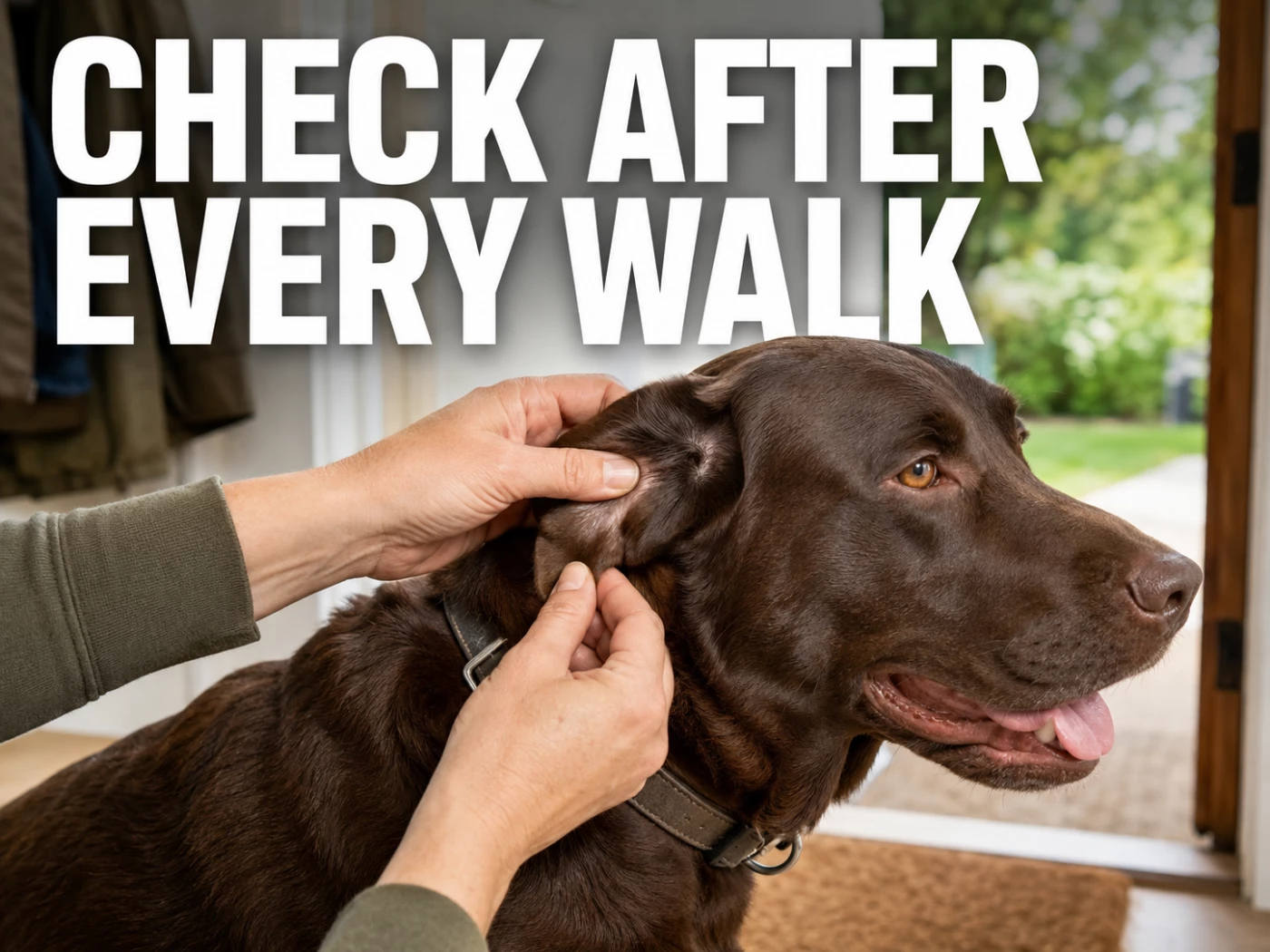
Where to look on a dog: ears and inside the ear flap, around the eyes and lips, under the collar, in the armpits and groin, between the toes, and under the tail. Ticks favor thin skin and hidden spots. Run your fingertips over the coat rather than relying on sight, especially on a dark or thick-coated dog.
Most ticks are picked up in tall grass, leaf litter, brush, and the edges where lawn meets woods. Keeping grass short, clearing leaf litter, and creating a border between lawn and woodland reduces tick pressure in the part of the yard your dog actually uses. The Companion Animal Parasite Council also notes that keeping dogs from roaming, on leash or behind a fence, limits exposure, and that outdoor environments can be treated to reduce tick numbers.
The brown dog tick is the exception that catches people off guard. University of Florida entomologists describe it as unusual among ticks because it can complete its whole life cycle indoors, which is why infestations take hold in homes and kennels. Dogs typically acquire them in homes, kennels, boarding environments, and other places where dogs are housed together. Infestations usually start with a handful of ticks that nobody notices, then climb quickly. Each engorged female drops off into a crack or crevice and lays a single large clutch of eggs, with published figures running into the thousands.
If you are seeing ticks on walls, baseboards, or bedding rather than only on the dog, that is not a yard problem. That is an indoor infestation and it needs professional pest control alongside veterinary treatment of the dog.
Because dogs pick these ticks up where other dogs are, it is worth knowing how the facilities you use handle parasite control. You can look through pet boarding facilities and the wider range of pet services listed on AllinPets before you book, then ask any of them directly what their tick policy is.
Tick prevention does not end at the product. The Companion Animal Parasite Council recommends annual testing for tick-transmitted pathogens, particularly in regions where those pathogens are endemic or emerging. Many veterinary clinics run this as part of the same annual blood draw used for heartworm screening, so it usually costs you nothing extra in time.
The reason to test a dog that looks healthy is that exposure often outruns symptoms. A positive result changes what your veterinarian watches for and how aggressively they investigate a vague problem two years later.
A note on the Lyme vaccine: the Companion Animal Parasite Council frames it as a risk-based decision that depends on where the dog lives and how often it goes into tick habitat, and is explicit that vaccinating does not replace a stringent tick-control program. Ticks also carry pathogens that no Lyme vaccine addresses. The vaccine is an addition, never a substitute.
Tick prevention fails on human behavior, not on veterinary science. The plan that works is the one you can still run in month eight.
If you are still choosing a dog and thinking about how much outdoor exposure your household can realistically manage, AllinPets.com lets breeders list puppies for free and helps buyers browse available listings nationwide at available dogs and puppies for sale. And whatever the breed, the tick math is the same: hours outdoors, times months of the year, times how good you are at remembering the dose. Our guide to keeping a pet safe outdoors in warm weather covers the rest of the seasonal picture.
Yes, in most of the country. The Companion Animal Parasite Council recommends year-round tick control for all pets rather than a seasonal approach. Adult ticks stay active on mild winter days, and the brown dog tick can live and breed indoors regardless of the outdoor temperature.
They do different jobs. Oral products generally kill the tick after it bites, while some topical products repel and kill on contact so fewer ticks feed at all. Oral products are not washed off by swimming or bathing. Permethrin-containing topicals carry strict label precautions in homes with cats. The right choice depends on your dog, your household, and your region, which is a decision to make with your veterinarian.
It depends on the pathogen. Veterinary parasitologists describe a roughly 24-to-48-hour window for organisms such as the Lyme bacterium and Babesia, but other tick-borne pathogens can transmit within hours. That range is why prompt removal matters and why a preventive product is still necessary between checks.
No. Permethrin-containing dog products can be fatal to cats even in small amounts, and the American Association of Feline Practitioners identifies these products as a major source of feline poisonings reported to the ASPCA Animal Poison Control Center. Cats need products labeled for cats. Where a permethrin product is used on a dog in a home with cats, the label precautions on separating the animals must be followed exactly. If a dog product has been applied to a cat, or a cat has been in contact with a freshly treated dog, contact a veterinarian immediately.
The Companion Animal Parasite Council recommends annual testing for tick-transmitted pathogens, especially where those diseases are endemic or emerging. Many exposed dogs show no obvious signs, so a healthy-looking dog can still carry information your veterinarian needs.
This article is general educational information, not veterinary advice, and it cannot account for your individual dog. Disease risk, product suitability, and reactions vary from dog to dog and from region to region. Always follow the label of the specific product you use. Talk to your veterinarian before starting, stopping, or changing any parasite preventive, and seek veterinary care promptly if your dog or cat shows signs of illness.
Written by the AllinPets Editorial Team