
Short Read · 6 min
Labrador Retrievers are one of the most common family dogs in the United States, which means buyers can find many puppies and many kinds of sellers. Some breeders carefully screen parents, raise puppies in a stable home environment, and document every promise. Others rely on cute photos, fast deposits, and vague claims that the puppies are “healthy.”
Price alone does not separate the two. A high price is not proof of quality, and a lower price is not automatically a scam. The real difference is documentation, transparency, and whether the breeder can explain exactly how the litter was planned and raised. For a broader view of the breed before choosing a seller, read the complete Labrador Retriever breed guide.
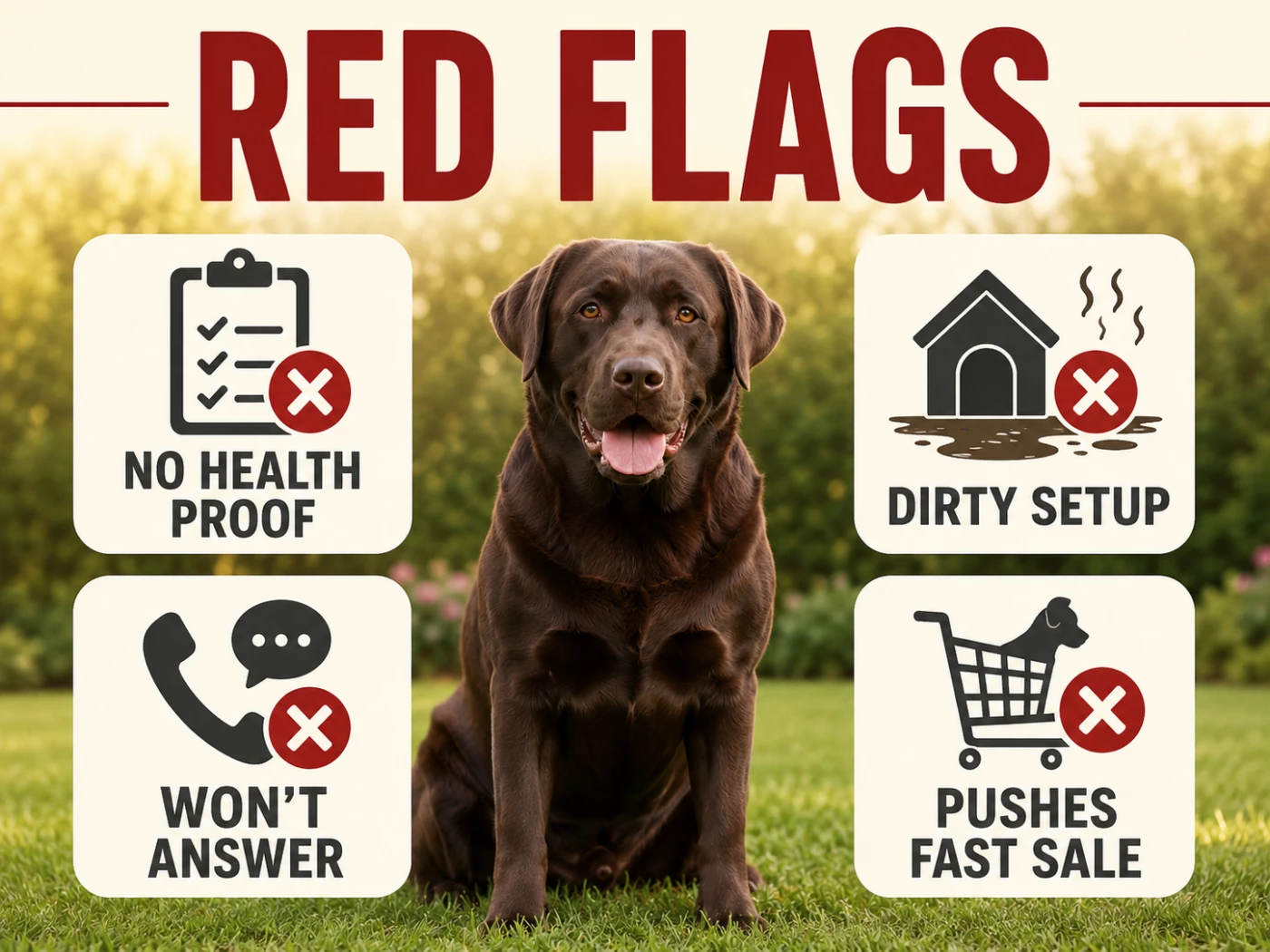
A responsible Labrador Retriever breeder should be ready to discuss health testing before you fall in love with a puppy photo. For this breed, the core conversation usually includes hip evaluations, elbow evaluations, an eye examination by a boarded veterinary ophthalmologist, and DNA testing for exercise-induced collapse. The Labrador Retriever health guide explains why those tests matter.
Ask to see records for both parents, not just the puppy’s vaccine card. A vaccine record tells you about basic puppy care. It does not show whether the breeding dogs were screened for orthopedic, eye, or inherited neuromuscular risks.
Good breeders do not treat these questions as rude. They expect them. If a seller says the parents are healthy but cannot provide documents, the buyer is being asked to accept risk without proof.
Before sending a deposit, compare each breeder against the same practical checklist. This keeps the decision focused on evidence instead of emotion.
A breeder does not become responsible just because one box is checked. The pattern matters. Strong health records paired with a messy contract, or a beautiful home setup with no parent testing, still leaves the buyer with avoidable risk.

A Labrador puppy’s first weeks shape how it responds to normal family life. Puppies raised with regular handling, household sounds, safe surfaces, and gentle new experiences often adjust more easily than puppies kept in isolated conditions with little human contact.
Ask to see the puppy’s environment through live video or an in-person visit. You do not need a staged tour. You need enough visibility to confirm that the puppies are clean, alert, housed safely, and interacting normally with people.
Be cautious if a seller refuses to show the living area, insists on meeting only in a parking lot, or sends only cropped photos. There can be legitimate privacy boundaries, but there should still be a way to verify that the puppy exists and is being raised in acceptable conditions.
Seeing the mother gives useful clues about temperament, body condition, and the breeder’s care standards. A tired mother with nursing puppies is normal. A fearful, aggressive, extremely thin, or poorly kept mother is a warning sign.
If the sire does not live on site, that is not automatically a problem. Many breeders use an outside stud. The breeder should still be able to explain why that male was chosen and provide his health documentation.
A written contract should explain what the buyer is receiving, what the breeder guarantees, and what happens if something goes wrong. It should cover health terms, return policy, registration status, spay or neuter expectations if any, and whether the breeder wants the dog returned if the buyer cannot keep it later.
Verbal promises are harder to prove and should be included in the written contract. If the breeder says a guarantee exists, it should be in the document. If the breeder says the deposit is refundable under certain conditions, that should be written too.
Do not let excitement push the contract to the end of the process. Read it before paying. A fair breeder will give you time to review the terms instead of demanding an immediate decision.
Registration papers can document pedigree, but they do not guarantee health, temperament, or breeder quality. A registered Labrador can still come from parents with no health testing. A polished website, a long social media page, or a high price also does not prove that the breeder is responsible.
Registration is one piece of the file. It should be evaluated alongside health records, contract terms, puppy environment, and the breeder’s willingness to answer direct questions.
Some warning signs are serious enough to slow down or walk away. One red flag does not always prove bad intent, but several together should make a buyer cautious.
A responsible Labrador breeder usually wants the puppy placed well, not just sold quickly. They may ask about your yard, children, work schedule, training plans, and experience with large active dogs. That is a good sign, not an inconvenience.
Labradors are friendly and trainable, but they are not automatically easy. Puppies can be mouthy, energetic, food-driven, and physically strong. A good breeder should be able to describe differences within the litter and help match a puppy to the buyer’s household. For realistic owner expectations, see the Labrador Retriever temperament and training guide.
Ask which puppies are bold, which are softer, which recover quickly from new sounds, and which are more intense around food or toys. The answer should sound specific. If every puppy is described with the same generic phrase, the breeder may not be observing them carefully.
A reputable Labrador breeder can show health records for the parents, explain the puppy’s veterinary care, provide a written contract, show where puppies are raised, and answer questions without pressure or defensiveness.
Ask for hip and elbow evaluations, an eye examination by a boarded veterinary ophthalmologist, and exercise-induced collapse DNA results. These are core Labrador-specific screening items buyers should expect to discuss.
It can be safe only if you verify the seller carefully. Use live video, written records, a clear contract, and traceable payment terms. Do not send money based only on photos, emotional pressure, or promises that cannot be documented.
A deposit can be normal, but the terms should be written before payment. The contract or receipt should say whether the deposit is refundable, what puppy it reserves, and what happens if the breeder cannot provide that puppy.
Choosing a Labrador Retriever breeder is not about finding the prettiest puppy photo. It is about verifying health testing, reading the contract, seeing how the puppies are raised, and choosing a seller who is transparent before money changes hands.
Price is only one part of the decision. For current listing ranges and first-year ownership costs, read the Labrador Retriever puppy cost guide.
AllinPets.com lets Labrador Retriever breeders list puppies for free and helps buyers browse available listings nationwide. You can browse current Labrador Retriever listings on AllinPets.
Written by the AllinPets Editorial Team.