
Long Read · 11 min
Labrador Retrievers are often described as sturdy, friendly, and dependable, but no popular breed is risk-free. Labs have several well-documented health concerns that buyers should understand before choosing a puppy, especially because the same cheerful, food-loving temperament that makes the breed so appealing can also hide early signs of pain, weight gain, or fatigue.
This guide does not replace veterinary care. It explains the main Labrador Retriever health risks, what breeder testing can reduce, and which symptoms deserve a prompt veterinary appointment or emergency care. For broader breed context, start with the complete Labrador Retriever breed guide.
Contents
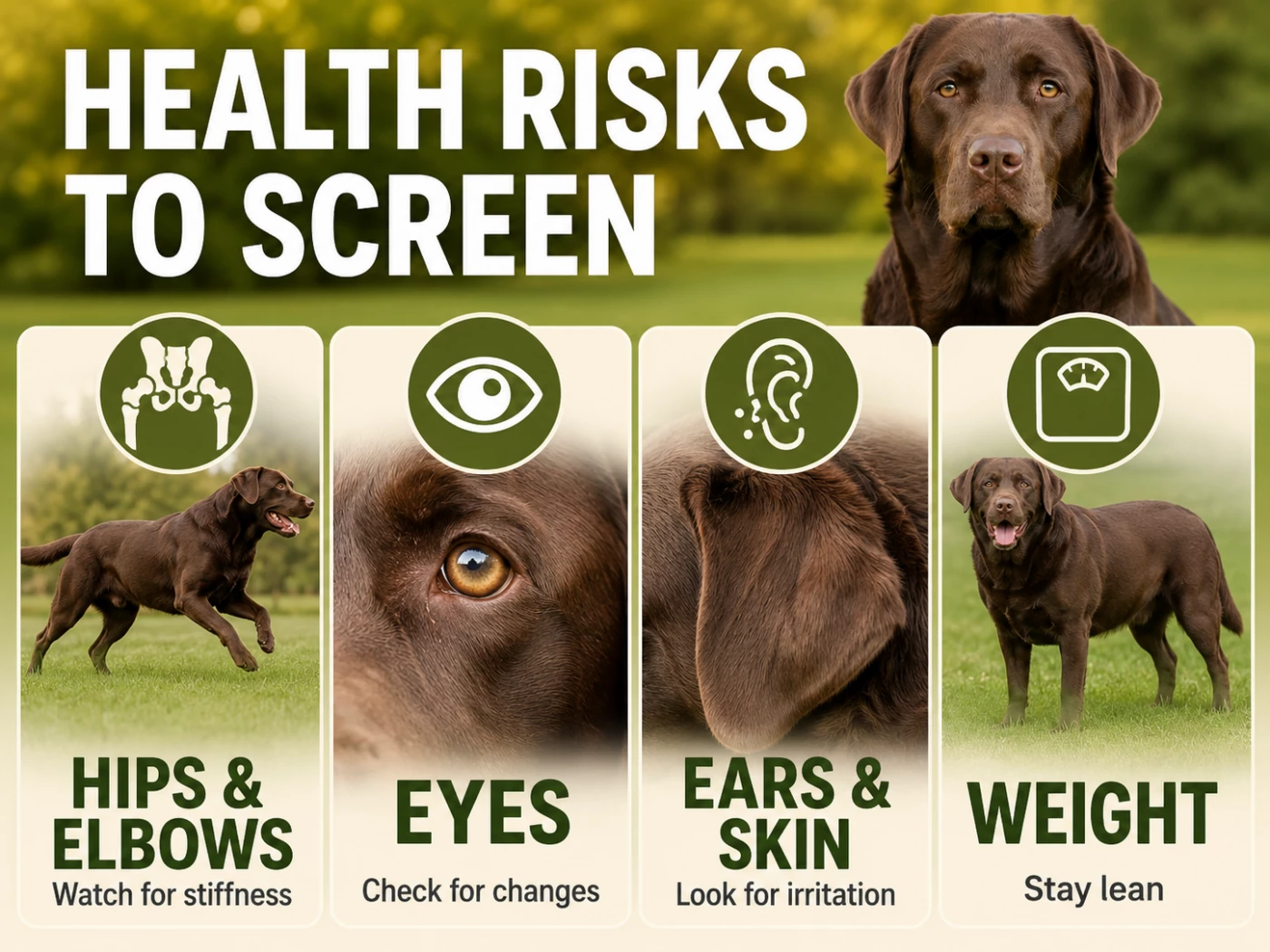
Hip dysplasia is one of the most important orthopedic risks in Labrador Retrievers. It happens when the ball and socket of the hip joint do not fit together correctly as the dog grows. Over time, the loose joint can lead to pain, reduced range of motion, and arthritis.
Genetics matter, but they are not the only factor. Fast growth, excess weight during puppyhood, and inappropriate exercise can all influence how early signs appear and how severe the problem becomes. A Lab with sore hips may avoid stairs, move stiffly after rest, bunny-hop while running, or become less willing to jump into a car.
Responsible Labrador breeders should screen breeding dogs before producing puppies. Buyers should ask for documented hip evaluations, not a verbal promise that the parents “move well” or “have never had problems.” Screening cannot guarantee a perfect puppy, but it reduces avoidable risk and shows that the breeder is making health decisions instead of guessing. The Labrador Retriever breeder guide explains how to ask for those records before paying a deposit.
Elbow dysplasia is another major developmental joint concern in Labs. It refers to a group of abnormalities in the elbow joint that can cause front-leg lameness and early arthritis. Because Labradors are active, strong, and often enthusiastic about play, front-leg pain can affect daily life quickly.
Signs can include limping after exercise, stiffness when rising, reluctance to run, or a head-bobbing gait. Some dogs show obvious lameness when young, while others compensate for a long time and are diagnosed later after arthritis has developed.
Elbow evaluations are part of the expected health-screening conversation for Labrador Retriever breeding dogs. A buyer should ask to see records for both parents. “The parents are athletic” is not the same as an orthopedic evaluation.
Exercise-induced collapse, often shortened to EIC, is an inherited neuromuscular condition documented in Labrador Retrievers. Affected dogs may look normal at rest and during mild activity, then develop weakness, an uncoordinated gait, or collapse after intense exercise and excitement.
Episodes are often associated with high-intensity retrieving, hard running, warm weather, or emotional excitement. Many dogs recover after rest, but repeated episodes are not something to ignore. Collapse during exercise can resemble other serious problems, so a veterinarian should evaluate the dog rather than assuming EIC from symptoms alone.
DNA testing can identify clear, carrier, and affected dogs. This is one reason EIC documentation matters when choosing a Labrador puppy. A responsible breeder should be able to explain the parents’ results and how the pairing avoids producing affected puppies.
Labradors can be affected by inherited eye conditions, including progressive retinal atrophy. Progressive retinal atrophy is a group of diseases in which the retina gradually deteriorates, often causing night blindness first and then worsening vision over time.
Early signs can be subtle. A dog may hesitate in dim light, bump into objects at night, or seem less confident in unfamiliar spaces. Because some inherited eye disease develops gradually, a normal-looking eye in a young dog is not enough proof that breeding dogs were properly screened.
Buyers should ask whether the parents have had a current eye examination by a boarded veterinary ophthalmologist. A regular wellness exam is useful, but it is not the same as a breed-appropriate ophthalmic screening for inherited eye disease.
Obesity is one of the most controllable Labrador Retriever health risks, and it deserves serious attention. Labs are famously food-motivated, and research has linked variants in the POMC gene with increased appetite and obesity risk in the breed.
This does not mean a Lab is doomed to become overweight. It means owners need a plan from the beginning. Free-feeding, frequent table scraps, and “just a little extra” treats can quickly turn into a long-term health problem because many Labs keep asking for food even when their body does not need more calories.
Excess weight increases stress on hips, elbows, and knees. It can also worsen heat intolerance, reduce stamina, complicate anesthesia, and make chronic disease harder to manage. For this breed, keeping the dog lean is not cosmetic. It is preventive care.
A healthy Lab should have a visible waist when viewed from above, and the ribs should be easy to feel under a light fat covering. Regular weigh-ins, measured meals, lower-calorie training rewards, and honest body-condition checks are more effective than guessing by appearance alone. Food and preventive care also affect the long-term budget, which is covered in the Labrador Retriever puppy cost guide.
Labradors have floppy ears and many love water, which can create a perfect setup for ear irritation. Moisture trapped in the ear canal after swimming or bathing can contribute to bacterial or yeast overgrowth, especially in dogs with allergies.
Warning signs include head shaking, scratching at the ear, redness, odor, discharge, or sensitivity when the ear is touched. Recurrent ear infections should not be treated as a normal part of owning a Lab. They often point to an underlying issue such as allergy, moisture management, or chronic inflammation.
Skin problems can also occur in the breed. Hot spots, itchiness, paw licking, recurrent skin infections, and coat changes all deserve veterinary attention when they persist. Because allergies, parasites, infections, and endocrine problems can look similar, guessing at home can delay the right treatment.
The official Labrador Retriever colors are black, yellow, and chocolate. Color alone should not be treated as a health diagnosis, but buyers should understand the difference between a standard color and a responsible breeding program.
A large UK health-record study reported shorter median lifespan and higher rates of some ear and skin problems in chocolate Labradors compared with black and yellow Labs. This does not mean every chocolate Lab will be unhealthy. It does mean a buyer interested in a chocolate puppy should pay close attention to the breeder’s health testing, depth of pedigree, and overall selection priorities.
A breeder who markets color as the main selling point while avoiding health documentation is not a good sign. In Labradors, health screening should lead the conversation. Color should come after structure, temperament, and documented parent testing.
Cranial cruciate ligament disease affects the knee and is a common cause of hind-leg lameness in dogs. Labradors are one of the breeds owners should watch carefully, especially when the dog is overweight or highly active.
Signs can include sudden limping after play, toe-touching on one back leg, stiffness after rest, or reluctance to jump. Some injuries are sudden, but many cruciate problems develop from gradual ligament degeneration rather than one dramatic accident.
A veterinarian should examine a Lab with new hind-leg lameness. Resting the dog for a few days may reduce symptoms temporarily, but it does not confirm the cause or prevent long-term joint damage.
Hypothyroidism occurs when the thyroid gland does not produce enough hormone. In Labradors, owners may notice unexplained weight gain, low energy, a dull coat, thinning hair, recurrent skin issues, or sensitivity to cold.
The condition is usually diagnosed with blood testing and managed with lifelong medication when confirmed. The challenge is that early signs can look like normal aging or simple overfeeding. If a Lab gains weight despite measured meals and normal activity, a veterinary check is a better response than just cutting food again and again.
Senior Labradors are among the dogs veterinarians commonly associate with laryngeal paralysis. In this condition, structures around the airway do not open normally during breathing, which can make exercise and heat more dangerous.
Early signs can include a changed bark, noisy breathing, gagging, reduced stamina, or distress during warm weather. Because older Labs can also have arthritis, weight gain, or heart disease, owners may mistake reduced activity for ordinary aging.
A senior Lab with new noisy breathing, sudden exercise intolerance, or breathing distress should be examined by a veterinarian. Heat, excitement, and hard exercise can worsen symptoms, so owners should avoid pushing through breathing changes.
Gastric dilatation-volvulus is a life-threatening emergency. It occurs when the stomach fills with gas and may twist, cutting off blood flow and rapidly becoming fatal without urgent treatment. Labradors are not the highest-risk breed, but they are large enough that owners should know the signs.
Warning signs can include repeated unproductive retching, excessive drooling, restlessness, pacing, a swollen or tight abdomen, weakness, collapse, or signs of severe discomfort. This is not a “wait until morning” situation. A dog showing these signs needs emergency veterinary care immediately.
Many Labradors live active, happy lives, but the breed has important risks including hip dysplasia, elbow dysplasia, obesity, inherited eye disease, exercise-induced collapse, ear problems, and some age-related conditions. Good breeding and proactive ownership reduce risk but do not remove it entirely.
A responsible Labrador breeder should be able to show documented hip and elbow evaluations, a current eye exam by a boarded veterinary ophthalmologist, and DNA testing for exercise-induced collapse. Other tests may also be relevant depending on the breeding line.
Many Labs are highly food-motivated, and research has linked POMC gene variants with increased appetite and obesity risk in the breed. Owners should use measured meals, structured treats, regular weigh-ins, and body-condition scoring.
Color alone does not determine an individual dog’s health. However, a large UK study reported shorter median lifespan and higher rates of some ear and skin problems in chocolate Labradors, so buyers should be especially careful to verify health testing instead of choosing only by color.
Repeated unproductive retching, a swollen abdomen, collapse, severe breathing distress, sudden weakness, or extreme pain should be treated as urgent. These signs can point to conditions that cannot safely wait for a routine appointment.

The best health plan for a Labrador starts before purchase. Choose a breeder who can show real documentation, not vague reassurance. Once the dog is home, keep growth steady, maintain lean body condition, use appropriate exercise, dry the ears after swimming, and treat limping, eye changes, breathing changes, or collapse as reasons to call a veterinarian.
Training and daily routine also affect health because overexcitement, poor recall, and unmanaged exercise can increase risk. For behavior and routine planning, see the Labrador Retriever temperament and training guide.
AllinPets.com lets Labrador Retriever breeders list puppies for free and helps buyers browse available listings nationwide. You can browse current Labrador Retriever listings on AllinPets.
This article is for informational purposes only and does not replace professional veterinary advice. Always consult a licensed veterinarian about your pet's health.
Written by the AllinPets Editorial Team.