Short Read · 6 min
A Labrador Retriever’s reputation as a friendly family dog is mostly earned, but it can mislead new owners. A Lab is not a low-effort couch dog just because the breed is sweet. Most Labradors are social, physical, food-driven, and slow to mature, which means the right home gets a wonderful companion and the wrong home gets a large teenager with a tail like a broom handle.
The good news is that the same traits that create early chaos also make Labs highly trainable. They usually want to work with people, respond well to rewards, and enjoy games that combine movement, food, and attention. For the full breed overview, see the complete Labrador Retriever breed guide.
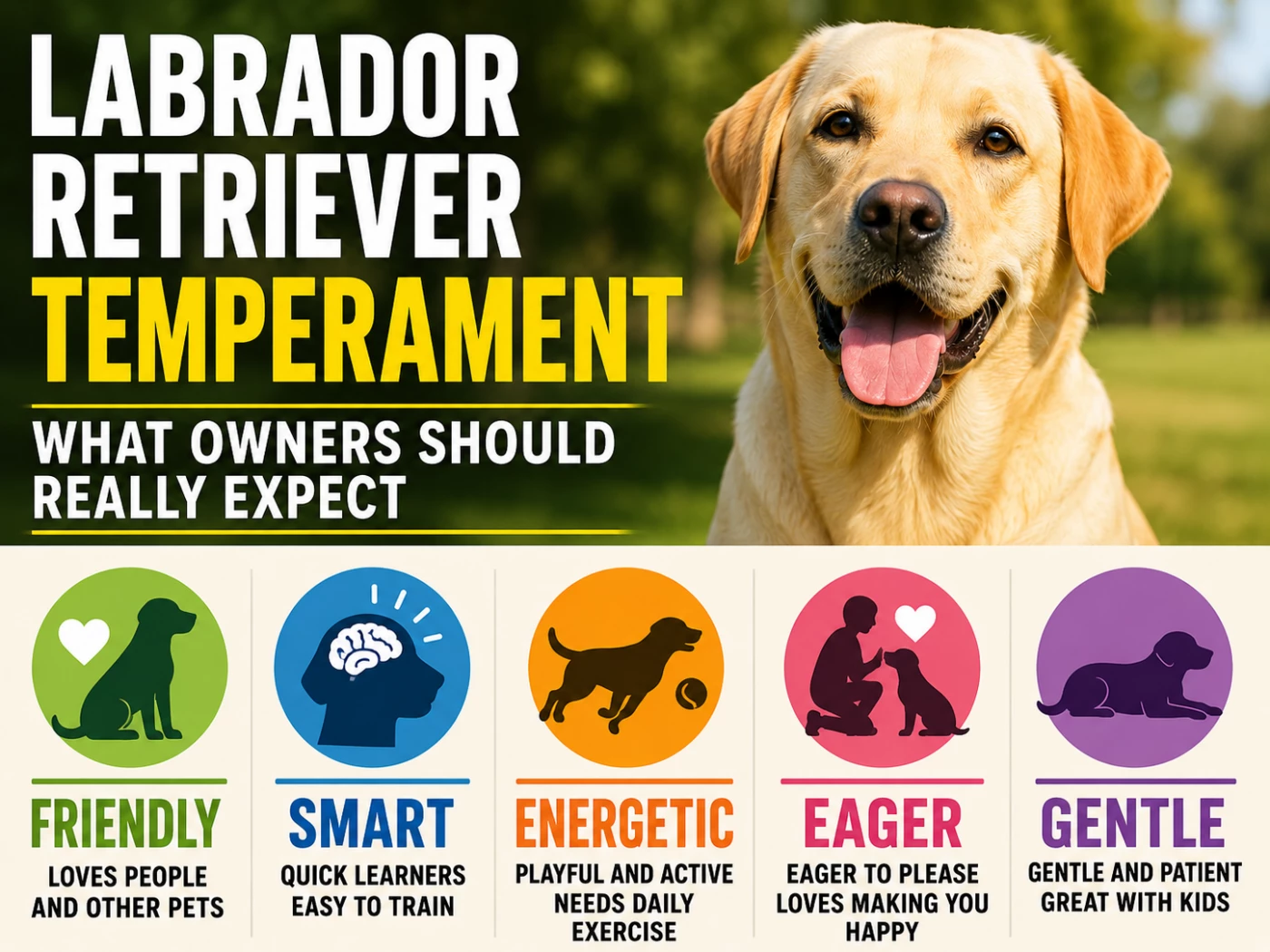
Well-bred, well-socialized Labrador Retrievers are typically friendly, outgoing, and people-oriented. They are more likely to greet a visitor with enthusiasm than suspicion, which is one reason they are common as family companions, service dogs, therapy dogs, and public-facing working dogs.
This friendliness has limits. A Labrador still needs socialization, training, supervision, and structure. A poorly raised Lab can become pushy, anxious, destructive, or overexcited, even if the breed standard describes the ideal dog as kind and outgoing.
Labs are usually not serious guard dogs. Some will bark when someone comes to the door, but many would rather make a new friend than protect the house. Buyers who want a naturally suspicious protection breed are usually looking in the wrong place.
A young Labrador is often more energetic than buyers expect. Puppies and adolescents can jump, mouth, steal socks, grab food, pull on leash, and slam into people during play. Much of this is not aggression. It is size, enthusiasm, and weak impulse control.
Many Labs remain puppyish for roughly the first two years, and some field-line dogs stay intense longer. Field-bred Labradors may need more structured work, retrieving, scent games, and outdoor time than a family expecting a relaxed pet realizes.
Exercise matters, but exercise alone does not create a calm Lab. A dog that gets long walks but no mental work may still invent its own entertainment. Short training sessions, food puzzles, scent games, controlled retrieves, and calm-place practice are often more useful than simply trying to tire the dog out.
Labradors are usually very trainable because they like food, attention, and interaction. That does not mean they train themselves. A Lab learns whatever gets rewarded, including jumping on guests, stealing from counters, pulling toward people, or barking for attention.
Reward-based training works especially well with this breed. Food rewards, praise, toys, and access to things the dog wants can be used to teach polite greetings, leash manners, recall, drop it, leave it, and calm behavior around meals.
Harsh corrections are not necessary for normal training and can create stress or conflict. When a Labrador ignores a cue, the first question should not be “Is this dog stubborn?” It should be “Was the cue clear, was the environment too difficult, was the reward strong enough, and has the dog practiced this skill here before?”
Labradors are often excellent family dogs, but “good with kids” does not mean safe without supervision. A happy adult Lab can knock over a small child by accident. A mouthy puppy can scare a child even when the puppy is only playing.
Children should learn not to climb on the dog, grab ears, take food, disturb sleep, or bother the dog in a crate. The dog should learn calm greetings, gentle mouth behavior, and how to settle away from the action. Family success comes from training both sides, not assuming the breed will handle everything automatically.
Many Labs do well with other dogs, especially when they are introduced gradually and have enough space, exercise, and management. Their play style can be physical, so some smaller or softer dogs may find a young Lab overwhelming.
Labs can also live with cats when introductions are slow and supervised. Some individuals have stronger chase instincts, especially around fast movement, so a cat should have escape routes and high resting places. Friendly intent is not enough if the dog is large, excited, and untrained.
Labradors are not usually known as extreme barkers, but they can bark for visitors, excitement, boredom, frustration, or attention. A Lab that barks from the window all day may need more management, enrichment, and rest, not just correction.
Persistent barking should be treated as information. Is the dog under-exercised? Is it anxious when left alone? Is it rehearsing alert barking at every passerby? Is the owner accidentally rewarding noise with attention? The answer determines the training plan.
Labradors were developed as retrievers, so many have a strong desire to carry, chase, and bring things back. This can be useful in training, but it also explains why puppies steal laundry, grab shoes, or parade around with objects they should not have.
Teach drop it, trade, leave it, and calm retrieving early. Chasing a Lab around the house for stolen items often turns the behavior into a game. Trading for a treat or toy usually works better and keeps the dog from learning to guard objects.
Labradors are social dogs, and many dislike being isolated for long stretches. That does not mean every Lab has separation anxiety, but it does mean alone-time training should begin gradually.
Short practice absences, crate or safe-room training, calm departures, and food-stuffed toys can help a puppy learn that being alone is normal. A Lab that has never practiced being alone may struggle when the owner suddenly returns to work or leaves for a full day.
If a dog panics, destroys exits, drools heavily, injures itself, or cannot settle when left alone, the issue may be separation-related distress and should be handled with professional guidance rather than punishment.
A Labrador can live in an apartment if the owner provides daily exercise, training, bathroom breaks, and mental enrichment. The challenge is not the square footage alone. It is whether the dog has enough outlets and whether the owner can manage noise, jumping, stairs, and leash manners in shared spaces.
Elevators, hallways, neighbors, and busy sidewalks can be difficult for an adolescent Lab without training. Apartment owners should prioritize leash skills, calm greetings, mat training, and a realistic schedule for outdoor time.
Many Labradors are excellent with children, but supervision is still necessary. The biggest risk is often enthusiasm rather than aggression, especially with young dogs that jump, mouth, or play roughly.
Most Labradors are easier to train than many breeds because they are social and food-motivated. They still need consistency. Without training, the same food drive can turn into counter-surfing, stealing, jumping, and begging.
Labradors are not usually considered heavy barkers, but they can bark from excitement, boredom, alerting, or separation-related stress. Persistent barking is usually a management and training issue, not just a breed trait.
Many Labs can live with cats when introductions are slow, supervised, and structured. Individual prey drive varies, so the cat should have safe escape routes and the dog should learn calm behavior before free access.
Many Labs become noticeably easier after adolescence, often around two years old, but maturity varies. Training, routine, exercise, and mental enrichment matter more than simply waiting for age to fix everything.
A Labrador Retriever is a strong match for owners who want a friendly, active, trainable dog and are ready to put in daily work during puppyhood and adolescence. The breed is less ideal for people who want a naturally quiet, low-energy dog or a dog that will guard the home without training.
Before choosing a puppy, compare temperament fit with health documentation and seller quality. The Labrador Retriever health guide, Labrador Retriever breeder guide, and Labrador Retriever puppy cost guide cover those parts of the decision.
AllinPets.com lets Labrador Retriever breeders list puppies for free and helps buyers browse available listings nationwide. You can browse current Labrador Retriever listings on AllinPets.
Written by the AllinPets Editorial Team.