Long Read · 18 min
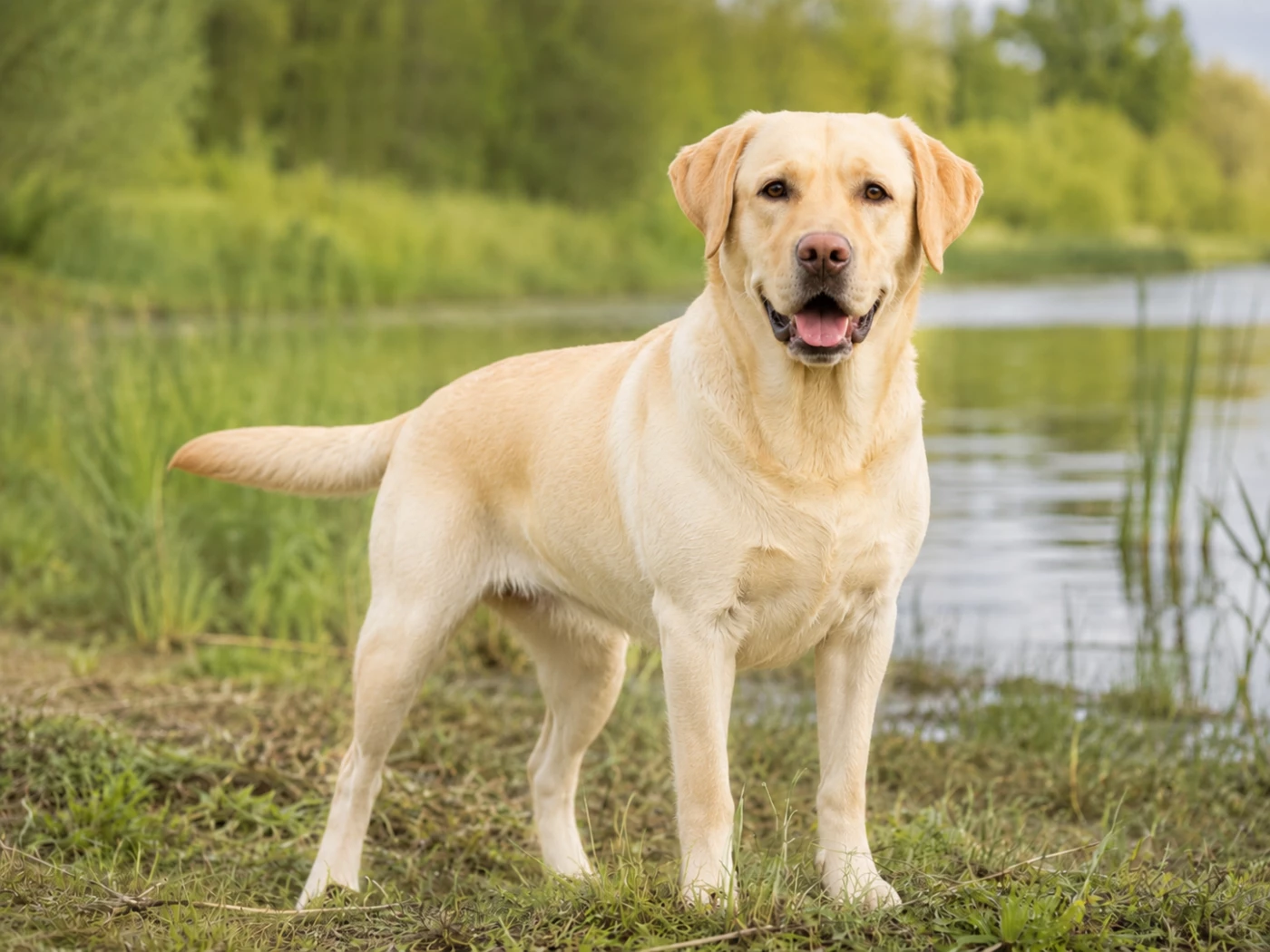
The Labrador Retriever is a medium-to-large sporting dog built for work, water, food rewards, and close cooperation with people. That combination explains why Labs fit so many American homes: they are usually friendly, trainable, confident, and deeply people-oriented. It also explains why the breed is not as easy as its reputation sounds. A Labrador that gets enough exercise, training, food control, and structure can be one of the best family dogs in the world.
A Lab that is left bored, overfed, and under-trained can become a large, noisy, destructive problem.
This guide gives you the practical version: temperament, size, exercise needs, coat care, health risks, cost, breeder checks, and the kind of home where a Labrador actually thrives.
Contents
| Trait | Detail |
|---|---|
| Breed type | Medium-to-large sporting retriever |
| Origin | Developed from Newfoundland working water dogs and refined in Britain |
| AKC group | Sporting Group |
| Male size | 22.5–24.5 inches; about 65–80 lb in working condition under the AKC Labrador Retriever standard |
| Female size | 21.5–23.5 inches; about 55–70 lb in working condition under the AKC standard |
| Coat colors | Black, yellow, and chocolate are the standard Labrador colors |
| Coat type | Short, dense, weather-resistant double coat with heavy shedding |
| Typical fit | Active families, outdoorsy owners, training-focused homes, and people who want a social dog |
| Main challenge | High food motivation, obesity risk, strong exercise needs, and slow maturity |
The Labrador Retriever did not begin in Labrador. The breed's ancestors were working water dogs from Newfoundland, where they helped fishermen retrieve lines, fish, and gear from cold water. British sportsmen imported these dogs in the 1800s and developed them into the modern retriever used for field work, shooting sports, and later service work. The American Kennel Club recognized the Labrador Retriever in 1917.
That working history still shows in ordinary pet Labs. The dense coat, strong swimming instinct, broad head, carrying behavior, and love of retrieving are not random traits. They are pieces of the original job. A Lab that constantly brings you toys, shoes, socks, or anything it can carry is not being strange. It is using a retriever brain.
Owners often hear about English Labs and American Labs. These are informal terms, not separate breeds. English-style or show-line Labs are often stockier and calmer in build and expression. American-style or field-line Labs are often leaner, faster, and more intense. There is overlap, and every dog is an individual, but the difference matters when choosing a puppy. A field-line Lab can be too much dog for a quiet household that only wants a couch companion.
Labradors are usually friendly, outgoing, and eager to be involved. A well-bred, well-socialized Lab tends to greet people with confidence rather than suspicion, which is one reason the breed is so common in family homes and public-facing working roles. That same friendliness means most Labs are not natural guard dogs. They may bark when someone arrives, but many are more likely to welcome a visitor than challenge one.
The breed's strength is cooperation. Labs usually want to work with people, and their food motivation makes training easier when the owner is consistent. They can learn household manners, recall, leash skills, retrieving games, and sports quickly. The catch is that a smart, hungry, social dog also learns bad habits quickly. Counter-surfing, jumping, stealing food, chewing shoes, and pulling on leash can become rehearsed behaviors if they are rewarded even a few times. For a deeper owner-focused breakdown, see the Labrador Retriever temperament and training guide.
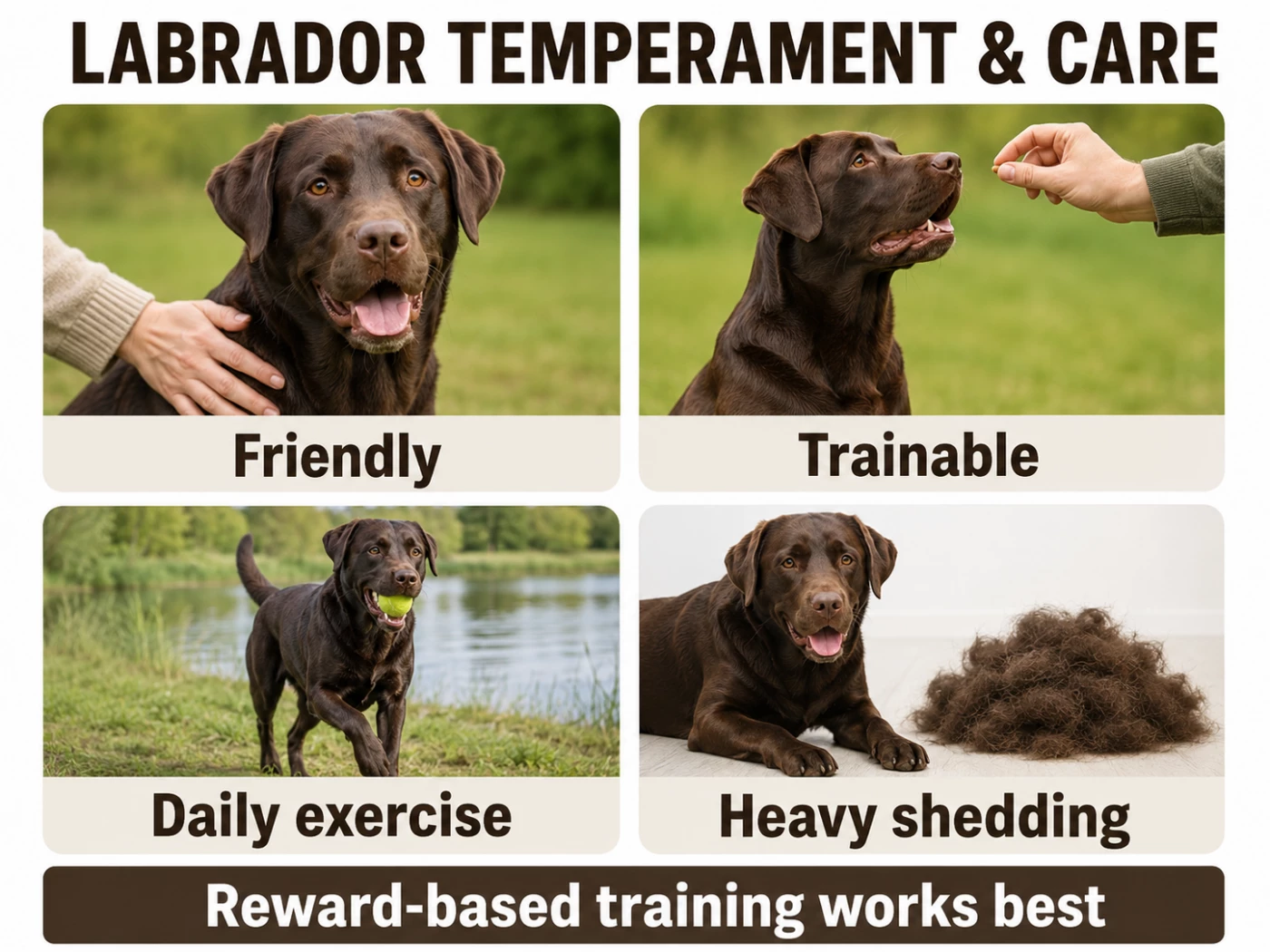
A young Labrador is not a calm dog in a large body. Many Labs stay puppyish for two years or more, and adolescent Labs can be especially physical. They may jump, mouth, crash into people, steal objects, and race through the house when they are under-exercised or overexcited. This is not a sign that the breed is bad. It is a sign that the owner needs to manage energy, reward calm behavior, and teach clear rules early.
Exercise alone is not enough. Labs need mental work too. Short reward-based training sessions, scent games, retrieving drills, food puzzles, loose-leash practice, and calm settle training usually do more for the dog than simply letting it run wild in the yard. A tired Lab should be tired in the brain, not only in the legs.
Labs respond best to reward-based training because the breed is highly motivated by food, play, praise, and access to activity. The American Veterinary Society of Animal Behavior recommends reward-based methods and warns against aversive training because of welfare and behavior risks. For a Labrador, harsh corrections can also create conflict around food, objects, or excitement when the real issue is poor impulse control.
When a Lab ignores a cue, do not assume the dog is being intentionally stubborn. More likely explanations include distraction, a cue that was never fully proofed, an environment that is too exciting, unclear timing, insufficient reward history, fear, fatigue, pain, or discomfort. Good training asks what the dog understood and what the situation rewarded.
Well-socialized Labradors are often excellent with children, but they are not automatically safe just because they are friendly. A happy 70-pound dog can knock over a toddler by accident. Children should not climb on the dog, grab food, pull ears, or disturb sleep. The best family Labs learn calm greetings, gentle mouth behavior, leash manners, and how to settle while life happens around them.
Most Labs can live well with other dogs, and many live peacefully with cats when introduced carefully. Some individuals have stronger chase drive, especially around small animals that run. Introductions should be gradual, supervised, and managed with gates or leashes when needed. A breed reputation is useful background; it is not a substitute for reading the individual dog.
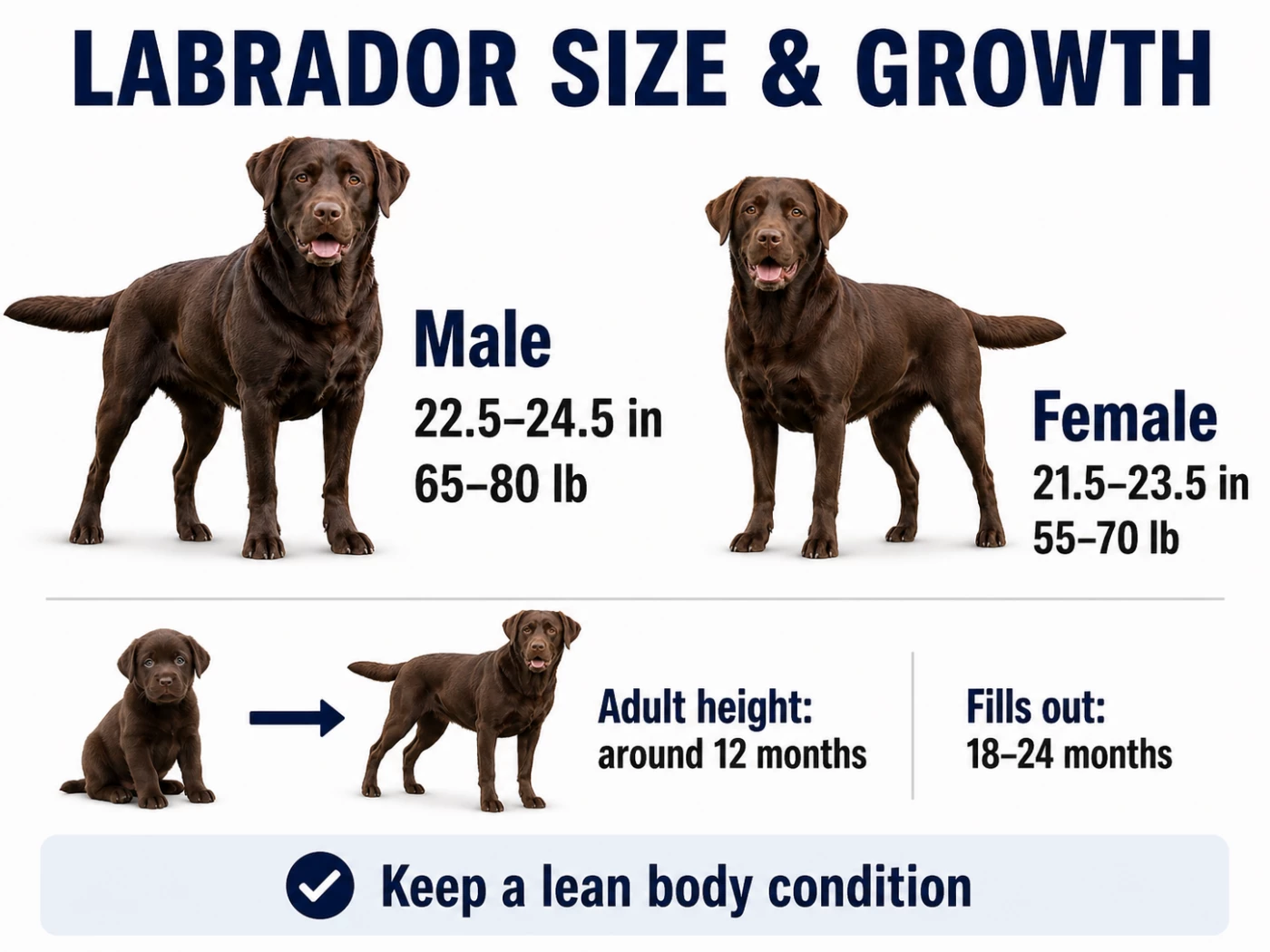
Under the AKC standard, male Labradors stand 22.5 to 24.5 inches at the shoulder and weigh about 65 to 80 pounds in working condition. Females stand 21.5 to 23.5 inches and weigh about 55 to 70 pounds. Pet Labs can fall outside those ranges, but a larger number on the scale is not automatically better. The healthiest Lab is the one with an appropriate body condition for its frame.
Most Labradors reach much of their adult height by around one year, but many continue filling out through 18 to 24 months. Males, in particular, may look leggy before they gain mature chest width and muscle. This is normal. Do not rush a young Lab into a heavy body by overfeeding.
Be cautious with month-by-month growth charts. They can be helpful as rough orientation, but they are not official breed standards and often give false precision. Frame size, sex, line, diet, and health all matter. A better rule is body condition. You should be able to feel the ribs under a light fat layer, see a waist from above, and see a slight abdominal tuck from the side. If you cannot feel the ribs easily, your Lab is probably too heavy even if the scale number looks normal.
A healthy adult Labrador usually needs serious daily activity, not just access to a backyard. Brisk walking, swimming, fetch, hiking, field-style retrieving games, scent work, and structured training all help. Young field-line Labs may need more than the average family expects. Without enough activity, the breed often creates its own entertainment through chewing, digging, barking, food theft, or rough play.
Puppy exercise needs more care. Avoid forced long-distance running, repetitive jumping, and hard landings while the dog is still growing. Large-breed puppies need movement, play, and controlled exploration, but not a human fitness program. Build intensity gradually as the dog matures.
The Labrador coat is simple but not low-shedding. The short double coat sheds all year and sheds heavily during seasonal coat changes. Weekly brushing helps; daily brushing during heavy shedding helps more. Bathing should be occasional, not constant, because over-bathing can dry the skin and strip natural coat oils.
Routine care matters more than fancy grooming. Check ears after swimming or bathing, keep nails short, brush teeth regularly, and teach the dog to accept handling while young. Labs are floppy-eared water dogs, so ear moisture and wax should not be ignored. If the ear smells bad, looks red, produces discharge, or the dog shakes its head repeatedly, veterinary care is the right next step.
Labradors are generally sturdy dogs, but the breed has several important health risks that buyers should understand before choosing a puppy. The goal is not to scare owners. The goal is to know what to screen for, what to manage, and when to call a veterinarian. The separate Labrador Retriever health guide covers these risks in more detail.
Hip dysplasia and elbow dysplasia are major orthopedic concerns in Labradors. Both involve abnormal joint development that can lead to pain, lameness, and arthritis. Genetics matter, but growth rate, weight, nutrition, and exercise management also influence how orthopedic problems appear. Responsible breeders screen breeding dogs before producing litters.
The Labrador Retriever Club lists hip evaluation, elbow evaluation, eye examination, exercise-induced collapse DNA testing, and D Locus DNA testing among its recommended health clearances. Buyers should ask for actual results, not just a verbal promise that the parents are healthy.
Obesity is one of the most important Labrador health issues because it affects almost everything else: joints, stamina, anesthesia risk, heat tolerance, and lifespan. Labs are famous for acting hungry, and research helps explain why. Cambridge researchers have identified POMC-related genetic variants associated with appetite, weight, and obesity risk in Labradors. In practical terms, some Labs really do feel more driven by food than the average dog.
The owner's job is not to feed the begging. It is to manage the dog kindly and consistently. Measure meals, limit treats, use part of the daily ration for training, choose lower-calorie rewards when needed, and track body condition every week. The Purina Labrador life span study found that lean-fed Labs lived longer and had delayed onset of some age-related problems compared with their littermates that were fed more. For this breed, staying lean is not cosmetic. It is health care.
Exercise-induced collapse, often shortened to EIC, is a genetic condition seen in Labradors. Affected dogs can appear normal at rest but develop weakness, poor coordination, or collapse after intense, excited exercise. A DNA test can identify clear, carrier, and affected dogs. Responsible breeding uses this information to avoid producing affected puppies.
Labradors can be affected by inherited eye conditions, including forms of progressive retinal atrophy. These conditions can gradually damage vision and, in some cases, lead to blindness. Breeding dogs should have appropriate eye examinations, and many breeders also use DNA tests for known inherited risks. A puppy buyer should ask which eye tests were performed and whether the results are public or documented.
Ear infections and skin problems are common practical issues for many Labs. Swimming, allergies, floppy ears, moisture, and skin sensitivity can all contribute. Chocolate Labs deserve a specific note: a large UK VetCompass study reported shorter median lifespan and higher rates of ear and skin disease in chocolate Labradors compared with black and yellow Labradors. That does not mean every chocolate Lab will be unhealthy. It means color-focused breeding can narrow the gene pool, and buyers should be especially careful about health testing and breeder quality.
Emergency alert: Gastric dilatation-volvulus, or GDV, is a life-threatening emergency in which the stomach expands with gas and may twist. Labradors are not the highest-risk breed, but they are large, deep-chested enough that owners should know the signs. The Merck Veterinary Manual lists signs such as nonproductive retching, excessive salivation, restlessness, abdominal distention, depression, and collapse.
If your Lab has a swollen belly, tries to vomit without producing anything, drools, paces, or suddenly looks weak and painful, go to an emergency veterinarian immediately.
This article is for informational purposes only and does not replace professional veterinary advice. Always consult a licensed veterinarian about your pet's health.
A Labrador can be a wonderful family dog when the household wants an active companion. The breed usually enjoys people, visitors, games, car rides, outdoor time, and participation in daily life. Labs often do best in homes where someone is willing to train, walk, play, and manage food rules every day.
With children, the key issue is usually impulse control rather than aggression. Teach the dog not to jump, not to snatch food from small hands, and not to mouth during play. Teach children to respect the dog too. No ear pulling, no sitting on the dog, no teasing with food, and no bothering the dog while it eats or sleeps.
With other pets, Labradors are often easier than many breeds, but introductions still matter. A Lab that has never learned calm behavior around cats may chase simply because chasing is exciting. Use barriers, leashes, rewards for calm behavior, and slow exposure. Do not rely on "he is friendly" as a safety plan.
Can a Labrador live in an apartment? Yes, but only with an owner who takes the exercise seriously and with a lease that allows a dog of this size. A yard is helpful but not magic. A bored Lab in a yard can still bark, dig, and destroy things. A well-exercised Lab in an apartment can be calm. The difference is not the floor plan. It is the routine.
The purchase price is only one part of owning a Labrador. Food, vet care, parasite prevention, training, grooming tools, replacement toys, insurance, and emergency savings all matter because this is a large, active breed. The full Labrador Retriever puppy cost guide breaks down the current listing snapshot and first-year budget in more detail.
A live AllinPets listing snapshot on July 4, 2026 showed 25 Labrador Retriever ads. All 25 displayed a price. The visible range was $200 to $2,800, with listings across California, Florida, Illinois, Kentucky, New York, North Carolina, Ohio, Oregon, and Texas. This is not a national average and should not be treated as a market statistic. It is a current platform snapshot, and small samples can include rescues, discounted puppies, regional differences, duplicates, or outliers.
| Cost area | What to expect |
|---|---|
| Purchase price | Can vary widely by region, health testing, pedigree, age, color demand, and seller quality |
| First-year veterinary care | Puppy exams, vaccines, deworming, parasite prevention, possible spay or neuter, and unexpected visits |
| Food | A major ongoing cost because adult Labs are medium-to-large dogs with strong appetites |
| Training | Group classes, private help if needed, and time spent building manners during adolescence |
| Gear | Crate, bed, leash, harness, bowls, nail tools, brushes, toys, chews, and replacement items |
| Insurance or emergency fund | Useful because orthopedic issues, swallowed objects, ear problems, and emergencies can become expensive |
Very cheap Labrador puppies can cost more later if health testing, early socialization, vaccines, or documentation were skipped. A high price is not proof of quality either. The right question is not only "How much is the puppy?" It is "What does this price include, and what proof supports the breeder's claims?"
The best Labrador purchase starts before you fall in love with a puppy photo. Good breeders and sellers are transparent. They can explain the parents, the health testing, the puppy's environment, the contract, and what happens if the dog cannot stay with the buyer later. For a deeper checklist, read how to choose a Labrador Retriever breeder.
Red flags include always-available puppies, pressure to pay immediately, refusal to show the living environment, no health paperwork, vague claims about "champion bloodlines," multiple unrelated breeds sold at the same time, and a seller who asks nothing about your home. Registration alone does not prove health, temperament, or breeder quality. A pretty website does not prove it either.
Verbal promises are harder to prove and should be included in the written contract. If the seller promises a health guarantee, return policy, registration, vaccination record, or specific rights, get it in writing before money changes hands.
| Good fit if you... | Likely to struggle if you... |
|---|---|
| Want an active, social, trainable dog | Want a calm dog that needs little daily effort |
| Can manage food strictly and keep the dog lean | Prefer free-feeding or give in easily to begging |
| Can handle shedding, mud, water, and dog hair | Need a tidy, low-shedding home |
| Enjoy walking, training, fetch, swimming, or outdoor activity | Are away for long hours and cannot provide exercise |
| Want a family dog with strong people focus | Want a natural guard dog or highly independent dog |
| Are ready for puppy and adolescent chaos | Expect a young dog to be calm without training |
The honest summary is simple. A Labrador is easy to love and easy to underestimate. The breed gives back a lot: affection, trainability, humor, confidence, and companionship. But the owner must bring structure. Exercise, food control, early manners, health screening, and patience through adolescence are not optional extras. They are the price of getting the best version of the breed.
Because Labradors are popular, buyers can usually find puppies, young dogs, and adults through many channels. That availability is useful, but it also attracts careless sellers. Compare more than one option. Look at health testing, not only price. Ask how the puppies are raised. Notice whether the seller is willing to slow down and answer questions.
AllinPets.com lets Labrador Retriever breeders list puppies for free and helps buyers browse available listings nationwide. You can browse Labrador Retriever listings on AllinPets and compare puppies by location, sex, price, age, and seller details as inventory changes.
If you are not set on a young puppy, also consider Labrador rescues and shelters. Adult Labs can be a smart choice for families that want a known size, clearer temperament, and sometimes a dog that is already housetrained. Whether you buy or adopt, the same rule applies: choose the source carefully, ask for records, and make sure the dog fits your real lifestyle.
Labrador ownership changes by climate, housing, and local rules. For local buying and care notes, see the Labrador guides for New York, California, Illinois, Florida, and Texas.
Yes, Labrador Retrievers are often excellent family dogs when they get enough exercise, training, and supervision around small children. Their main family-life issue is usually enthusiasm, not aggression. A young Lab may jump, mouth, or knock over a toddler unless manners are taught early.
Most adult Labradors need a serious daily routine that includes walking, play, training, and mental work. A short bathroom walk is not enough for many Labs, especially young or field-line dogs. Swimming, fetch, scent games, hiking, and reward-based training all help.
Yes. Labradors have a short double coat that sheds year-round and sheds more heavily during seasonal coat changes. Weekly brushing helps, but owners should still expect hair on floors, furniture, clothing, and car seats.
Generally, yes. Labs are usually food-motivated and people-focused, which makes reward-based training effective. They still need consistency. A Lab that is not trained early can become strong, pushy, and difficult on leash simply because it rehearsed bad habits.
Prices vary by region, age, health testing, pedigree, color demand, and seller quality. A July 4, 2026 AllinPets snapshot showed 25 visible Labrador Retriever listings ranging from $200 to $2,800. That is a platform snapshot, not a national average.
At minimum, ask for hip and elbow evaluations, an eye examination by a veterinary ophthalmologist, and DNA testing for exercise-induced collapse. Many responsible breeders also test for inherited eye disease and other breed-relevant conditions. Ask to see the actual documents or public database records.
Yes, but only if the owner provides daily exercise, training, and enrichment and the building allows a dog of that size. A Labrador does not require a huge yard, but it does require a real routine. Without one, apartment living can become noisy and stressful.

Written by the AllinPets Editorial Team.