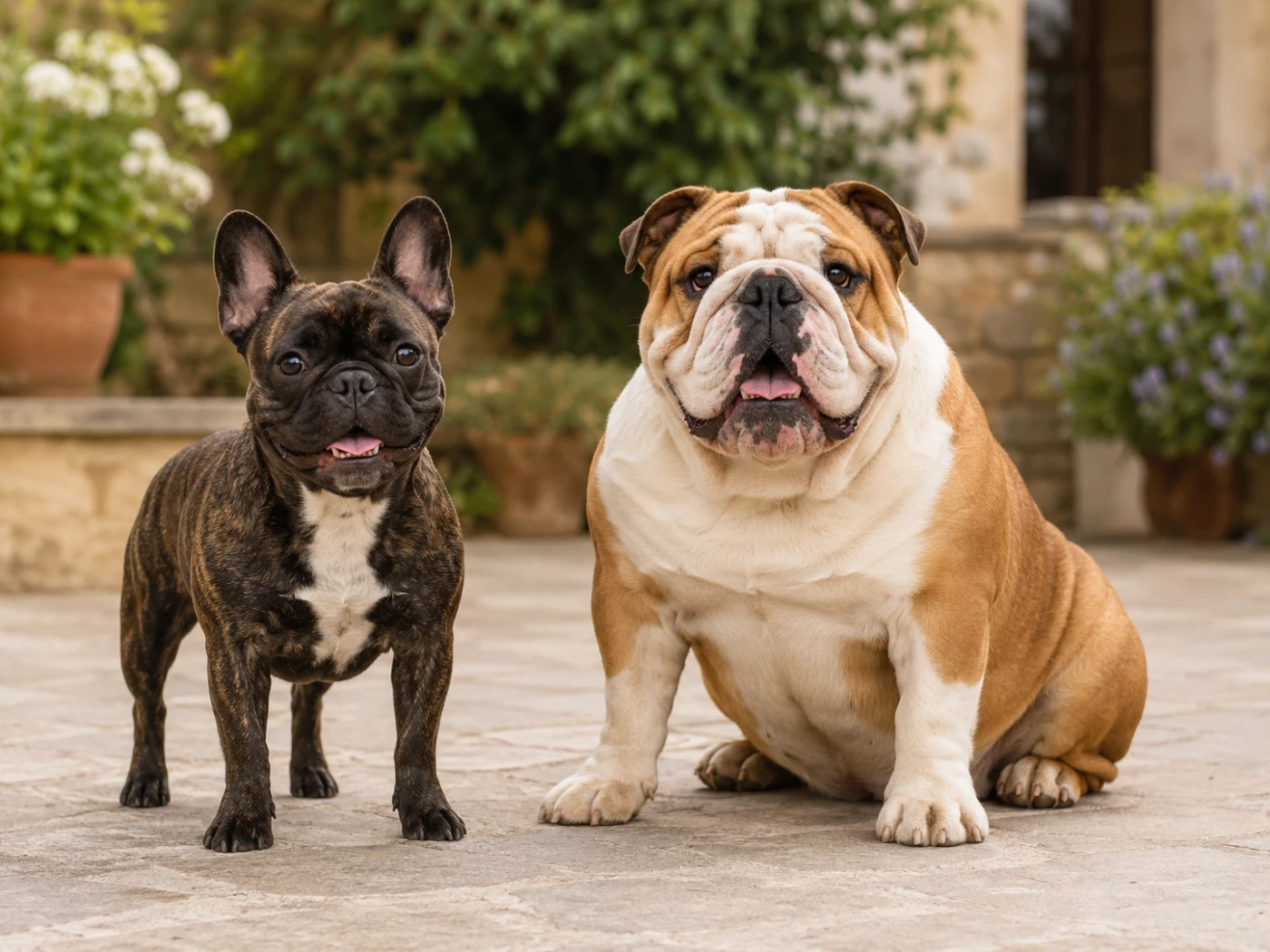
The French Bulldog is smaller, lighter, and usually more playful. The English Bulldog is heavier, slower, and often more relaxed. Both are affectionate companion dogs. Both also have flat faces, poor heat tolerance, and potentially high veterinary costs.
So which one should you choose? Pick the dog whose size, activity level, care needs, and health risks fit your real life. Looks should come second.
Table of Contents
French Bulldog vs. English Bulldog at a Glance
Which Bulldog Is Smaller?
Which Breed Has the Better Temperament?
Which Bulldog Needs More Exercise?
Which Breed Is Easier to Train?
Which Bulldog Is Healthier?
Which Breed Needs More Grooming?
Which Bulldog Costs More to Own?
Which Breed Is Better for Families and Apartments?
Which Bulldog Should You Choose?
Frequently Asked Questions
| Factor | French Bulldog | English Bulldog |
|---|---|---|
| Official size | 11–13 inches; under 28 pounds | About 14–15 inches; around 40 pounds for females and 50 pounds for males |
| General build | Compact and lighter | Broad, heavy, and low to the ground |
| Typical activity style | Playful and alert | Slower and more relaxed |
| Exercise | Short walks and regular play | Short walks and gentle daily activity |
| Apartment fit | Usually easier because of the smaller size | Possible, but the dog needs more floor space |
| Grooming | Short coat with regular fold, ear, nail, and dental care | Short coat with more intensive wrinkle and skin-fold care |
| Drooling | Usually less | Usually more |
| Heat tolerance | Poor | Poor |
| AKC lifespan range | 10–12 years | 8–10 years |
| Best match | Someone who wants a smaller, lively companion | Someone who prefers a heavier, slower companion |
The French Bulldog is clearly smaller. The American Kennel Club lists the breed at 11–13 inches tall and under 28 pounds.
The English Bulldog is only slightly taller, but much heavier. Its official breed standard describes mature males at about 50 pounds and females at about 40 pounds. The breed usually stands around 14–15 inches at the shoulder.
That weight difference affects everyday life. A Frenchie is easier to carry into a car, place in a bathtub, or move during an emergency. Its crate, bed, carrier, and travel equipment also take up less room.
An English Bulldog is short, but it is dense and powerful. Lifting one may be difficult for an older owner or anyone with back problems. This is worth considering if you live upstairs or travel often.
Neither breed has a universally better temperament. French Bulldogs are often more animated and playful. English Bulldogs usually have a slower, more relaxed style.
A Frenchie may follow you from room to room, start games, and look for attention. An English Bulldog may be happier resting nearby after a short walk.
These are general tendencies. They are not guarantees. A calm French Bulldog may be easier than an excitable English Bulldog. Parent temperament, early socialization, health, and training matter more than a simple breed stereotype.
Both breeds were developed as companion dogs. They often become strongly attached to their people. Neither is ideal for a household where the dog will be left alone for long periods every day.
Some individuals can develop separation-related problems. Teach alone time gradually. Start with very short absences and build up while the dog remains calm.
The French Bulldog usually wants more play and interaction. The English Bulldog often has a slower activity style. Both still need safe, regular exercise.
Short walks are usually a better fit than long hikes or jogging. Indoor play, food puzzles, sniffing games, and brief training sessions can provide extra activity without pushing the dog too hard.
Do not assume that low exercise needs mean no exercise. Too little movement can lead to weight gain, weaker muscles, and poorer mobility.
At the same time, both breeds can overheat quickly. Exercise should be reduced during warm or humid weather. Early morning and evening walks are often safer.
Watch breathing closely. Loud breathing while awake, repeated gagging, weakness, slowing down, blue or gray gums, or collapse require immediate attention.
Neither breed is famous for perfect obedience. Both can learn well, but training works best when it is short, clear, and rewarding.
French Bulldogs are often quick and interested at the start. They may also become bored when exercises are repeated too many times.
English Bulldogs may work at a slower pace. Some need more patience and stronger motivation. Their heavier build can also make repeated sitting, jumping, or stair work uncomfortable.
Useful early skills include:
A dog that suddenly refuses a familiar task may be tired or uncomfortable. It may not be “stubborn.” Pain, breathing difficulty, or overheating can all affect behavior.
Neither breed is a low-risk health choice. Both are brachycephalic, meaning they have shortened skulls and flat faces. This shape can restrict airflow and reduce the dog’s ability to cool itself.
Cornell University’s guidance on brachycephalic obstructive airway syndrome explains that affected dogs may have narrowed nostrils, an elongated soft palate, noisy breathing, disturbed sleep, exercise intolerance, and heat sensitivity.
Snoring is common in both breeds, but constant loud breathing should not automatically be treated as normal. A dog that struggles to breathe while awake needs veterinary evaluation.
French Bulldogs also have important spinal risks. Intervertebral disc disease and abnormal vertebrae can lead to pain, weakness, or paralysis. Eye injuries, skin-fold disease, allergies, and ear problems are also common concerns.
English Bulldogs face many of the same airway, skin, and eye problems. Their heavier structure adds major concerns around joints, mobility, obesity, and skin irritation in deep wrinkles.
The AKC lists the typical lifespan of a French Bulldog as 10–12 years and the English Bulldog as 8–10 years. These are breed ranges, not promises for an individual dog.
Good breeding matters. Ask for documented screening results, not only a statement that the parents “look healthy.”
The French Bulldog Club of America recommends breed-specific screening that includes hips, patellas, eyes, and cardiac evaluation.
The Bulldog Club of America lists cardiac, patella, and tracheal evaluation among the core CHIC requirements for Bulldogs.
Results may also be available through the Orthopedic Foundation for Animals database. Search for both parents before placing a deposit.
This article is for informational purposes only and does not replace professional veterinary advice. Always consult a licensed veterinarian about your pet’s health.
Both breeds have short coats and shed. Weekly brushing helps remove loose hair. Nails, ears, teeth, and facial folds also need regular attention.
The English Bulldog usually needs more wrinkle care. Its facial folds can be deeper and more numerous. The tail area may also trap moisture and debris.
French Bulldogs have folds too, but they are often less extensive. Their upright ears make inspection easy, although irritation and infection can still occur.
Check folds regularly and keep them dry. Do not apply random creams or powders to red skin without veterinary advice.
Odor, swelling, pain, broken skin, discharge, or repeated irritation may indicate infection or another skin problem.
Neither breed should be assumed to swim safely. Both have heavy front ends and short muzzles. Use a properly fitted life jacket and close supervision around water.
Either breed can be expensive. Purchase price is only one part of the total cost.
The English Bulldog may cost more for food, equipment, medication, or procedures because it is heavier. The French Bulldog uses smaller supplies, but airway, spinal, skin, eye, or allergy treatment can still be costly.
There is no reliable rule that one breed will always cost more. The final amount depends on the individual dog’s health, insurance, location, and veterinary needs.
Before choosing either breed, budget for:
Request insurance quotes before bringing the puppy home. Check waiting periods, hereditary-condition exclusions, annual limits, and reimbursement rules.
Both breeds can live in apartments. Neither needs a large yard. The French Bulldog is usually easier in a tight space because it is smaller and lighter.
The English Bulldog can also fit apartment life, especially in a quiet household. It still needs enough room for a large bed, crate, and safe movement through the home.
Stairs can be a problem for either breed. French Bulldogs may have spinal or joint issues. English Bulldogs may struggle because of weight, breathing, or mobility problems.
Both breeds can live with children when the individual dog has a stable temperament and interactions are supervised.
The English Bulldog’s weight can knock over a small child. A playful Frenchie can also become too excited. Children should not climb on the dog, pull ears, disturb sleep, or approach food.
Both breeds can live with other pets. Match the individual animals by energy, confidence, and play style. A young Frenchie may irritate an older dog. A heavy English Bulldog may overwhelm a very small pet during rough play.
Check lease and HOA rules before choosing. Weight limits may affect an English Bulldog differently than a French Bulldog.
Choose the French Bulldog if:
Choose the English Bulldog if:
Choose neither breed if you want a running partner, an outdoor dog for hot weather, or a breed with low potential veterinary costs.
The French Bulldog is usually the better choice for someone who wants a smaller and livelier companion. The English Bulldog often suits someone who prefers a heavier dog with a slower pace.
Do not choose by face alone. Meet the puppy. Observe the parents. Review health tests. Check breathing. Consider your budget. Then choose the dog whose real needs fit your home.
Yes. French Bulldogs developed partly from small Bulldogs taken from England to France during the nineteenth century. The two breeds share ancestry but now have separate standards and different builds.
Neither breed is automatically easy. The French Bulldog may be easier to lift and manage in a small home. The English Bulldog may have a slower activity style. Both require careful heat management, fold care, training, and a realistic veterinary budget.
Both have short coats and shed. Individual coat, season, diet, skin health, and brushing routine affect how much hair you see at home.
They can live in a hot area only with careful management. Both need reliable indoor cooling, short walks during cooler hours, access to water, and protection from heat and humidity.
English Bulldogs usually drool more because of their heavier lips and facial structure. French Bulldogs may still drool after drinking, eating, exercise, or during breathing distress.
French Bulldogs are usually more playful and active. English Bulldogs often prefer shorter, slower activity. The individual dog’s age, health, breathing, and weight still matter.
For a deeper look at Frenchie ownership, read the complete French Bulldog breed guide.
AllinPets.com lists French Bulldog breeders across all 50 states for free — browse active listings, compare breeders, and reach out directly with no fees or middlemen.
Browse French Bulldog listings on AllinPets.
AllinPets.com lists English Bulldog breeders across all 50 states for free — browse active listings, compare breeders, and reach out directly with no fees or middlemen.
Browse English Bulldog listings on AllinPets.
Written by the AllinPets Editorial Team.