Long Read · 6 min
In this guide:
What Is a House Line?
Why Use a House Line With a Cavapoo Puppy
House Line Safety Rules
Collar or Harness?
How to Fit a Harness
How to Use a House Line Step by Step
Common Mistakes to Avoid
When to Stop Using the House Line
Cavapoo House Line FAQ
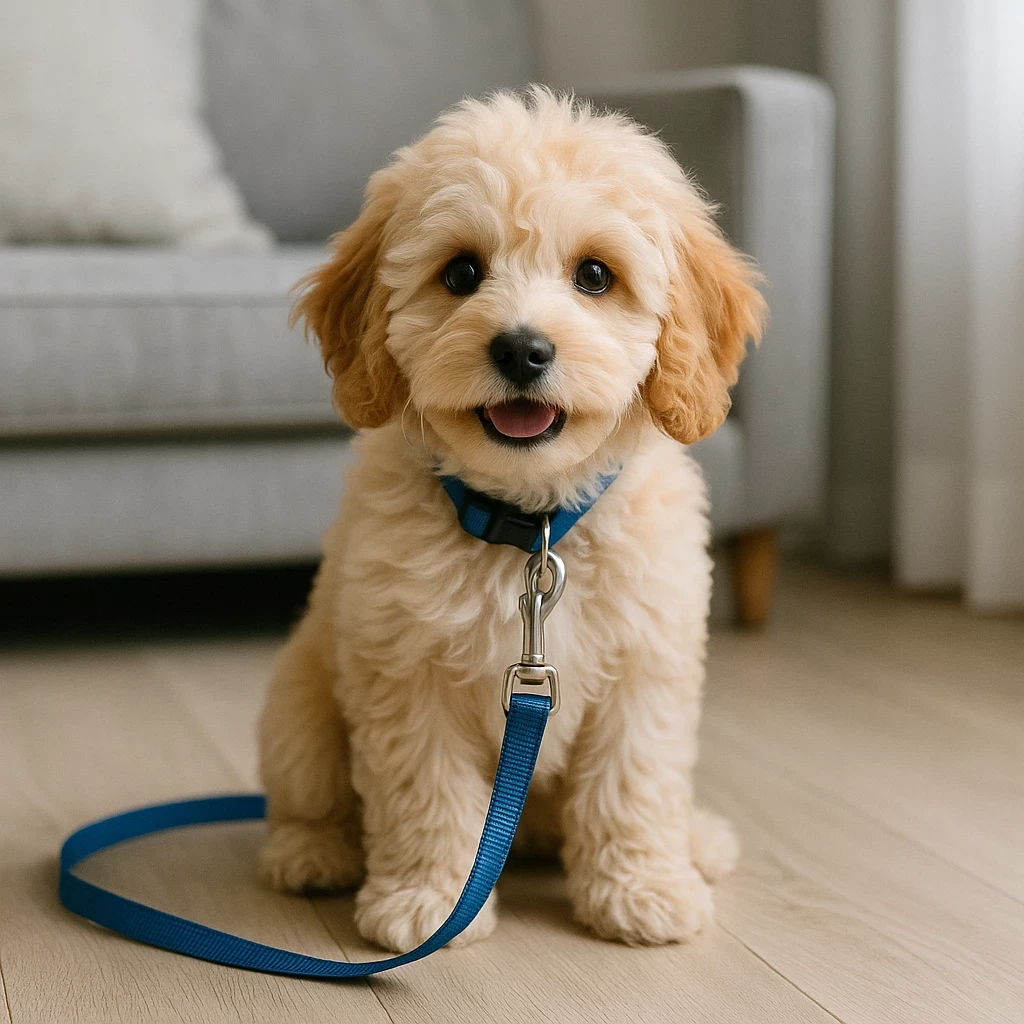
A house line is a light, handle-free leash your Cavapoo puppy wears indoors so you can calmly guide it away from trouble. Use it only while you are watching, attach it to a well-fitted flat collar or harness, never jerk it, and pair it with rewards for good choices.
Cavapoo puppies are curious and quick to explore. A house line lets you stop a puppy from chewing a cable or slipping out the door without chasing or grabbing it, which keeps training calm and gentle. This guide covers what a house line is, safety rules, collar or harness choice, fitting and step-by-step use. For the full breed profile, see this overview of the Cavapoo breed.
A house line is a lightweight lead that trails behind your puppy as it moves around the home. A behavior guide published on the RSPCA Llys Nini branch website describes it as a light fabric lead, 1 to 2 meters long, with no handle. The missing handle matters, because a loop can catch on furniture.
The same guide notes that a house line lets you catch or guide a dog without touching it, which is useful for puppies in training and for fearful dogs. It is a management and communication tool, not a way to pull or correct your puppy.
Cavapoos are a cross between the Cavalier King Charles Spaniel and the Poodle. Many are playful, people-focused and eager to explore every corner of a new home. A house line helps you:
Because you do not have to chase or pick up your puppy every time, it is less likely to turn guidance into a game of keep-away. A house line also fits well with a house-training routine. The guide to Cavapoo house-training basics explains timing and rewards.
A house line is safe only when used with care. The RSPCA Llys Nini guide sets clear rules:
Add a few common-sense rules of your own:
Both can work for a house line, as long as they fit well and the line stays loose. Each has its own strengths.
For a small breed like the Cavapoo, many owners move to a harness for walks once the puppy is used to wearing gear. Whichever you choose, a house line should hang slack nearly all the time, so it puts little pressure on your puppy.
Measure your puppy when it is calm. Use a soft tape measure to check chest girth, just behind the front legs, and neck size. Then follow the sizing chart for the harness you choose. Typical weights by age, in the guide to typical Cavapoo weights by age, help you judge how often to recheck.
Let your puppy get used to the harness with treats and praise before you attach a line. Put it on for short periods at first, and reward calm behavior.
Rewards are what make a house line work. If your puppy is not interested in food, see the tips on rewarding a puppy that skips treats.
A house line is a short-term tool. As your puppy learns household rules and responds to cues such as come and leave it, you will need it less. Many owners start by using it only at busy times, such as when guests visit, and then stop entirely.
Early weeks at home are also a key time for socialization. The American Veterinary Society of Animal Behavior (AVSAB) notes that the sensitive period for socialization lasts until about 3 to 4 months of age, and that puppies can start socialization classes at 7 to 8 weeks once they have had at least one set of vaccines. Ask your vet when your puppy can safely visit busier places. If you are still looking for a puppy, AllinPets.com lets breeders list Cavapoo puppies for free and helps buyers browse available listings nationwide.
Yes, when used correctly. Use it only under supervision, attach it to a flat collar or harness, never jerk it, and take it off before rest or crate time.
Either can work if it fits well. A harness puts less pressure on the neck if your puppy pulls, which suits a small dog like a Cavapoo.
One RSPCA branch guide describes a house line as 1 to 2 meters of light fabric with no handle, so it trails freely without snagging.
Use it while your puppy is learning house rules, then cut back as it responds reliably to cues and stop once it is no longer needed.
This article is for informational purposes only and does not replace professional veterinary advice. Always consult a licensed veterinarian about your pet's health.
Written by the AllinPets Editorial Team