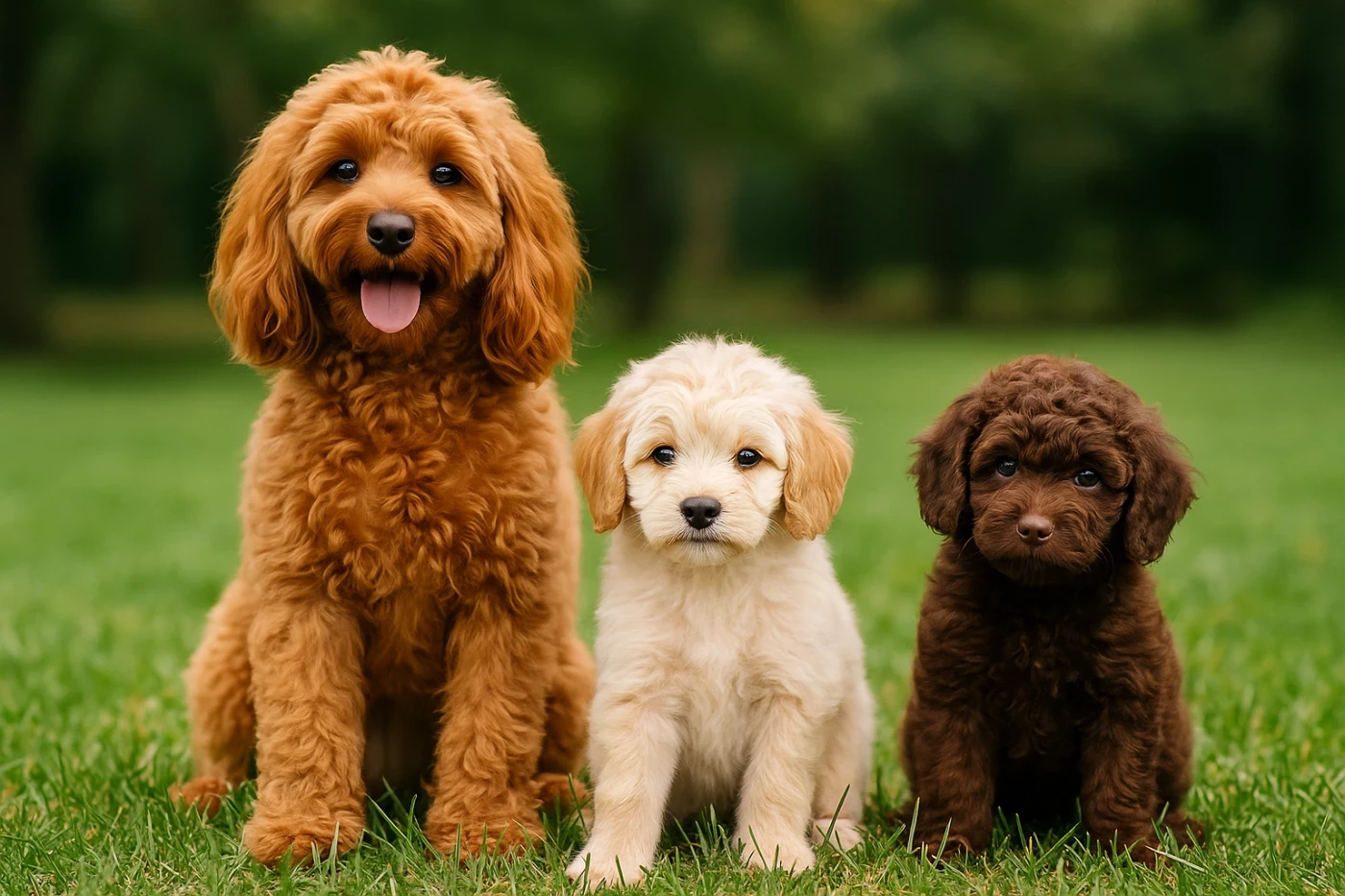
Long Read · 13 min
In this guide:
Why Size Matters Before You Buy
Where Cavapoo Size Comes From
Cavapoo Size Labels: Teacup, Toy, Mini and Standard
How Cavapoo Puppies Grow
What Changes Final Size
How to Estimate Your Puppy's Adult Size
Size Questions to Ask Any Seller
Feeding and Daily Care as Your Cavapoo Grows
Size and Health: What Each Size Brings
Keeping a Grown Cavapoo at a Healthy Weight
Frequently Asked Questions
A Cavapoo's adult size depends mostly on its Poodle parent. A Cavalier King Charles Spaniel crossed with a Toy Poodle usually produces a small dog, while a cross with a Miniature Poodle produces a sturdier, larger one. There is no official Cavapoo size standard, so "Toy," "Mini" and "Standard" are seller labels, not guarantees.
Knowing the likely adult size helps you choose the right home, crate, harness, food portions and exercise plan from day one. This guide explains where Cavapoo size comes from, how puppies grow, what each size label usually means, and how to get a realistic estimate before you commit to a puppy. For a full overview of the breed, see the complete Cavapoo breed guide.
Size decides more about daily life with a Cavapoo than most buyers expect. A very small dog fits easily in an apartment and travels well, but it is also easier to injure. A larger Cavapoo is sturdier around children and on trails, but it needs a bigger crate, more food and a stronger hand on the leash.
Planning ahead also saves money. Owners who guess wrong often replace crates, harnesses, beds and car restraints within months. A puppy that outgrows its gear quickly is normal, but a puppy that turns out twice the size you planned for can change whether the dog still fits your home and routine.
The most common surprise is not a giant Cavapoo. It is a dog that lands outside the label it was sold under, because the seller's "Toy" or "Mini" was never tied to measured parents.
A Cavapoo is a cross between two recognized breeds, so the honest starting point is the size of those breeds. The American Kennel Club does not recognize the Cavapoo as a breed, so there is no official height or weight standard for it. What does exist is a standard for each parent.
| Parent breed | Height at the shoulder (AKC) | Typical adult weight |
| Cavalier King Charles Spaniel | 12 to 13 inches | 13 to 18 pounds |
| Toy Poodle | 10 inches or under | About 4 to 6 pounds |
| Miniature Poodle | Over 10 inches, up to 15 inches | About 10 to 15 pounds |
| Standard Poodle | Over 15 inches | About 40 to 50 pounds for females, 60 to 70 pounds for males |
The Cavalier side is fairly fixed, because the breed comes in one size. The Poodle side is what moves the result. AKC separates the three Poodle varieties by shoulder height only, which is why the variety of the Poodle parent matters far more than any label in a listing.
A first-generation puppy usually lands somewhere between its two parents, but genes do not average neatly. Two puppies from the same litter can finish several pounds apart. That is why the measured size of both parents is a better clue than any number printed on an ad.
Sellers use four labels for Cavapoo size. None of them is defined by a breed club, and one seller's "Toy" can be another seller's "Mini." Treat each label as a starting question, then ask which Poodle variety was used and what both parents weigh.
Sellers commonly quote these adult ranges for each label. They are not a breed standard and vary by parents.
| Size label | Adult weight sellers quote | Adult height sellers quote |
| Toy | 7 to 13 pounds | 9 to 11 inches |
| Mini | 14 to 25 pounds | 12 to 16 inches |
| Standard (uncommon) | 26 to 40 pounds | 17 to 20 inches |
| Teacup | No defined range | No defined range |
"Teacup" is a marketing label, not a size. The AKC does not recognize it, and the AKC Toy Poodle standard already defines the smallest Poodle variety. The label alone does not tell you how the puppy was bred or how large it will become.
Extreme smallness carries real risks. Tiny puppies are more vulnerable to low blood sugar, are easier to injure in falls from furniture or arms, and do not suit homes with toddlers or rough play. Whatever the asking price, request the parents' health screening results and the puppy's veterinary records before making a decision. If you are drawn to the smallest size, ask how the seller produces it and what the parents weigh as adults.
A Toy Cavapoo comes from a Cavalier crossed with a Toy Poodle. It is the most portable size and suits apartments, singles, couples and seniors who want a dog that stays close and travels easily. It still needs daily walks and play.
The trade-off is fragility. A small Toy can be hurt by being stepped on, dropped or jumping off a high bed or sofa, so these puppies are often a poor match for homes with toddlers. Long or curly coats need daily brushing to prevent tangles and mats. When a seller calls a puppy a Toy, ask for proof that the Poodle parent is a Toy and not a small Miniature.
A Mini Cavapoo comes from a Cavalier crossed with a Miniature Poodle. It is a common family choice, because it is compact enough for apartment living but sturdy enough for active play with sensible children and for light hiking.
The Mini label covers a wide range, since Miniature Poodles themselves vary across five inches of height. The generation matters too. A puppy bred back to a Miniature Poodle may differ from a first-cross puppy, and one bred back to a Toy Poodle will usually be smaller. The guide to Cavapoo generations explains how F1, F1B and later crosses change size and coat.
"Standard Cavapoo" is the most confusing label. Sellers use it inconsistently. It can describe a large Mini, meaning a puppy from a bigger Miniature Poodle parent, or a cross with an actual Standard Poodle.
A true cross with a Standard Poodle is uncommon, and the result is much less predictable, because the Standard Poodle is several times heavier than a Cavalier. Such a dog can end up larger than the typical Cavapoo profile, and the result varies widely. Ask about the adult size and activity levels of both parents and of any adult puppies from previous litters. If a listing says "Standard," ask directly whether the Poodle parent is a Miniature or a Standard, and ask for both parents' measurements before you look at anything else.
Cavapoo puppies grow fastest in the first few months, then slow down as they approach adult height. Most small dogs reach adult height before their first birthday, though sources disagree on exactly when. The AKC places the end of growth for small breeds at around 6 to 8 months, while PetMD gives about 8 to 12 months for toy-sized dogs and 9 to 12 months for small dogs. The Merck Veterinary Manual notes that growth and skeletal maturity may be complete by 8 to 12 months in small and medium breeds.
As a typical pattern, not a rule: by 8 weeks most puppies weigh 2 to 5 pounds, their weight often triples by 4 months, and many reach 60 to 70 percent of their adult weight by 6 months. Toy Cavapoos usually finish growing by about 9 months, Minis by about a year, and Standards can take up to 14 months.
Height usually settles first, and weight and muscle keep filling in for a while afterward. A Cavapoo that looks lanky at seven months may look noticeably more solid at a year. Larger Cavapoos, especially those from a Standard Poodle parent, can take longer to finish.
Be careful with month-by-month growth charts for Cavapoos. Because the breed has no standard and the parents can range from a 5-pound Toy Poodle to a 70-pound Standard Poodle, a single "average" chart can be badly wrong for your puppy. Use charts as a loose reference at most, and rely on your own weekly records and your veterinarian's assessment instead.
Energy shifts during this period as well. Puppies need frequent meals and short bursts of play rather than long, hard exercise. Avoid repeated high-impact activity, such as jumping off furniture or long runs on hard surfaces, while the skeleton is still developing.
Several factors shape how big a Cavapoo gets. Some are fixed at birth, and some you influence every day.
No single calculation guarantees a Cavapoo's adult size. Use both parents' measurements, records from earlier litters and your veterinarian's assessment of repeated weight measurements to form a rough estimate.
Start with the breeder. A breeder who has raised several litters from the same pair can usually tell you how earlier puppies turned out as adults. That history is far more useful than a projection made on the spot.
Then keep your own records. Weigh your puppy weekly at the same time of day and write the number down. Steady gains are a good sign. A sudden stall or a sudden jump is worth a call to your veterinarian, who can check growth against body condition rather than against a generic chart.
The size you get is only as reliable as the information behind the listing. A seller who answers these questions clearly and in writing is giving you something you can check. A seller who avoids them is asking you to buy on a label.
Size is only one part of choosing a seller. The checklist for choosing a Cavapoo breeder covers contracts, health records and the warning signs that matter most.
A growing Cavapoo needs a complete diet formulated for puppies, fed in several small meals a day. Small puppies in particular should not go long stretches without food. Follow the portion guidance on the food label as a starting point, then adjust with your veterinarian as your puppy grows.
Exercise should be regular but gentle while the skeleton develops. Short walks, play sessions and early training work better than long runs or repeated jumping. Toys are the most delicate size, so supervise play with children and larger dogs closely.
Start grooming early so your puppy gets used to brushing, nail trims and handling. Long or curly coats can mat without regular brushing, and early, gentle handling helps a puppy become comfortable with grooming.
Routine and rest matter as much as food. Growing puppies need a quiet place to sleep without being disturbed, short training sessions that build confidence, and gentle exposure to new people, sounds and places. Recheck collar and harness fit often, because a puppy can outgrow gear in a matter of weeks.
Every Cavapoo can inherit conditions from either parent breed, but some risks shift with size. Health screening of both parents matters at every size, and the severity of any inherited condition varies from dog to dog.
Very small puppies are more vulnerable to low blood sugar, called hypoglycemia, especially in their first few months. VCA Animal Hospitals lists inadequate nutrition in toy-breed puppies as one cause, and describes the typical signs as weakness, collapse, disorientation, tremors and sometimes seizures. If a puppy becomes weak, disoriented, shaky, collapses or has a seizure, seek emergency veterinary care immediately. Frequent small meals, warmth and a calm routine help keep blood sugar stable in toy-sized puppies.
Legg-Calvé-Perthes disease is a hip condition in which the head of the thighbone loses its blood supply and breaks down. The Merck Veterinary Manual describes it in young miniature and small-breed dogs, typically between 4 and 11 months of age, with hind-leg lameness and pain when the hip is moved. Kneecaps that slip out of place, known as patellar luxation, are also common: VCA Animal Hospitals notes that many toy and small-breed dogs, including Poodles, have a genetic predisposition, and owners may notice a skip in the dog's step. Parent dogs can be evaluated for it.
VCA Animal Hospitals notes that small dogs are more prone to periodontal disease because their smaller jaws can crowd the teeth. Ask your veterinarian about dental checks and a suitable home dental care routine.
From the Cavalier side, the most important risk is myxomatous mitral valve disease, a degenerative heart valve condition. It is extremely common in Cavaliers, with published research describing it in nearly all Cavaliers by about 10 years of age, and it can begin much earlier. Whether a Cavapoo inherits the same risk depends on its parents, which is why a heart evaluation of the Cavalier parent matters at every size.
Larger Cavapoos carry more weight on their joints, so hip evaluations of the Poodle parent are worth asking about, along with eye screening for inherited conditions such as progressive retinal atrophy. Regular veterinary checkups, weight control and age-appropriate exercise support a healthy life in every size.
A healthy adult Cavapoo is judged by body condition, not by a single number on the scale. Veterinarians commonly use a 9-point body condition score from the World Small Animal Veterinary Association, where 4 or 5 out of 9 is ideal. At that range, you can feel the ribs easily with only a light covering of fat, see a waist from above, and see the belly tuck up from the side.
If your Cavapoo looks round, has no visible waist, or you have to press to find the ribs, it is likely carrying extra weight. If the ribs, spine and hip bones are easy to see, the dog may be too thin. A thick or curly coat can hide both, so check by touch, not just by looking.
Treats add up quickly in a small dog. Count them as part of daily food, keep portions consistent, and ask your veterinarian to score your dog's body condition at each visit. Small, steady adjustments work better than sudden diet changes.
If you are still deciding which size fits your home, compare current listings and ask every seller the parent questions above. AllinPets.com lets breeders list Cavapoo puppies for free and helps buyers browse available listings nationwide.
A Cavapoo's adult size depends mainly on its Poodle parent. Crosses with a Toy Poodle usually produce a small dog, crosses with a Miniature Poodle a sturdier medium-small dog, and rare crosses with a Standard Poodle a much larger one. The best predictor is the measured size of both parents.
Most Cavapoos reach adult height before their first birthday. Sources differ on the exact timing for small dogs, ranging from about 6 to 12 months, and weight and muscle often keep filling in for a few months after height settles. Larger Cavapoos can take longer.
No. "Teacup" is a marketing label, not a size recognized by the AKC or by any parent-breed standard. Very small puppies are more prone to low blood sugar and injury, so ask how the seller produces this size and what the parents weigh as adults.
A Mini Cavapoo has a Miniature Poodle parent. A puppy sold as "Standard" can be either a large Mini or a cross with a Standard Poodle, which produces a much bigger and less predictable dog. Ask the seller which Poodle variety is the parent.
Only roughly. Ask for both parents' adult measurements and records from earlier litters, then review your puppy's growth with your veterinarian.
This article is for informational purposes only and does not replace professional veterinary advice. Always consult a licensed veterinarian about your pet's health.
Written by the AllinPets Editorial Team