Long Read · 9 min
In this guide:
Understanding Cavapoo Coat Types
How Often Should You Groom a Cavapoo?
Popular Cavapoo Haircuts
Essential Grooming Tools
How to Groom a Cavapoo Step by Step
Preventing Matting
Health Checks During Grooming
Grooming Cavapoo Puppies
Seasonal Grooming Tips
Common Grooming Mistakes
Cavapoo Grooming FAQ
Most Cavapoos need brushing several times a week, a bath every few weeks, and a professional trim every 4 to 8 weeks. Exactly how much work your dog needs depends on its coat type, with curly coats needing the most care and straighter coats the least.
That soft "teddy bear" look takes steady upkeep. Regular grooming prevents painful mats, lets you catch skin and ear problems early, and keeps your dog comfortable. This guide covers coat types, grooming schedules, haircuts, tools, step-by-step care, puppy grooming and seasonal tips. For the full breed picture, see the complete guide to the Cavapoo breed.
A Cavapoo can have a straight, wavy or curly coat, depending on the genes it inherits from its Cavalier King Charles Spaniel and Poodle parents. Owners and breeders usually describe three coat types: hair, fleece and wool. These are informal labels, not a breed standard, but they are a useful way to plan grooming.
Curl is strongly influenced by one gene. The UC Davis Veterinary Genetics Laboratory explains that variants of the KRT71 gene are linked to curly coats and appear to be inherited with incomplete dominance. A dog with no copies is expected to have a straight coat, one copy gives a wavy coat, and two copies give a curly coat.
Another gene, RSPO2, controls "furnishings," the longer hair on the muzzle and eyebrows that gives many doodle crosses their shaggy face. UC Davis notes that dogs without this dominant variant can have an "improper coat," with short hair on the face and legs.
Generation affects the odds of each coat type. A puppy with more Poodle in its background is more likely to inherit curl. The details are in the guide to F1, F1B and F2 Cavapoo generations.
A low-shedding coat can help some people with allergies, but no Cavapoo is allergy-proof. The AKC states that there are no 100% hypoallergenic dogs, breeds or mixed breeds. It explains that dander, which clings to hair, causes most dog allergies, and that non-shedding coats leave less of it around the home. If someone in your home has allergies, spend time with the specific dog before you commit.
| Coat type | Texture | Shedding | Grooming effort | Best for |
|---|---|---|---|---|
| Fleece | Soft, wavy, light | Low | Medium | Owners who want the teddy bear look with moderate upkeep |
| Wool | Dense, curly, Poodle-like | Very low | High | Owners who want minimal shedding and can brush daily |
| Hair | Straight or slightly wavy | Medium to high | Low | Owners who accept some shedding for easier care |
How often you groom depends on coat type, lifestyle and how short you keep the coat. The schedules below are common grooming guidelines, not a breed standard, so adjust them to your dog's coat and how quickly it tangles.
Brush the whole body, not just the top. Pay extra attention to the spots that tangle first: behind and under the ears, the armpits, chest, collar line and the backs of the legs.
A bath every 3 to 4 weeks is a common routine for Cavapoos. Bathing too often with harsh products can dry the skin. A bath without thorough drying and brushing afterward can also make matting worse, because damp, tangled hair knots easily.
A groomer handles clipping, face and paw trims, sanitary trims and nails. Grooming is a real ongoing cost and time commitment, so factor it in before you choose a Cavapoo.
| Task | Fleece | Wool | Hair |
|---|---|---|---|
| Brushing | 3 to 4 times weekly | Daily | 1 to 2 times weekly |
| Bathing | Every 3 to 4 weeks | Every 3 to 4 weeks | Every 3 to 4 weeks |
| Professional groomer | Every 6 to 8 weeks | Every 4 to 6 weeks | Every 6 to 8 weeks |
| Ear cleaning | Every 1 to 2 weeks or when dirty | Every 1 to 2 weeks or when dirty | Every 1 to 2 weeks or when dirty |
| Nail trimming | Every 3 to 4 weeks | Every 3 to 4 weeks | Every 3 to 4 weeks |
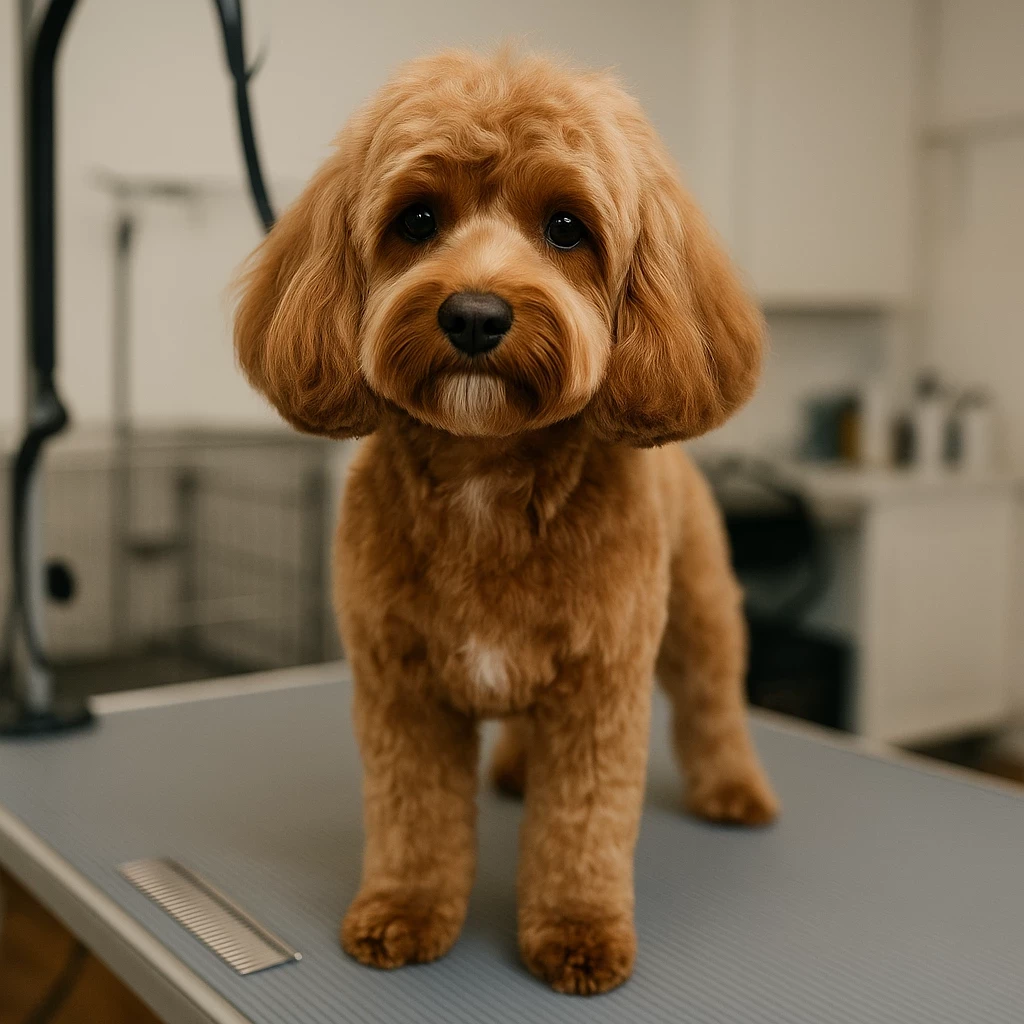
The most popular Cavapoo haircut is the teddy bear cut, but the best choice is the one that fits your dog's coat and your schedule. These names are grooming-salon terms, so show your groomer a photo to make sure you both mean the same thing.
Be careful with very close shaves. A coat clipped down to the skin leaves little protection from the sun and from scrapes. The AVMA suggests asking your veterinarian whether a warm-weather haircut makes sense for your pet.
A few basic tools cover most home grooming:
Lighter coats such as cream, apricot, white and Blenheim show staining around the eyes more clearly. You can see how each shade looks in the guide to every Cavapoo coat color.
Work in small sections from the skin outward, starting low on the legs and moving up. Use the slicker brush first, then run the comb through each section all the way to the skin. If the comb catches, you have found a tangle. Work it loose gently with your fingers or a dematting tool while it is still small. Avoid cutting mats out with scissors, since it is easy to nick the skin underneath.
Use a shampoo made for dogs, ideally one for sensitive or curly coats. Lather from neck to tail, keep shampoo out of the eyes and ears, and rinse well. A dog conditioner can make brushing easier. Dry with a low or cool dryer while brushing, rather than letting the coat air-dry, to stop tangles from forming.
Wipe gently around the eyes with a soft, damp cloth. Keep hair trimmed so it does not poke the eyes. VCA Animal Hospitals lists reddish-brown staining under the eyes as a common sign of epiphora, or excess tearing, which has many possible causes, from allergies and eye irritation to hair blocking the tear ducts. Ask your vet to check ongoing tearing, and avoid any product containing hydrogen peroxide near the eyes, which VCA warns against.
Cavapoos have long, hairy ears, so check them often. Cornell University's College of Veterinary Medicine suggests routine cleaning every 1 to 2 weeks, and cleaning after swimming or bathing. Its guidance:
Cornell advises calling your vet if you see redness, itching, head shaking, discharge, extra wax, odor, or pain when the ear is touched.
Trim the hair between the paw pads so your dog has better grip and tracks in less dirt. Keep the hair around the rear and genitals short. A tidy sanitary trim keeps your dog cleaner and makes cleanup easier during potty training.
Mats form when loose hair, moisture and rubbing twist the coat into tight knots. Tight mats pull on the skin and can hide irritation, cuts or parasites underneath, so it pays to catch them early.
The usual trouble spots are behind the ears, under the front legs, the chest, under a collar or harness, behind the legs and around the base of the tail. To prevent mats:
If your dog is badly matted, see a professional groomer. Removing severe mats at home can hurt your dog and damage the skin.
Grooming is the best time to check your Cavapoo from nose to tail. Look for redness, bumps, flaky skin, sore spots and anything new. Run your hands over the body to feel for lumps you cannot see under the coat.
Check for ticks after time outdoors. The CDC recommends checking in and around the ears, around the eyelids, under the collar, under the front legs, between the toes, between the back legs and around the tail. A thick Cavapoo coat makes ticks easy to miss, so part the hair as you go. For prevention products and safe removal, see the AllinPets guide to tick prevention for dogs.
Start gentle handling as soon as your puppy comes home. The goal is to build good feelings about grooming, not to get a perfect trim. A common approach is to begin short sessions at around 8 to 10 weeks old, keeping them to just 2 to 5 minutes at first. These are typical starting points, not fixed rules.
A puppy that learns to enjoy handling grows into an adult that is easier to groom at home, at the vet and at the salon.
The AVMA recommends wiping or washing your dog's feet, legs and belly after walks to remove snow, ice, salt and de-icing chemicals. It also suggests using pet-safe de-icers at home, checking paws often for irritation, and considering well-fitting booties. If you keep your Cavapoo's coat short in winter, a sweater or dog coat can help, which the AVMA suggests for short-coated dogs bothered by cold. Dry the coat fully after wet walks to prevent tangles.
The AVMA advises avoiding hot surfaces such as asphalt, which can burn paws, and walking in cooler parts of the day. Make sure your dog always has fresh water and shade outside. A shorter trim can make care easier in hot months, but ask your vet before a very close shave.
Avoiding these keeps grooming easier and your Cavapoo more comfortable. If you are still deciding whether the grooming load fits your life, ask breeders about each puppy's coat type and parents. AllinPets.com lets breeders list Cavapoo puppies for free and helps buyers browse available listings nationwide.
Most Cavapoos need brushing 1 to 7 times a week, depending on coat type, and a professional groom every 4 to 8 weeks. Curly wool coats need the most care.
The teddy bear cut is the most popular. A puppy cut or summer cut can be easier for busy owners or hot climates.
Yes, especially dogs with fleece or wool coats. Mats form most often behind the ears, under the front legs and on the chest.
Grooming needs are moderate to high, depending on coat type and haircut. Plan for regular brushing at home and the cost of professional trims.
This article is for informational purposes only and does not replace professional veterinary advice. Always consult a licensed veterinarian about your pet's health.
Written by the AllinPets Editorial Team