Long Read · 8 min
In this guide:
What Generation Labels Mean
Cavapoo Generations at a Glance
F1 Cavapoo
F1B Cavapoo
F2 Cavapoo
F2B Cavapoo
F3 Cavapoo
F3B Cavapoo
Multigen Cavapoo
Why Coats Vary Between Generations
Health Considerations by Generation
Does Generation Affect Price?
Choosing the Best Generation for You
Cavapoo Generations FAQ
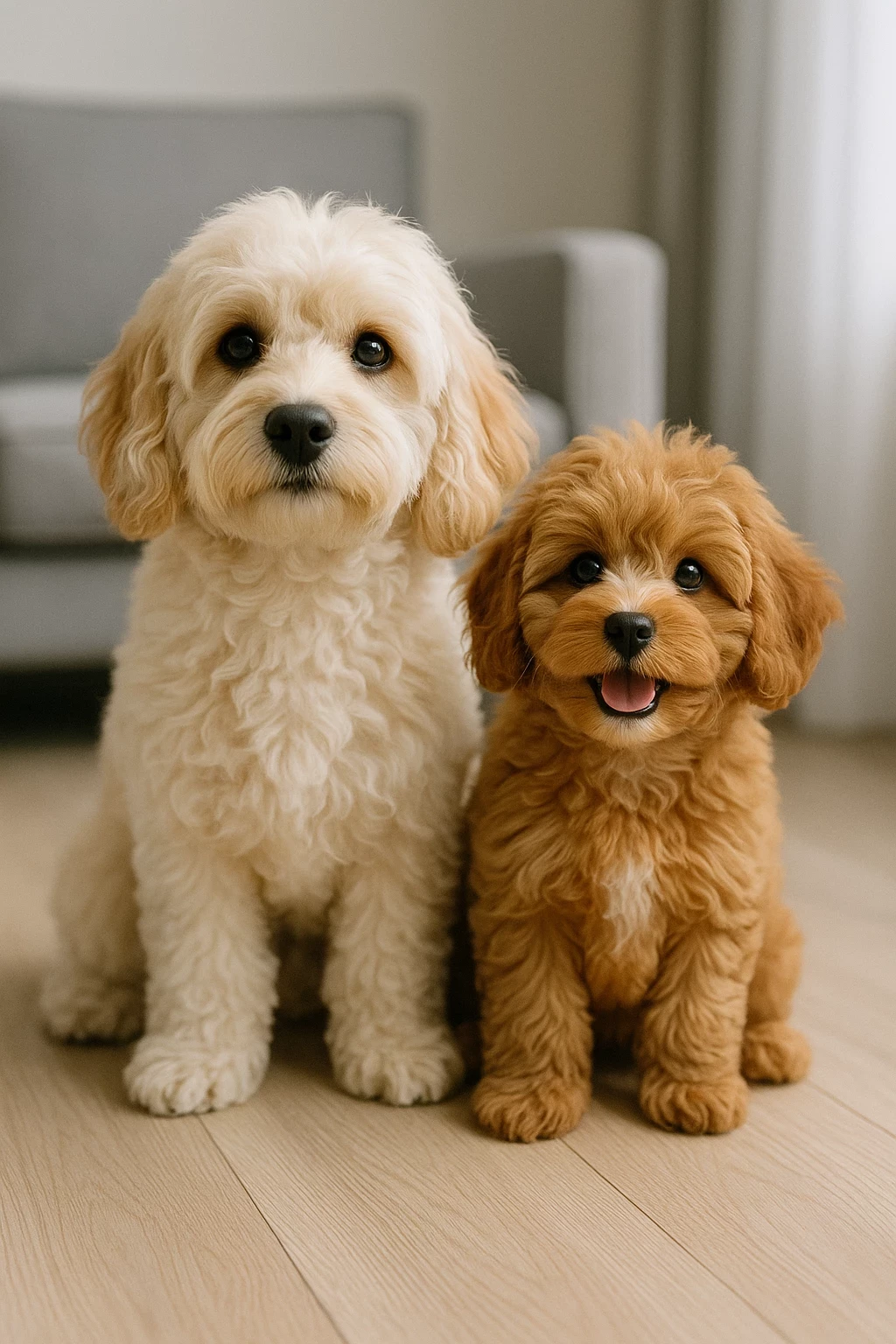
A Cavapoo's generation label, such as F1, F1B or F2, tells you how its parents were bred. An F1 is a direct cross of a purebred Cavalier King Charles Spaniel and a purebred Poodle, while labels with a "B" mean the dog was bred back to a Poodle, which usually adds more Poodle coat traits.
Generation can shift the odds of a curly, wavy or straight coat, how much a dog sheds, and how much grooming it needs. It does not guarantee any of these, and it does not replace health testing. This guide explains every common label, from F1 to multigen, and what each one can and cannot tell you. For a complete overview of the breed, see the full guide to Cavapoos.
In generation labels, "F" stands for filial, a genetics term for offspring. The number shows how many generations of Cavapoo-to-Cavapoo breeding are behind the dog, and a "B" means one parent was a purebred Poodle, a step known as a backcross.
These labels are informal. The AKC does not recognize the Cavapoo as a breed, and no official registry sets or checks Cavapoo generation names. Breeders sometimes use the same label in slightly different ways, especially for F2B, F3 and multigen dogs. Always ask what the parents actually were, rather than relying on the label alone.
The percentages often quoted for each generation, such as "75% Poodle," are averages based on the pedigree. They do not tell you which genes a particular puppy inherited, so two littermates can look and shed very differently.
The table below shows the usual parent pairings and the approximate average ancestry for each label. The ancestry figures are pedigree averages, not genetic test results, and the coat notes describe common tendencies rather than guarantees.
| Generation | Usual parents | Approximate ancestry | Typical coat tendency |
|---|---|---|---|
| F1 | Cavalier × Poodle | 50% Cavalier, 50% Poodle | Often wavy, varies most within the litter |
| F1B | F1 Cavapoo × Poodle | 25% Cavalier, 75% Poodle | More often curly and low-shedding |
| F2 | F1 × F1 | 50% Cavalier, 50% Poodle | Wide variety, from straight to curly |
| F2B | F1 × F1B (most common definition) | About 37.5% Cavalier, 62.5% Poodle | Often wavy to curly |
| F3 | F2 × F2, or later Cavapoo crosses | Depends on the parents | Depends on how carefully parents were selected |
| F3B | F3 or multigen Cavapoo × Poodle | Higher Poodle share | More often curly |
| Multigen | Cavapoo × Cavapoo, beyond F3 | Varies by line | Can be more consistent in well-planned lines |
An F1 Cavapoo is the first-generation cross: one purebred Cavalier King Charles Spaniel parent and one purebred Poodle parent. On average, it carries half its ancestry from each breed.
F1 puppies often have soft, wavy coats with low to moderate shedding, but there is no single F1 look. Some take after the straighter Cavalier coat, others after the curlier Poodle coat. F1s are a common choice for owners who want a balance of both parent breeds and can accept some uncertainty about coat type and shedding.
Because both parents are purebreds, you can check their health records against each breed's own testing standards. That makes F1 litters fairly easy to evaluate.
An F1B Cavapoo comes from breeding an F1 Cavapoo back to a purebred Poodle. On average, it is about 75% Poodle and 25% Cavalier.
The extra Poodle influence makes a curly, low-shedding coat more likely. F1Bs are often offered to families concerned about allergies. Keep in mind that the AKC states there are no 100% hypoallergenic dogs, and that dander, which clings to hair, causes most dog allergies. A low-shedding coat may help some people, but it is not a guarantee.
Curlier coats usually need more grooming. Expect frequent brushing and regular professional trims to keep tighter curls free of mats.
An F2 Cavapoo is the result of breeding two F1 Cavapoos together. Its average ancestry is still about half Cavalier and half Poodle.
F2 litters are known for the widest variety. Because both parents carry a mix of Cavalier and Poodle genes, puppies in the same litter can range from straight-coated and shedding to tightly curled. If coat type or shedding matters a lot to you, an F2 puppy is the hardest to predict, so meet the parents and look closely at each puppy's coat.
An F2B Cavapoo usually comes from breeding an F1 Cavapoo with an F1B Cavapoo. On that definition, it averages about 62.5% Poodle and 37.5% Cavalier.
Naming varies here more than with other labels. Some breeders use F2B for other pairings, such as an F2 bred back to a Poodle. Ask the breeder to name both parents' generations so you know exactly what you are getting. F2B puppies often have wavy to curly coats with low shedding, but individual puppies still vary.
An F3 Cavapoo comes from two F2 Cavapoos, or from other pairings where both parents are second-generation or later. Its average ancestry depends on the parents chosen.
By the third generation, the breeder's choices matter more than the label itself. A breeder who selects parents for coat, temperament and health over several generations may produce more consistent puppies. A breeder who simply pairs any two Cavapoos may not. Ask what traits the line has been selected for and how long the breeder has worked with it.
An F3B Cavapoo is usually an F3 or later Cavapoo bred back to a purebred Poodle. As with other "B" labels, the backcross raises the Poodle share and the odds of a curly, low-shedding coat.
F3B is one of the less common labels, and breeders define it in different ways. Treat it as a sign that a Poodle was added back into an established Cavapoo line, and ask for the full pedigree.
A multigenerational, or multigen, Cavapoo has Cavapoo parents going back several generations, typically beyond F3. Some multigen lines also include occasional Poodle backcrosses.
Multigen breeding aims to make traits such as coat type, size and temperament more consistent from litter to litter. That only happens with careful selection over many years. A multigen label alone does not prove a line is stable, so ask to see past litters, parent photos and health records.
Coat type depends on specific genes, not on a percentage. The UC Davis Veterinary Genetics Laboratory explains that variants of the KRT71 gene are linked to curly coats and appear to be inherited with incomplete dominance: no copies usually means a straight coat, one copy a wavy coat, and two copies a curly coat.
Another gene, RSPO2, controls "furnishings," the longer hair on the muzzle and eyebrows that gives doodle crosses their shaggy face. UC Davis notes that dogs without this dominant variant can have an "improper coat," with short hair on the face and legs.
This is why generation shifts the odds but cannot promise a result. A backcross to a Poodle makes it more likely that a puppy inherits curl and furnishings, but each puppy gets its own combination. Some breeders DNA test parents for these coat genes, which predicts coats more reliably than a generation label. Coat type also drives grooming time, which is covered in the Cavapoo grooming and coat care guide. Color follows its own genetic rules, explained in the guide to Cavapoo coat colors and patterns.
Every Cavapoo generation can inherit health problems from its Cavalier and Poodle ancestors. Generation does not make a dog healthy or unhealthy on its own. What matters most is whether the parents were health tested.
Crossbreeding is often said to create "hybrid vigor," but the evidence is mixed. A 2013 study by Bellumori and colleagues in the Journal of the American Veterinary Medical Association compared 27,254 dogs for 24 inherited disorders. Ten were more common in purebred dogs, one was more common in mixed-breed dogs, and 13 showed no difference. In other words, mixed ancestry does not protect a dog from many inherited conditions.
The AKC lists the health tests recommended by each breed's national club. For the Cavalier King Charles Spaniel, these are a cardiac exam, an eye exam by an ophthalmologist, a hip evaluation and a patella (kneecap) evaluation. For the Toy Poodle, they are a patella evaluation, an eye exam and a DNA test for progressive retinal atrophy (PRA-prcd). The Poodle Club of America adds a hip evaluation for Miniature Poodles.
For F1 litters, ask for these results on both purebred parents. For F1B, F2 and later generations, ask for results on both Cavapoo parents and, ideally, on the purebreds in the line. A checklist of what to request is in the guide on how to vet a Cavapoo breeder.
There is no reliable public data on how Cavapoo prices differ by generation. Some breeders charge more for F1B or multigen puppies, but price depends on many factors, including the breeder, location, parent health testing and demand.
For a current snapshot, the AllinPets Cavapoo catalog on October 22, 2026, showed 31 listings. Of these, 21 listed a price between $800 and $2,500, and 10 asked buyers to contact the breeder. Listing cards do not show generation, so these prices cannot be compared by generation. This is a small sample, not a national average. Ask each breeder what generation the puppy is and what the price includes.
The right generation depends on what matters most in your home. Use these questions as a guide:
When you start comparing puppies, AllinPets.com lets breeders list Cavapoo puppies for free and helps buyers browse available listings nationwide. Ask each breeder to confirm the generation and name both parents.
An F1 Cavapoo is a first-generation cross between a purebred Cavalier King Charles Spaniel and a purebred Poodle. On average it is half of each breed, and its coat is often wavy but can vary.
An F1B has more Poodle ancestry, so it is more likely to have a curly, low-shedding coat. That can suit some allergy-sensitive homes, but no dog is fully hypoallergenic and curly coats need more grooming.
A multigen Cavapoo comes from several generations of Cavapoo-to-Cavapoo breeding. Well-planned multigen lines aim for more consistent coats and temperaments, but the label alone does not prove that.
Not directly. Every generation can inherit problems from the parent breeds, so health testing of the parents matters far more than the generation label.
This article is for informational purposes only and does not replace professional veterinary advice. Always consult a licensed veterinarian about your pet's health.
Written by the AllinPets Editorial Team